
A career data economy is defined as a labor market system where a professional's career-related data, including applications, skills, job engagement, and work history, is treated as a measurable economic asset with real market value. This concept shifts the way you think about job searching. Your clicks, resume edits, and application patterns are not just activity. They are signals that employers and platforms use to make hiring decisions. The World Economic Forum projects a net increase of 78 million jobs by 2030, with data-driven roles among the fastest growing. Understanding what is a career data economy is no longer optional for professionals who want to stay competitive.
What is a career data economy and how does it shape the labor market?
A career data economy treats your professional information the same way financial markets treat assets: it has value, it can be traded, and it can grow or depreciate. The concept draws directly from the broader field of data economics, where data economists quantify data's worth and help organizations treat data as a strategic resource with board-level impact. When that same logic is applied to individual careers, your resume, your job search behavior, and your skill set become economic signals.
The emergence of this concept is tied to how hiring has changed. Employers no longer rely solely on interviews and referrals. They use behavioral data from job boards, skills assessments, and application patterns to evaluate candidates before a single conversation happens. That means your career data is already being used. The question is whether you are using it too.
Here is what gets commodified in a career data economy:
- Application history: which roles you apply to, how often, and at what seniority level
- Skill signals: certifications, endorsements, and keywords that appear across your profiles
- Engagement patterns: how you interact with job postings, company pages, and professional content
- Career trajectory data: gaps, transitions, and progression speed across roles
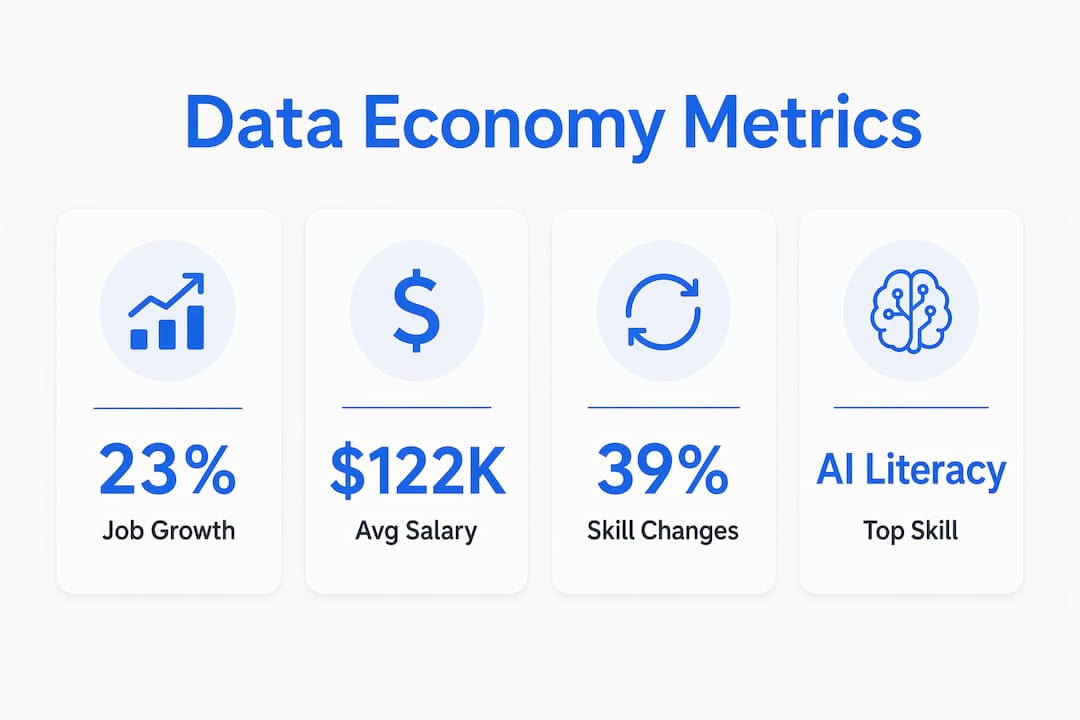
The World Economic Forum also reports that 39% of key job skills will change by 2030. That rate of change means your career data has a shelf life. Skills that signal value today may not carry the same weight in three years.
Pro Tip: Treat your career data the way a CFO treats a balance sheet. Audit it regularly, update it with current market signals, and remove anything that no longer reflects your professional value.
Which career opportunities are emerging within the data economy?
Data economy careers are growing faster than most other sectors. The US Bureau of Labor Statistics forecasts 23% growth in data analyst positions by 2032, a rate significantly faster than the average across all occupations. That growth spans finance, healthcare, retail, manufacturing, and technology. It is not confined to Silicon Valley or tech startups.

The roles themselves are also diversifying. Data scientists, data analysts, AI specialists, and machine learning engineers represent the most visible tier. Below that sits a growing layer of data-adjacent roles: data governance managers, ethics officers, career intelligence analysts, and data economics consultants. These roles did not exist at scale a decade ago. They are now appearing in job postings across industries that have nothing to do with software.
| Role | Projected Growth | Average Salary (2025) |
|---|---|---|
| Data Scientist | High | $122,738 |
| Data Analyst | 23% by 2032 | Varies by sector |
| AI/ML Specialist | Among fastest growing | Above market average |
| Data Governance Manager | Emerging rapidly | Competitive |
| Data Economics Consultant | Board-level demand | Premium |
The salary picture is compelling. Data science careers average $122,738 in 2025, reflecting the premium employers place on professionals who can translate data into decisions. Technology, finance, and healthcare offer the most lucrative paths, but demand is spreading into public sector and nonprofit work as well.
One shift worth noting: data career paths are increasingly non-linear. Technical coding skills matter less as the sole credential. Data governance, ethics, and communication are gaining equal weight. A professional who can explain data findings to a board room is as valuable as one who can build the model behind them.
How can professionals use career data to improve job searching?
Career intelligence is the ongoing practice of using real-world labor market data and hiring trends to make informed career decisions. The concept, defined by practitioners in the field, draws from actual organizational hiring data, not generic advice or assumptions. This distinction matters. Most career guidance is built on patterns from years ago. Career intelligence is built on what is happening in hiring right now.
Professionals who quantify their skills economically position themselves better for strategic roles. That means going beyond listing job titles and responsibilities. It means attaching outcomes, metrics, and market context to every claim on your resume and profile.
Here are the best practices for managing your career data actively:
- Audit your digital footprint: Review every platform where your professional data exists. Outdated profiles send weak signals.
- Align skills with current job postings: Use real job descriptions to identify the exact language employers are using, then mirror it in your materials.
- Track your application data: Note which roles get responses and which do not. Patterns in that data tell you where your profile resonates.
- Build a skills inventory: List your skills with evidence, not just labels. "Python" is weak. "Python for financial modeling across three enterprise projects" is a signal.
- Use job search as market research: Every application teaches you something about where the market values your experience.
Common pitfalls to avoid:
- Relying on a single resume version for every application
- Ignoring engagement data from your own job search activity
- Treating your LinkedIn profile as static rather than a living document
- Skipping data governance: not knowing who has access to your career data or how it is used
Pro Tip: Use job market trend analysis tools to identify which skills are gaining demand in your target sector before you update your resume. Reactive updates lag the market. Proactive ones lead it.
What challenges and ethical concerns come with the career data economy?
The career data economy creates real advantages for professionals who understand it. It also creates risks that most professionals have not considered. Your career data is already being collected, analyzed, and monetized by platforms you use every day. The question is whether you benefit from that process or simply fuel it.
Here are the core challenges professionals face:
-
Data privacy gaps: Most job boards collect behavioral data from your searches and applications. Few disclose exactly how that data is used or sold. Professionals who understand why job seekers are unpaid data sources can make more informed choices about where they search.
-
Unequal access to career data tools: Professionals with access to premium platforms, coaching, and analytics tools gain a measurable edge. Those without access face a structural disadvantage that compounds over time.
-
Data literacy gaps: Understanding how to read labor market signals, interpret hiring trends, and use that information strategically requires skills that most professionals were never taught. This gap widens as the data economy grows.
-
Commodification without consent: Actively managing your application history and engagement data shifts you from a passive data source to an informed participant. Without that awareness, your career data works for platforms and employers, not for you.
-
Ethical use of AI in hiring: As employers use AI to screen candidates, the data you provide shapes algorithmic decisions. Errors or gaps in your career data can disqualify you before a human ever reviews your application.
The responsible path forward is straightforward. Know what data you are sharing, with whom, and what value you receive in return. Treat your career data the way you would treat any professional asset: protect it, manage it, and make it work for you.
Key takeaways
A career data economy rewards professionals who treat their career information as a managed asset, not a passive record.
| Point | Details |
|---|---|
| Career data has economic value | Your applications, skills, and job engagement are signals employers use to make hiring decisions. |
| Data roles are growing fast | The US Bureau of Labor Statistics forecasts 23% growth in data analyst roles by 2032. |
| Career intelligence beats generic advice | Using real-time labor market data produces better outcomes than following outdated career guidance. |
| Data privacy is a real risk | Most platforms collect and monetize your career data without clear disclosure. Know what you are sharing. |
| Active management shifts your position | Professionals who quantify and manage their career data move from passive candidates to informed market participants. |
Why I think most professionals are sitting on career data they are not using
I have watched professionals spend months applying to roles with no feedback, no pattern recognition, and no idea why some applications land and others disappear. The frustrating part is that the data to fix that problem already exists. It is sitting in their application history, their profile engagement, and the gap between the skills they list and the skills employers actually search for.
The shift I keep coming back to is this: career intelligence over generic advice is not just a better strategy. It is the only strategy that holds up in a market where 39% of key skills are projected to change by 2030. Generic advice is built on yesterday's hiring patterns. Career intelligence is built on what is actually happening in the market right now.
What I find most underused is the job search itself as a data collection tool. Every application you send, every role you save, every job description you read is a data point. Professionals who treat that activity as research rather than just effort start to see patterns. They notice which roles respond, which skill sets are in demand, and where their profile creates friction. That awareness is the foundation of a real career strategy.
The professionals who will win in a career data economy are not necessarily the most credentialed. They are the ones who understand the signals, manage their data deliberately, and use the right tools to stay ahead of the market.
— Eric
How Earnhire helps you build real career data worth
Earnhire is built for exactly this moment. Every search you run, every resume you tailor, and every job you analyze on the platform builds your job seeker data worth, creating insights that employers use to make informed hiring decisions.
Earnhire's AI resume tailoring and guided job search tools give you the infrastructure to manage your career data the way this economy demands. You are not just applying to jobs. You are building a professional record that signals your value to the right employers at the right time. Earnhire also compensates you for the work of searching, so your effort is never wasted. If you are serious about turning your career data into a competitive advantage, Earnhire is where that work happens.
FAQ
What is a career data economy in simple terms?
A career data economy is a labor market system where your professional information, including your skills, applications, and job search behavior, is treated as an economic asset with measurable value.
What skills are most valuable in the data economy?
Data analysis, data governance, AI literacy, and the ability to translate data into business decisions are among the most in-demand skills, with data science roles averaging $122,738 in 2025.
How does career intelligence differ from career advice?
Career intelligence uses real-time labor market data and actual hiring trends to guide decisions. Generic career advice relies on outdated patterns and assumptions rather than live market signals.
Why should professionals care about their career data rights?
Most job platforms collect and use your behavioral data without clear disclosure. Understanding your data rights as a job seeker helps you make informed choices about where you search and what you share.
How fast are data economy careers growing?
The US Bureau of Labor Statistics forecasts 23% growth in data analyst positions by 2032, and the World Economic Forum projects a net increase of 78 million data-driven jobs globally by 2030.