
Data rights for job seekers are the legal and practical tools that define how you can access, control, and protect your personal information during the hiring process. Every resume you submit, every profile you create, and every video interview you complete generates data that platforms collect, store, and often sell. Understanding why job seekers need data rights is not a legal exercise. It is a career survival skill. Platforms like LinkedIn, Indeed, and ZipRecruiter operate inside a data economy where your professional identity is the product. Knowing your rights is the first step to protecting it.
Why job seekers need data rights now more than ever
The hiring process has gone almost entirely digital, and that shift has created a massive data exposure problem. When you apply for a job online, you hand over your name, address, work history, education, salary expectations, and sometimes your face and voice. That data does not disappear after the application closes.
Incogni's June 2026 audit of 17 criteria across major platforms found that 90% of job search and networking platforms sell user data to third-party businesses. That means the platform you trusted with your resume is likely monetizing your information without your knowledge.
The data types involved go far beyond a name and email address. Job platforms collect:
- Resume content: work history, education, certifications, and skills
- Behavioral data: which jobs you click, how long you spend on listings, and what you save
- Biometric data: facial expressions, voice patterns, and eye movement from AI video interviews
- Digital profiles: aggregated data from multiple platforms merged into broker databases
Digital sovereignty over this data is now considered essential for career success in AI-driven professional markets. Your data fuels recruitment intelligence. If you do not control it, someone else profits from it.
How job platforms collect and share your data

Most job seekers assume their data stays with the employer they applied to. It does not. The data collection pipeline is much longer than a single application.
LinkedIn, Indeed, and ZipRecruiter each use tracking pixels, cookies, and behavioral analytics to build detailed profiles of every user. That data is then packaged and sold to advertisers, data brokers, and third-party analytics firms. The Incogni audit confirmed this practice is the norm, not the exception, across the industry.
The risk compounds when you use multiple platforms. Over 34% of job seekers maintain accounts on more than two job platforms, and 1 in 4 cannot recall how many accounts they have or what data they shared. More accounts means more exposure points, more brokers with your information, and more chances for a breach.
Then there is the "zombie profile" problem. Nearly 40% of job seekers never delete profiles they created on job platforms. Those dormant accounts keep feeding data broker ecosystems long after you stopped using them. A profile you created in 2019 on a now-obscure job board may still be actively selling your information today.
Pro Tip: Search your full name plus "resume" or "profile" in Google to find forgotten accounts you may have left active. Delete any you no longer use.
The data broker ecosystem is the downstream problem. Brokers buy data from platforms, combine it with public records, and resell enriched profiles to employers, insurers, and marketers. You never consented to that secondary sale. That is exactly why the importance of data rights cannot be overstated for anyone actively job searching.
What are your legal data rights as a job applicant?
Job applicant data protection is not just a concept. It is enforceable law in many jurisdictions, and recent updates have made those rights stronger.
Under GDPR and the UK Data (Use and Access) Act 2025, job seekers hold six core data subject rights that cover the entire hiring data lifecycle:
- Right to be informed: Employers and platforms must tell you what data they collect and why before they collect it.
- Right of access: You can request a full copy of every piece of personal data a company holds on you, known as a Subject Access Request (SAR).
- Right to erasure: You can demand deletion of your data when it is no longer needed for the original purpose.
- Right to data portability: You can request your data in a machine-readable format to transfer it elsewhere.
- Right to object: You can object to processing based on legitimate interests, including profiling used in automated hiring decisions.
- Right to complain: Since June 2026, new regulations allow you to complain directly to data controllers, not just to regulators, creating faster accountability.
These rights apply from the moment a company collects your CV through the entire post-rejection retention period. Many employers hold rejected applicant data for up to two years. You have the right to request deletion before that window closes.
Pro Tip: Send a Subject Access Request to any employer or platform that holds your data. Under GDPR, they must respond within 30 days. Use a simple email template: "I am exercising my right of access under Article 15 of the UK GDPR. Please provide all personal data you hold about me."
The new 2026 complaint mechanism is a significant shift. Previously, you had to escalate to a national regulator like the ICO. Now you can hold companies directly accountable. That is real leverage.
Common misconceptions that leave job seekers exposed
The biggest barrier to asserting your data rights is not complexity. It is resignation. Despite 81% of Americans being concerned about how their data is used, 73% believe they have little to no control over it. Experts call this "data nihilism," and it is especially damaging for job seekers.
Data nihilism is the belief that your data is already out there, so there is no point trying to protect it. That mindset is wrong, and it is costly. You do have rights. You can exercise them. The platforms just prefer you do not know that.
A second misconception is confusing data ownership with data control. Many platforms claim in their terms of service that you "own" your data. That claim is often misleading because API restrictions and export limits prevent you from meaningfully moving or deleting that data. Ownership without control is not ownership. It is a marketing phrase.
Free tools create another blind spot. Many free resume builders use server-side processing that logs every keystroke and sells that data to brokers. The product is free because you are the product. Client-side tools that process data locally on your device are far safer.
AI video interviews are the most overlooked risk. AI-driven video platforms often require candidates to grant perpetual, sublicensable rights to their biometric data, including facial expressions and voice patterns, without clear disclosure. Your face and voice can then be used to train AI models with no compensation and no way to revoke consent. Look for terms like "irrevocable," "sublicensable," and "for any purpose" before you click accept.
How to protect your data and maintain your career identity
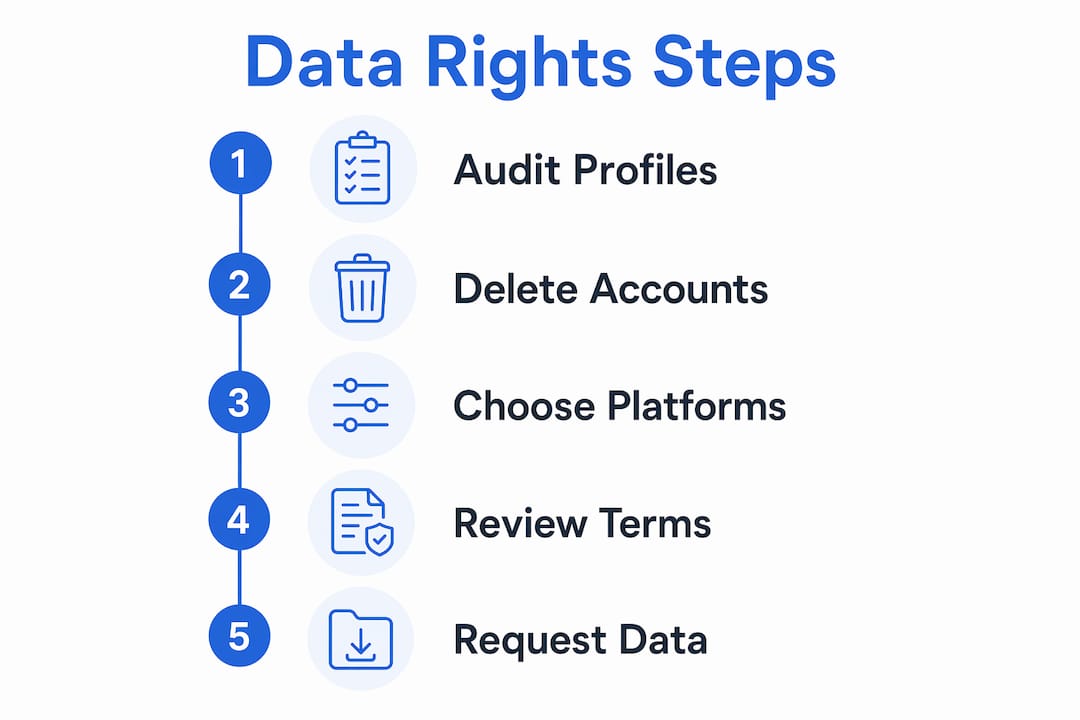
Taking control of your data does not require a law degree. It requires a system. Here is a practical framework you can start using today.
Step 1: Audit your digital footprint. List every job platform you have ever used. Check your email inbox for registration confirmations going back five or more years. You will likely find platforms you forgot about entirely.
Step 2: Delete unused profiles. For every platform you no longer actively use, submit a deletion request. Most platforms have a data deletion option buried in account settings. If you cannot find it, send a direct erasure request under your GDPR rights.
Step 3: Choose privacy-respecting platforms. Use the job search platform comparison checklist to evaluate which platforms disclose their data practices clearly and give you real control over your information.
Step 4: Read AI interview terms before you join. If a company asks you to complete a video interview using a third-party AI tool, read the terms of service first. Specifically search for the words "biometric," "irrevocable," and "sublicense." If those terms appear without clear limits, ask the employer if an alternative format is available.
Step 5: File Subject Access Requests strategically. After any rejection, send a SAR to the employer. You will learn exactly what data they hold, how long they plan to keep it, and whether it was shared with any third parties. That information gives you the ability to request deletion before your data circulates further.
| Platform Type | Data Risk Level | Best Practice |
|---|---|---|
| Major job boards (LinkedIn, Indeed) | High: sells to third parties | Minimize profile detail; request data deletion after use |
| Free resume builders | High: server-side logging | Switch to client-side tools or paid privacy-focused options |
| AI video interview platforms | Very high: biometric data capture | Review TOS for "irrevocable" clauses before participating |
| Privacy-focused job platforms | Low to moderate | Verify data policies; still audit periodically |
Pro Tip: Maintaining a lean, accurate digital footprint is not just about privacy. Employers and recruiters increasingly use data aggregation tools to build candidate profiles before the first interview. Controlling what is out there shapes the first impression you never knew you were making.
Data sovereignty over your professional identity is a long-term career asset. The job seekers who understand this now will have a real advantage as AI-driven hiring becomes the standard.
Key takeaways
Job seekers who understand and assert their data rights protect their professional identity, reduce exposure to data brokers, and gain real leverage over how employers and platforms use their information.
| Point | Details |
|---|---|
| Platforms sell your data | 90% of major job platforms sell user data to third parties, making data rights a practical necessity. |
| Zombie profiles are a real risk | Nearly 40% of job seekers never delete old profiles, leaving data exposed indefinitely. |
| Legal rights are enforceable | GDPR and the UK Data Act give you rights to access, delete, and complain about your data. |
| Free tools often cost you data | Many free resume builders harvest keystrokes and sell data to brokers via server-side processing. |
| Biometric data needs special care | AI video interviews can capture irrevocable rights to your face and voice without clear disclosure. |
Data rights are a career strategy, not a legal chore
I have spent years watching job seekers pour energy into perfecting their resumes while completely ignoring what happens to that resume after they hit submit. That gap frustrates me, because the data risk is not abstract. It is happening at scale, right now, to people who are already stressed and vulnerable.
Here is what I have come to believe: your data is your professional identity in digital form. When you let platforms harvest it without limits, you are not just losing privacy. You are losing agency over how the market perceives you. Recruiters and employers increasingly see an aggregated data profile before they ever read your actual application. If that profile is built from stale, inaccurate, or out-of-context data, you are being judged on a version of yourself you never approved.
The job seekers who will thrive in the next decade are the ones who treat their data the same way they treat their resume: something to be curated, protected, and presented intentionally. Data rights are not a legal hassle. They are the mechanism that makes that control possible. Start using them.
— Eric
Take control of your job search with Earnhire
Your data has real professional value. Earnhire is built on that premise.
Unlike traditional job boards that profit from selling your information, Earnhire is designed to turn your job search activity into measurable career value that works for you, not against you. Every job you analyze, every resume you tailor, and every application you track builds your data worth in a way that informs employers and preserves your professional identity. Earnhire's AI-powered resume tools keep your data in your hands while helping you stay competitive. You can also explore the guided job search to navigate your search with privacy and purpose built in from the start.
FAQ
What are data rights for job seekers?
Data rights for job seekers are legal entitlements that allow you to access, correct, delete, and control how employers and platforms use your personal information during the hiring process. Under GDPR and the UK Data Act, these rights are enforceable and cover the full data lifecycle from application to rejection.
Can employers share my resume data with third parties?
Yes, and many do. 90% of major job platforms sell user data to third-party businesses. You have the right to request information about any sharing and to object to processing that goes beyond the original hiring purpose.
How do i delete my data from a job platform?
Submit a formal erasure request citing your right to deletion under GDPR Article 17. Most platforms have a data deletion option in account settings, but a written request via email creates a paper trail and legally obligates them to respond within 30 days.
Are AI video interviews safe for my biometric data?
Not always. AI video interview platforms often require candidates to grant perpetual, sublicensable rights to biometric data including facial expressions and voice. Always read the terms of service before participating and look for the words "irrevocable" or "for any purpose."
What is a subject access request and how do i use it?
A Subject Access Request (SAR) is a formal request for all personal data a company holds about you. Send it by email after any job application or rejection. The company must respond within 30 days under GDPR, and the response tells you exactly what data they hold, how long they keep it, and who they share it with.