
Job seeker data value is defined by data type and context, not by the simple fact that you handed over your email to sign up for a job board. The types of job seeker data value range from commodity-level contact records worth fractions of a dollar to structured career datasets that power AI recruiting tools and command prices orders of magnitude higher. Most job seekers have no idea this gap exists. Understanding it changes how you search, which platforms you trust, and how you protect your professional identity during a career transition.
1. What types of job seeker data are most commonly collected?
Job seeker data falls into five broad categories, and each carries a different market value. Knowing the difference tells you exactly what you are handing over when you create a profile.
- Personal contact data: Email addresses, phone numbers, and home addresses are the most basic data type. Email records average $0.20 per record on the data broker market. That low price reflects how abundant and easy to collect this data is.
- Social media and professional profiles: LinkedIn profiles, GitHub accounts, and portfolio links carry richer context. Employers and recruiters pay a premium for this data because it signals skills, career trajectory, and professional network.
- Financial and medical records: These rarely surface in a standard job search, but financial and medical records are priced between $50 and $400 per record. The high price reflects scarcity and sensitivity.
- Behavioral and clickstream data: Every job you click, save, or skip on a platform generates behavioral signals. Platforms capture this data automatically. It reveals your preferences, urgency, and career intent in ways a resume never could.
- Structured first-party career datasets: This is the premium tier. When platforms compile your resume history, application patterns, and skill tags into a structured dataset, that data fuels AI recruiting tools. It is worth far more than any single data point you submitted.
The gap between a $0.20 email address and a structured career profile is not just a pricing curiosity. It reflects how much context and organization amplify raw data into something genuinely useful for hiring decisions.
2. How do job search platforms monetize your data under CCPA and CPRA?

Most job seekers assume their data goes to employers. That assumption is wrong. 8 out of 9 popular job search platforms sell user data under the CCPA definition, while 37% of users mistakenly believe data is only shared with potential employers.
The California Consumer Privacy Act and its amendment, the CPRA, define "sale" broadly. CCPA and CPRA define "sale" to include disclosing personal information to third parties for any valuable consideration. That means data shared with advertisers, affiliates, and analytics partners legally qualifies as a sale, even if no cash changes hands directly.
Here is what that means in practice for you:
- Your profile data can flow to ad networks and marketing platforms without your explicit knowledge.
- Behavioral data from your job searches can be used to build audience segments sold to third parties.
- Opt-out rights exist under CCPA and CPRA, but you must actively exercise them. Platforms do not opt you out by default.
- Privacy policies are written to permit broad data sharing. Reading them carefully before signing up is the only way to know what you are agreeing to.
Pro Tip: Search for the "Do Not Sell or Share My Personal Information" link in a platform's footer before creating an account. Submitting that request before you upload your resume limits how your data can be used from day one.
The mismatch between what job seekers expect and what platforms actually do is not accidental. It is a business model. Understanding it is the first step toward protecting yourself.
3. What is the economic difference between raw data and structured career datasets?
Raw personal data and structured career datasets are not in the same economic category. The pricing gap is significant, and it has direct implications for how you think about your own data worth.
Data valuation uses three standard approaches: cost (what it costs to collect), market (what comparable data sells for), and income (what revenue the data generates). For structured first-party career datasets used in AI recruiting, the income approach dominates. Structured first-party datasets can command 10 to 50 times higher value than raw personal data because of exclusivity, scale, and measurable impact on model performance.
| Data type | Approximate market value | Primary use |
|---|---|---|
| Email address | $0.20 per record | Marketing lists, outreach |
| Social media profile | $1–$10 per record | Audience targeting, recruiting |
| Financial record | $50–$150 per record | Credit, fraud analytics |
| Medical record | $200–$400 per record | Insurance, health analytics |
| Structured career dataset | 10x–50x raw data price | AI recruiting, hiring analytics |
Companies that actively license their proprietary user data earn roughly 11% of revenue from those data assets. Companies that ignore data assets earn almost nothing from them. That contrast shows exactly why job platforms invest so heavily in collecting and organizing your career information.
Pro Tip: Your resume, application history, and job preferences are not just profile fields. They are training data for AI recruiting tools. Treat them as assets worth protecting, not just forms to fill out.
The right question is not "How much is my data worth?" It is "How does context and packaging affect my data's recruiting value?" A structured, well-organized career profile on a transparent platform is worth far more to you and to employers than scattered data spread across a dozen job boards.
4. How can you manage your data exposure during a job search?
Data exposure grows with every new account you create. More than 34% of job seekers created accounts on more than two platforms, which multiplies the number of breach vectors tied to their personal information. Each platform is an independent risk.
Here is a practical approach to managing that exposure:
- Audit your existing accounts. List every job platform where you have an active profile. Include boards you signed up for once and forgot. Each one holds your data.
- Delete profiles you no longer use. Deleting one profile is not enough for full exposure control, but it reduces your attack surface. Treat every platform account as an independent security risk.
- Review privacy settings on active accounts. Most platforms offer some level of data control. Look for settings that limit profile visibility to recruiters only, rather than the open web.
- Exercise your opt-out rights. Under CCPA and CPRA, you can request that platforms stop selling or sharing your data. Submit those requests on every platform you use, not just the ones you plan to delete.
- Consolidate your presence. Fewer, better-managed profiles give you more control over your data and a cleaner signal to recruiters. Spreading your profile across ten platforms does not multiply your chances. It multiplies your risk.
- Use a dedicated email address for job searching. A separate email limits the connection between your job search activity and your primary personal or professional accounts.
Balancing visibility with control is the core challenge. You need recruiters to find you. You do not need data brokers to profile you. Those two goals require different strategies on the same platform.
5. How do platform types compare on data value and career outcomes?
Not all job platforms handle your data the same way. The 2026 Job Seeker Nation Report shows that trust issues with hiring processes make candidates more selective about which platforms they use. That selectivity is well-founded.
| Platform type | Data monetization | User control | Career outcome signal |
|---|---|---|---|
| General job boards | High monetization, broad data sharing | Low, opt-out required | Wide reach, low signal quality |
| Niche professional boards | Moderate monetization | Moderate | Strong signal for specific roles |
| AI-powered career platforms | Varies widely | Varies widely | High if data is used transparently |
| Transparent data-rights platforms | Low external monetization | High | Strong, data used for your benefit |
The job search platform comparison across these categories shows a clear pattern. Platforms with lower external monetization and higher user control tend to produce better alignment between job seeker profiles and employer needs. That alignment is what actually drives interviews and offers.
Choosing a platform based on its data practices is not paranoia. It is career strategy. A platform that uses your data to inform employers about your skills and fit is fundamentally different from one that sells your profile to ad networks.
Key takeaways
The most valuable job seeker data is structured, first-party career information, and understanding that distinction protects both your privacy and your professional marketability.
| Point | Details |
|---|---|
| Data value varies by type | Email records average $0.20 while structured career datasets command 10–50x that price. |
| Most platforms sell your data | 8 out of 9 popular job platforms sell user data under CCPA definitions, far beyond employer sharing. |
| Multiple accounts multiply risk | Each platform account is a separate breach vector; consolidate and audit regularly. |
| Opt-out rights exist but require action | CCPA and CPRA give you the right to stop data sales, but you must submit requests yourself. |
| Structured data drives AI recruiting | Organized career profiles fuel AI hiring tools and carry far more value than raw contact info. |
What I have learned about job seeker data that most articles skip
I have spent years watching job seekers treat their profiles as throwaway forms. They sign up for every board they can find, upload the same resume everywhere, and assume the platforms are working for them. Most of the time, the platforms are working with their data, not for their careers.
The uncomfortable truth is that job seekers are largely unpaid data sources for platforms monetizing their profiles behind the scenes. That is not a conspiracy. It is a business model, and it is written into the terms of service most people skip.
What I have found actually works is treating your job search data the way a professional treats any asset. You would not hand your financial records to a stranger without knowing how they would be used. Your career profile deserves the same scrutiny. Read the privacy policy. Submit the opt-out request. Delete the accounts you are not actively using.
The data rights conversation is only going to get louder as AI recruiting tools become more sophisticated. Job seekers who understand how their data is valued and used will be better positioned to control their narrative during a search. Those who do not will keep feeding systems that profit from their effort without compensating them for it.
My practical advice: pick two or three platforms you trust, manage them actively, and stop treating every new job board as a free opportunity. It is not free. You are paying with your data.
— Eric
Earnhire gives your search data a purpose
Your job search generates real professional value with every application, save, and resume you tailor. Earnhire is built on the idea that this work should benefit you, not just the platform.
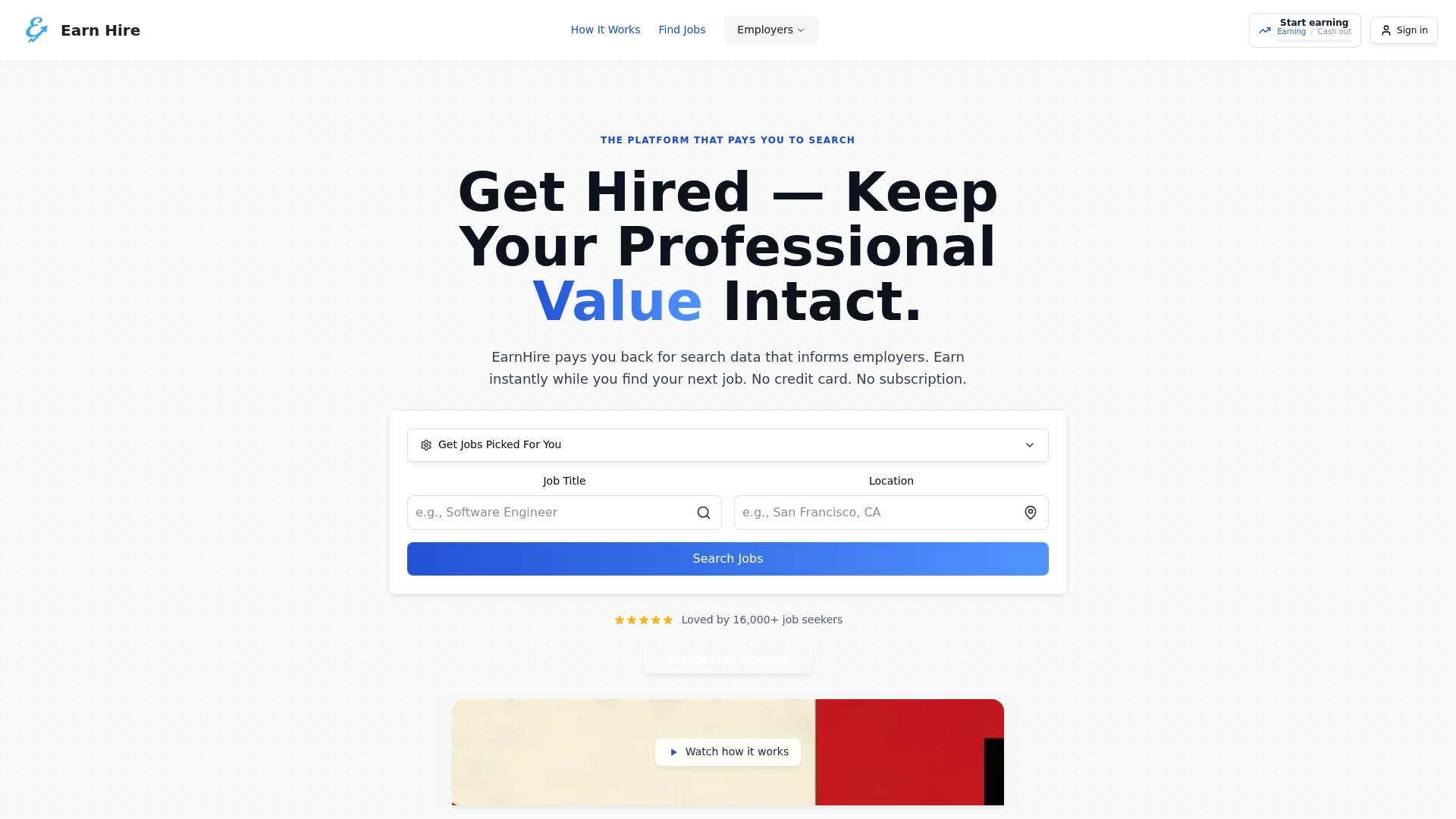
Earnhire's guided job search tools put your data to work for your career, not for ad networks. With AI-powered resume tailoring and job analysis, your profile becomes a signal employers can act on. Earnhire also compensates job seekers for the work of searching, which no traditional board does. If you want a platform where your data builds your career rather than someone else's revenue, Earnhire is the place to start.
FAQ
What is job seeker data worth on average?
Raw contact data like email addresses averages $0.20 per record, while structured career datasets used for AI recruiting can be worth 10 to 50 times more than raw personal data.
Do job search platforms sell my personal data?
Yes. Audits show that 8 out of 9 popular job search platforms sell user data under the CCPA definition, including sharing with advertisers and affiliates beyond potential employers.
How do I stop job platforms from selling my data?
Submit a "Do Not Sell or Share My Personal Information" request on every platform you use. CCPA and CPRA give you this right, but platforms do not apply it automatically.
Why does structured career data have higher value than raw personal data?
Structured datasets are organized, exclusive, and directly improve AI recruiting models. That combination of scale and measurable impact drives prices 10 to 50 times higher than commodity personal data.
How many job platforms should I use at once?
Limit yourself to two or three actively managed platforms. Each additional account is a separate data exposure risk, and spreading your profile thin reduces the signal quality recruiters see.