
Data-driven job searching is the strategic use of analytics, AI-powered tools, and systematic tracking to optimize every stage of your job search. Think of it as replacing guesswork with evidence. Instead of blasting out 50 generic resumes and hoping for the best, you measure what works, fix what doesn't, and make smarter decisions at every step. Job seekers using AI-powered tools achieve a 76% success rate in landing offers, compared to just 33% for those using traditional methods. That gap is too large to ignore.
What is data-driven job searching, really?
Data-driven job searching, also called a systematic job search, is the practice of treating your search like a performance system. You collect data on applications, responses, and interviews. You analyze where you're losing traction. Then you adjust. The industry term for this approach is "job search analytics," and it covers everything from resume keyword matching to tracking your application-to-interview conversion rate.
The core idea is simple: every action you take in a job search produces a signal. A recruiter opens your resume. A hiring manager ignores your LinkedIn message. You get a callback from a referral but silence from a cold application. Data-driven job seekers capture those signals and use them to sharpen their next move.

Platforms like LinkedIn, Grammarly, and Earnhire all contribute to this ecosystem. LinkedIn surfaces job fit scores and connection pathways. Grammarly flags weak language in cover letters. Earnhire goes further by turning your search activity itself into measurable professional value, with AI tools for resume tailoring and job analysis built in.
What are the core components of a data-driven job search?
A strong data-driven search runs on six interconnected components. Each one feeds the next.
-
Direction. Define your target clearly. What roles, industries, and companies are you pursuing? Without a defined target, your data has no baseline to measure against.
-
Proof. Build a resume that speaks in numbers. Employers now use skills-based hiring for 70% of entry-level roles, up from 65%. That means vague adjectives like "results-oriented" get ignored. Quantified achievements get noticed.
-
Access. Track your networking outreach. How many messages did you send this week? How many got a response? Response time and networking success rates are vital funnel indicators that reveal industry preferences and the quality of your outreach.
-
Apply. Use AI tools to tailor each application. Cross-reference the job description with your resume. Match keywords. Align your proof points to the role's requirements.
-
Convert. Track your interview-to-offer rate. If you're getting interviews but no offers, the problem is in your preparation or follow-up, not your resume.
-
Learn. Run a weekly 15–30 minute audit of your search metrics. Identify which funnel stage is leaking. Adjust your strategy before the next week starts.
Pro Tip: Set up a simple spreadsheet or use a job tracking tool to log every application with the date, company, role, source (referral, job board, LinkedIn), and current status. After 20 applications, patterns will start to emerge.
How does data-driven searching compare to traditional methods?
Traditional job searching relies on volume and instinct. You find a posting, send your standard resume, and wait. Data-driven searching treats every application as a test with measurable outcomes.
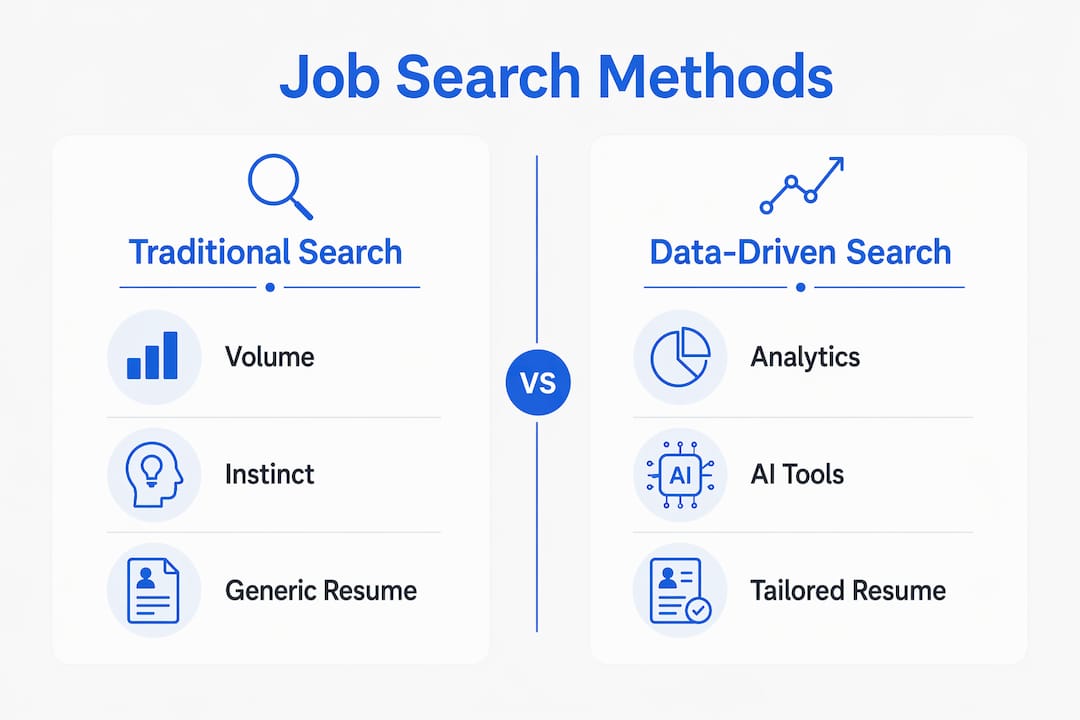
The numbers tell the story clearly. Referrals convert to interviews at roughly 40%, while cold applications convert at around 3%. That's a 13x difference. If you're spending 80% of your time on cold applications, you're working against your own data.
Speed matters too. AI tools can scan a job description, identify keyword gaps in your resume, and suggest edits in minutes. That same task takes most people an hour manually, and they still miss things.
The risk with automation is real, though. Fully autonomous auto-apply tools can cause blacklisting or produce low-quality submissions that damage your reputation with recruiters. The right approach keeps a human in the loop for every submission.
| Metric | Traditional Search | Data-Driven Search |
|---|---|---|
| Resume tailoring | Generic, one-size-fits-all | AI-matched to each job description |
| Networking | Informal, untracked | Measured outreach with response rate tracking |
| Application volume | High volume, low targeting | Focused, quality-first applications |
| Cold application conversion | ~3% to interview | ~40% via referrals with targeted outreach |
| Strategy adjustment | Rarely, based on gut feel | Weekly audits based on funnel metrics |
Pro Tip: Shift at least 30% of your weekly search time toward networking and referral outreach. The data on referral conversion rates makes this the highest-return activity in your entire search.
What tools enable data-driven job searching?
The right tools turn your search from a manual grind into a measurable system. Here's what the current toolkit looks like:
-
AI resume tailoring tools. Job Hunt Optimizer on GitHub and similar tools cross-reference your resume against job descriptions to surface keyword gaps and alignment scores. Effective AI resume tailoring focuses on proof-based, KPI-aligned metrics rather than generic claims.
-
Application tracking systems. Tools that integrate with your email to pull in application status updates automatically. These give you a live dashboard of where every application stands without manual logging.
-
LinkedIn analytics. Profile view trends, search appearance data, and connection response rates all signal how visible and compelling your professional brand is to recruiters.
-
Earnhire's AI tools. Earnhire offers AI-powered resume tailoring and job analysis tools that help you align your experience to specific roles. The platform also tracks your search activity as data worth, which employers can use to make more informed hiring decisions.
-
Funnel dashboards. Whether you build one in Notion, Google Sheets, or a dedicated job search app, a dashboard that shows your weekly application count, response rate, and interview conversion rate keeps your strategy grounded in reality.
Automation tools should assist with research, scoring, and tailoring, but human review before submission is non-negotiable. Recruiters can spot a mass-generated cover letter immediately.
How do you optimize each step of your job search using data?
Optimizing your search means applying data at every stage, not just when you write your resume. Here's how to do it step by step.
-
Set a measurable direction. Define your target role, target companies, and target salary range. Track how many roles per week match your criteria. If you can't find enough postings, your target may be too narrow or your location filters too tight.
-
Build proof that converts. Tailored resumes yield one interview per 17 applications, compared to one per 33 for untailored ones. That's nearly double the return. Use a resume tailoring checklist to align your bullet points to the specific language in each job description.
-
Create access through measured outreach. Set a weekly target for LinkedIn connection requests and informational interview asks. Track your response rate. If it's below 20%, test a different message format or a warmer introduction approach.
-
Apply with precision. Before submitting any application, run it through an AI tool to check keyword alignment. Confirm your top three achievements match the role's stated priorities. A focused application takes more time but produces far better results.
-
Convert interviews with data prep. Research the company's recent news, financials, and hiring trends before every interview. Prepare answers that reference specific metrics from your past work. Interviewers remember candidates who speak in numbers.
-
Learn from every outcome. Tracking conversion rates like application-to-screening and interview-to-offer reveals exactly where your funnel is breaking down. If you're getting screened but not interviewed, your resume is working but your phone presence needs work. Fix the right thing.
The optimized job search workflows guide from Earnhire walks through how to build this kind of system in practice, with specific steps for professionals at different career stages.
Key takeaways
A data-driven job search outperforms traditional methods at every measurable stage, from resume conversion to interview success, because it replaces guesswork with evidence.
| Point | Details |
|---|---|
| AI tools double success rates | Job seekers using AI tools land offers at 76% vs. 33% for traditional seekers. |
| Referrals beat cold applications | Referral outreach converts to interviews at 40%, versus 3% for cold applications. |
| Tailored resumes cut waste | Tailored resumes yield one interview per 17 apps; untailored ones require 33. |
| Weekly audits fix the right problem | A 15–30 minute weekly review of funnel metrics identifies exactly where your search is stalling. |
| Automation needs human oversight | Auto-apply tools risk blacklisting; always review and approve each submission manually. |
What i've learned after watching hundreds of job searches
I've seen smart, qualified people spend months searching with no results, not because they lacked skills, but because they had no system. They were measuring nothing. They couldn't tell you their application-to-response rate or how many of their interviews came from referrals versus cold applications. They were flying blind.
The shift to a data-informed approach isn't about becoming a spreadsheet obsessive. It's about knowing where your effort is going and whether it's working. When I started tracking my own outreach years ago, I realized I was spending 70% of my time on cold applications that converted at under 5%. Shifting that time toward warm introductions and referrals changed everything within weeks.
The other trap I see constantly is over-reliance on automation. People use AI to fire off 200 applications a week and then wonder why no one responds. Recruiters are not fooled. A generic AI cover letter reads like one. The AI divide already favors those with education and connections. If you're not using AI thoughtfully, with human judgment guiding every submission, you're not gaining an edge. You're just adding noise.
Treat your job search like an iterative execution system. Run it for a week. Audit the numbers. Adjust one variable. Run it again. That discipline, more than any single tool or tactic, is what separates people who land roles quickly from those who search for months.
— Eric
Start your data-driven search with Earnhire
If you're ready to stop guessing and start measuring, Earnhire is built for exactly this.
Earnhire is the only informed job search platform that turns your search activity into measurable professional value. Every application you tailor, every job you analyze, and every resume you refine builds your data worth, the kind of career signal that employers actually use to make hiring decisions. With AI tools for resume tailoring, job analysis, and guided search workflows, Earnhire gives you the system that most job seekers are missing. You put in the work. Earnhire makes sure that work counts.
Try the guided job search and see what a data-backed search looks like in practice.
FAQ
What is data-driven job searching in simple terms?
Data-driven job searching means using analytics, AI tools, and tracking systems to measure and improve every step of your job search. Instead of applying randomly, you track what works and adjust your strategy based on real results.
How much does AI actually improve job search outcomes?
Job seekers using AI-powered tools achieve a 76% job offer success rate, compared to 33% for those using traditional methods. That difference comes from better resume targeting, faster application cycles, and smarter outreach.
What metrics should i track in my job search?
Track your application-to-screening rate, screening-to-interview rate, and interview-to-offer rate. Also monitor your networking response rate and the source of each opportunity, referral, job board, or LinkedIn, to see which channel delivers the best return.
Is automation safe to use in a job search?
Automation is useful for research, keyword analysis, and resume tailoring, but fully automated submissions risk recruiter blacklisting and poor-quality applications. Always review and approve each application before it goes out.
How often should i review my job search data?
A weekly audit of 15–30 minutes is the recommended practice. Reviewing your funnel metrics weekly lets you catch problems early and adjust your strategy before wasting more time on an approach that isn't working.