
Job searching is defined as a high-stakes professional investment, and the ways to make job searching pay off are more data-driven than most people realize. Referrals alone convert to interviews at nearly 40%, compared to roughly 3% for cold applications. A six-month search for a $100,000 professional can cost up to $100,000 in lost income, benefits, and debt. That means your search strategy is not just a career decision. It is a financial one. This guide gives you the tactics that actually move the needle, from referrals and tailored resumes to side hustles and smart spending.
How to harness referrals and networking to multiply job search success
Referrals are the single most effective job search tactic available. Referrals represent only about 1% of total applications but produce a disproportionately high share of total hires. That gap between effort and result is the most important signal in modern job searching.
The concept of "weak ties" explains why your distant contacts matter more than your close friends. Weak ties, meaning acquaintances, former colleagues, and LinkedIn connections you rarely speak to, have access to job markets and hiring managers you do not. Activating those relationships is the fastest way to get your resume in front of a decision maker.
Here is how to do it practically. List every person you have worked with in the last five years. Reach out to 10 of them this week with a specific, short message. Ask for a 15-minute call to catch up and get their perspective on the market. Do not lead with "I need a job." Lead with curiosity and genuine interest in their experience.

Pro Tip: Ask for advice, not referrals. Saying "I'd love your perspective on how your company evaluates candidates like me" opens doors that "Can you refer me?" closes.
After applying to a role, message the hiring manager directly on LinkedIn within 48 hours. Keep it to three sentences: who you are, what you applied for, and one specific reason you are excited about the team's work. This follow-up alone separates you from the majority of applicants who apply and wait.
| Approach | Interview conversion rate |
|---|---|
| Cold application | ~3% |
| Referral from employee | ~40% |
The math is clear. Spending two hours building one referral connection beats spending two hours submitting ten cold applications.
Why tailored resumes and applications dramatically increase interview chances
A generic resume is the fastest way to get ignored. AI tools and tailored applications can increase your interview chances by over 200%, and the process takes about 15 minutes per application when done right.
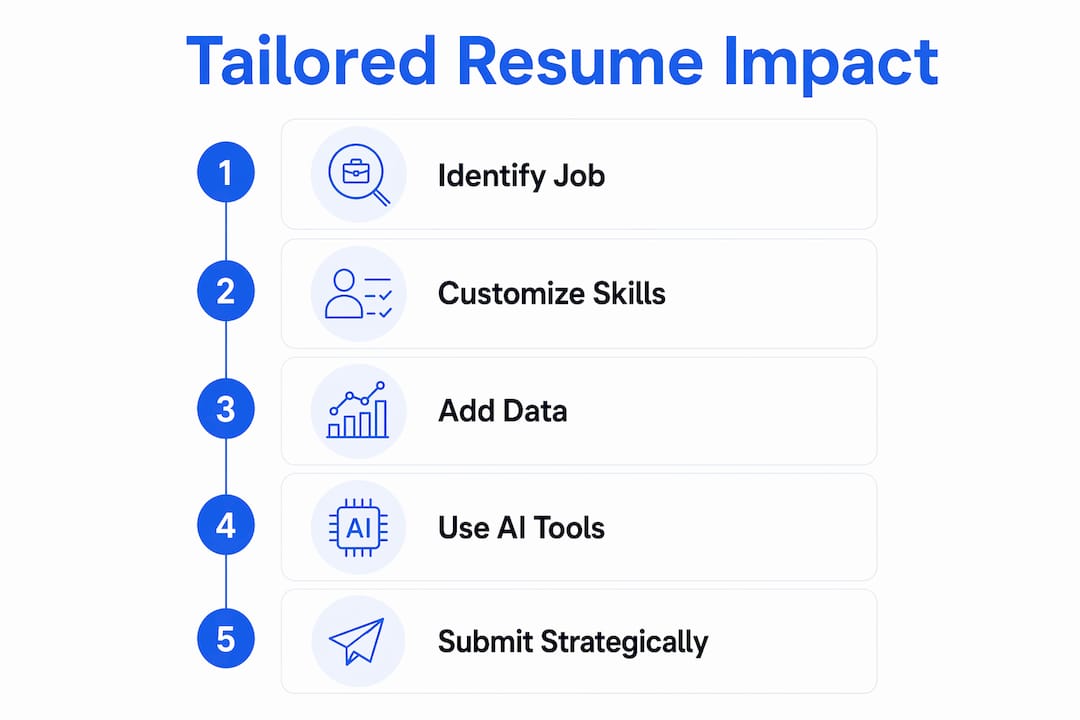
Tailoring means more than swapping out a job title. You adjust your summary to mirror the language in the job description. You reorder your skills section to front-load what the role values most. You rewrite your accomplishments to reflect the outcomes the employer cares about, not just the tasks you completed.
Here is a practical checklist for every application:
- Copy the job description into a document and highlight the top five skills or outcomes mentioned.
- Rewrite your resume summary to include at least three of those terms naturally.
- Replace vague descriptors like "team player" or "results-oriented" with metrics-driven value statements that show actual impact.
- Quantify every accomplishment you can. "Reduced onboarding time by 30%" beats "Improved onboarding process" every time.
- Cut any bullet point that does not connect directly to the role's core needs.
Data-backed resumes raise callbacks by about 8%. That may sound small, but across 20 applications, it is the difference between one callback and two or three. Earnhire's AI resume tailoring tools make this process faster by analyzing job descriptions and surfacing the language and metrics that matter most to each specific employer.
The biggest mistake job seekers make is writing a resume that describes their past. Hiring managers are not buying your history. They are buying your future output. Every line of your resume should answer one question: "What will this person do for us?"
Using side hustles strategically during a job search for income and resume-building
Side hustles are not just survival tools. They are evidence generators. Nearly 45% of workers earning over $150,000 have a side hustle, and the reason is not desperation. It is leverage.
A side hustle changes your negotiating position. When you generate $1,500 to $2,000 monthly from freelance work or consulting, you negotiate from sufficiency, not scarcity. You can afford to wait for the right offer instead of accepting the first one that comes along.
There are two types of side hustles worth pursuing during a job search. The first is an income floor hustle: freelance writing, consulting, tutoring, or gig work that keeps cash flowing. The second is a resume-building hustle: projects that produce measurable outcomes directly relevant to your target role. A marketing professional who runs paid ad campaigns for a local business has a live case study to discuss in every interview.
Pro Tip: Document every side hustle outcome with numbers. "Grew a client's Instagram following from 400 to 2,200 in 90 days" is interview gold. "Helped with social media" is forgettable.
Start before you need to. The best time to build a side hustle is while you are still employed. It takes 60 to 90 days to generate consistent results worth talking about. If you are already in a search, start this week with one small project. Upskilling alongside the hustle compounds the value. A data analyst who takes a Python course while freelancing on a data cleaning project is building both skill and proof simultaneously. For more ideas, Earnhire's guide on passive income during search covers eight real examples worth reviewing.
Managing the financial realities of job searching and investing in the process
The financial cost of a long job search is real and often underestimated. Unemployment insurance replaces only 30–40% of pre-layoff income, and over half of job seekers cut essentials or drain savings to survive. That pressure leads to bad decisions.
The "Austerity Trap" is what happens when job seekers cut every discretionary expense and then wonder why their search stalls. Avoiding all discretionary spending during a search leads to longer unemployment and lost opportunity. The logic is counterintuitive but backed by data: the right investments accelerate your search and pay for themselves.
Investing in a "Velocity Fund" for resume services, interview coaching, and professional tools yields a higher return than extreme budget cutting. A $500 investment that shortens your search by two weeks recovers its cost many times over when your salary is $80,000 or more.
Here is a prioritized list of investments that deliver real ROI:
- Professional resume review or rewrite. A strong resume gets you more interviews. More interviews mean faster offers.
- LinkedIn Premium. Direct messaging to hiring managers and InMail access are worth the monthly cost during an active search.
- Interview coaching. One session with a good coach can identify the specific answers that are costing you offers.
- Job analysis tools. Understanding what a role actually requires before you apply saves time and sharpens your targeting.
- Skills courses. A short, credentialed course in a high-demand skill signals growth and fills resume gaps.
Avoid spending on services that promise guaranteed job placement or charge large upfront fees with vague deliverables. Those are the scams. Spend on tools and people who improve specific, measurable outputs: your resume quality, your interview performance, or your network reach. Read more about the real cost of searching before you finalize your budget.
How to measure and track job search work that informs employers
Tracking your job search is not busywork. It is how you build credibility and spot what is actually working. Documenting job search progress can create secondary income streams and build professional credibility that outlasts any single application.
Hiring managers respond to candidates who can speak precisely about their process and results. "I applied to 40 roles, got 12 first-round interviews, and converted 4 to second rounds" signals self-awareness and analytical thinking. That is the kind of candidate who tracks outcomes at work too.
| Activity | What to track | Employer signal |
|---|---|---|
| Applications sent | Number, role type, source | Targeting discipline |
| Networking calls | Contacts reached, follow-ups | Relationship building |
| Interviews completed | Stage reached, feedback received | Communication skills |
| Skills acquired | Courses, certifications, projects | Growth mindset |
| Side hustle results | Revenue, client outcomes, metrics | Real-world execution |
Sharing your job search data authentically online, whether through LinkedIn posts, a newsletter, or a portfolio site, attracts attention from recruiters and builds a professional brand between roles. Earnhire is built specifically around this idea. Every search activity you log on the platform builds your data worth, the kind of signal employers use to make informed hiring decisions.
Key Takeaways
The most effective ways to make job searching pay off combine referral networking, tailored applications, strategic side hustles, and calculated financial investment in your own search process.
| Point | Details |
|---|---|
| Referrals dominate outcomes | Referrals convert to interviews at ~40% vs. ~3% for cold applications. |
| Tailoring multiplies callbacks | Customizing each resume to the job description can increase interview rates by over 200%. |
| Side hustles build leverage | Income and documented project results shift your negotiating power and strengthen your resume. |
| Avoid the Austerity Trap | Cutting all spending prolongs searches; targeted investments in coaching and tools accelerate hiring. |
| Track everything | Documented search activity builds credibility with employers and can generate secondary income. |
What I've learned about treating your job search like a business
Most job seekers I've observed treat their search like a waiting game. They apply, they hope, and they cut expenses while they wait. That mindset costs them months and thousands of dollars.
The shift that changes everything is treating your search as a business proposition. Hiring managers focus exclusively on ROI: revenue generation, cost reduction, or risk mitigation. Your job is not to explain why you need work. Your job is to show them what they get when they hire you.
I've seen job seekers with average credentials land roles over stronger candidates because they showed up with data. They tracked their search, documented their side hustle results, and walked into interviews with specific numbers. That preparation signals the same behavior employers want on their teams.
The other thing I'd push back on is the idea that networking feels transactional. Done right, it is not. Reaching out to former colleagues with genuine curiosity about their work is not manipulation. It is how careers actually move. The people who land the best roles are almost always the ones who stayed connected, not the ones who sent the most applications.
Invest in your search the way you would invest in any business with a clear return. Spend on tools that improve specific outputs. Document your results. Show employers what you can do, not just what you have done.
— Eric
Earnhire makes your job search work count
Every hour you spend searching has value. Earnhire is built to capture that value and put it to work for you.
Earnhire's platform documents your job search activity in a way that builds your data worth and signals real professional intent to employers. The AI resume tools tailor your application to each role in minutes, so you stop sending generic resumes and start getting callbacks. If you want a more guided approach, Earnhire's guided job search program pairs you with coaching and targeting tools that sharpen your networking and application strategy. Your search is already costing you time. Earnhire makes sure it also builds something lasting.
FAQ
How much do referrals improve interview chances?
Referrals convert to interviews at nearly 40%, compared to about 3% for cold applications. They represent only 1% of applications but generate a disproportionately high share of actual hires.
How long does tailoring a resume actually take?
Tailoring a resume to a specific job description takes about 15 minutes when done with a clear process. AI tools can reduce that time further by surfacing the most relevant language from each job posting.
What is the Austerity Trap in job searching?
The Austerity Trap is when job seekers cut all discretionary spending and accidentally prolong their unemployment. Targeted investments in resume services, coaching, and tools accelerate hiring and pay for themselves quickly.
Can a side hustle actually help you get hired?
Yes. Side hustles produce measurable project results that serve as live case studies in interviews. Nearly 45% of workers earning over $150,000 maintain a side hustle, using it for both income and negotiating leverage.
Why should I track my job search activities?
Tracking applications, interviews, and networking calls builds self-awareness and signals analytical discipline to employers. Documented search data can also build professional credibility and, in some cases, generate secondary income through content or consulting.