
An optimized job search workflow is a structured system that combines AI automation, targeted tracking, and daily routines to maximize both application volume and match quality. The best examples of optimized job search workflows in 2026 use tools like Claude Code, N8N, Teal, ChatGPT, and Jobscan to handle the repetitive work while you focus on what actually gets you hired. One creator using this approach evaluated 740+ listings, generated over 100 personalized resumes, and submitted 50 applications in a single week without a single manual submission. That is the gap between searching and a real system.
1. examples of optimized job search workflows that actually work
The most effective optimized job search workflows share three components: automated discovery, AI-powered tailoring, and a structured review step before you hit submit. Without all three, you are either wasting time on manual tasks or sending generic applications that get ignored.
Here is what a proven daily workflow looks like in practice:
- Automated scraping pulls fresh listings from LinkedIn, Indeed, and Lever every morning using tools like N8N.
- AI scoring ranks each role by skill fit, compensation, and location using a numeric match score.
- Resume tailoring generates a customized resume draft for each shortlisted role via ChatGPT or Claude Code.
- Morning Review takes 15 minutes to confirm AI selections and finalize the top 3–5 applications.
- Submission happens through Simplify.jobs or browser autofill extensions, with status logged automatically.
- Feedback loop updates your search filters based on rejected or ignored roles to sharpen tomorrow's results.
The semi-automated approach keeps a human review step before every submission. Top performers spend 5–10 minutes per role finalizing tailored resumes and answering screening questions. That step is what separates a high-response workflow from a spam machine.
Pro Tip: Set your Morning Review as a calendar block at the same time every day. Treating it like a meeting prevents it from sliding into the afternoon when your energy drops.
2. how AI automation transforms the job search process
AI automation handles the parts of job searching that drain your time without requiring your judgment. Scraping, sorting, and formatting are all tasks a well-configured agent does faster and more consistently than any human.

Tools like N8N automate scraping, tailoring via AI agents, PDF generation, and application tracking while you sleep. That means you wake up to a shortlist, not a blank search bar. Claude Code goes further by building a 14-skill agent that evaluates listings against your profile and generates role-specific resumes on demand.
The scoring step is underrated. Converting subjective role fit to a numeric score reduces anxiety and turns your search into a data pipeline. Instead of agonizing over whether a role is "good enough," you see a number. You act or you skip. That clarity speeds everything up.
Automated workflows also protect your energy. When the discovery and formatting work is handled, you spend your time on interviews, networking, and follow-up. Those are the activities that actually close offers.
3. the essential AI job search tools checklist for 2026
A smart job search technology checklist does not need to be long. The goal is one tool per function, not one tool per task.
Here is the core stack:
- Job Search CRM: Teal or Huntr for tracking applications, deadlines, and contacts in one place
- AI Writing Tool: ChatGPT for resume tailoring, cover letter drafts, and email follow-ups; Grammarly for final editing and tone checks
- ATS Optimization: Jobscan for keyword matching and formatting against specific job descriptions
- Application Automation: Simplify.jobs and browser extensions for autofill and status tracking
- Job Analysis: Earnhire's job analysis tool for evaluating opportunity quality and fit before you apply
97.8% of Fortune 500 companies use ATS to screen resumes before a human ever reads them. That statistic means keyword optimization is not optional. Jobscan directly compares your resume to a job description and shows you the gaps.
Pro Tip: Run every tailored resume through Jobscan before submitting. A score above 80% significantly improves your chances of passing the initial ATS filter.
The comparison below shows how each tool category contributes to your workflow:
| Tool Category | Example Tools | Primary Function |
|---|---|---|
| Job Search CRM | Teal, Huntr | Track applications and deadlines |
| AI Writing | ChatGPT, Grammarly | Draft and refine resumes and cover letters |
| ATS Optimization | Jobscan | Match keywords to job descriptions |
| Application Automation | Simplify.jobs | Autofill and submission tracking |
| Job Analysis | Earnhire Analyze | Score and prioritize opportunities |
4. how to build a smart daily job search routine
A smart job search workflow in 2026 runs on time blocks, not willpower. Structure your day so each task has a defined window and a clear output.
A proven weekly structure looks like this:
- Morning (15–20 min): Review AI-curated shortlist, confirm top roles, check application status updates
- Mid-morning (30–45 min): Tailor resumes and cover letters for confirmed roles using ChatGPT and Jobscan
- Afternoon (20–30 min): Submit applications via Simplify.jobs, log status in Teal or Huntr
- End of day (10 min): Update your feedback loop by flagging roles that did not fit and noting why
Rejecting unsuitable jobs updates your AI's memory state to improve the next search iteration. This feedback loop is what makes the system smarter over time. Without it, you keep seeing the same irrelevant listings.
Over-tooling creates cognitive overload without improving outcomes. Stick to 2–3 core tools. Fragmented data across five platforms wastes more time than it saves.
Maintain a single "Source of Truth" resume file with verified facts about your experience, metrics, and skills. This file underpins reliable AI tailoring and prevents the hallucinations that make AI-generated resumes embarrassing or inaccurate.
Pro Tip: Keep your Source of Truth file in Google Docs and share it with ChatGPT at the start of every tailoring session. This gives the AI accurate context and cuts editing time in half.
5. workflow examples for high-volume, quality-focused, and beginner seekers
Not every job seeker needs the same system. The right workflow depends on your goals, your comfort with technology, and how much time you can commit each day.
High-volume workflow
This approach suits seekers who need to move fast, such as those recently laid off or in competitive markets. Automation does the heavy lifting.
- N8N or Claude Code scrapes and scores 50+ listings daily
- ChatGPT generates tailored resume drafts for every shortlisted role
- Human review takes under 10 minutes per application
- Simplify.jobs handles submission and tracking
The tradeoff is depth. Applications are tailored but not deeply personalized. This works best for roles where your profile is a strong match and the volume compensates for lower per-application effort.
Quality-focused workflow
This suits senior professionals or those targeting a small number of specific companies. Fewer applications, more preparation.
- Teal tracks 10–15 target companies with detailed notes
- Each application gets a fully customized resume and cover letter reviewed by a human
- Interview prep uses ChatGPT to generate likely questions based on the job description
- Follow-up emails are drafted and scheduled in advance
Beginner workflow
If you are new to AI tools, start simple. Three tools are enough.
- Teal for tracking and organizing your search
- ChatGPT for drafting and editing application materials
- Manual follow-up via email or LinkedIn
The table below compares these three workflow types:
| Workflow Type | Tech Complexity | Daily Effort | Expected Weekly Applications |
|---|---|---|---|
| High-Volume Automated | High | 30–45 min | 30–50 |
| Quality-Focused | Medium | 60–90 min | 5–10 |
| Beginner Manual-Assisted | Low | 45–60 min | 10–15 |
AI-generated drafts must be carefully edited to reflect your personal voice. Generic applications get rejected regardless of how well the keywords match. Every workflow type requires that human editing step.
Key takeaways
The most effective job search system combines AI automation for discovery and drafting, a structured daily routine, and a human review step before every submission.
| Point | Details |
|---|---|
| Automate discovery, not decisions | Use N8N or Claude Code to find and score roles, but always confirm before applying. |
| Keep your tool stack small | Two to three core tools outperform five fragmented ones every time. |
| Maintain a Source of Truth file | A verified resume file prevents AI hallucinations and speeds up tailoring. |
| Use feedback loops daily | Flag rejected roles to train your AI filters and improve tomorrow's shortlist. |
| Edit every AI draft | Personal voice is what gets you interviews. Generic output gets you ignored. |
What i've learned about balancing AI and human judgment
I have watched a lot of job seekers get excited about automation and then burn out two weeks later. The pattern is always the same. They set up a complex system, send 40 applications in a week, and then realize none of them feel like they actually wrote them.
The honest truth is that AI handles volume. You handle quality. Those are two different jobs, and confusing them is where most people go wrong.
The "spray and pray" instinct gets worse with automation because the barrier to applying drops to almost zero. That is a trap. Human review before submission is not a bottleneck. It is the part that actually works. Spend 5–10 minutes per application making it sound like you. That is the difference between a 2% response rate and a 15% response rate.
I also think people underestimate how much the Source of Truth file matters. If you feed ChatGPT vague bullet points, you get vague resumes. If you feed it specific metrics, project names, and outcomes, you get something worth sending. The quality of your input determines the quality of your output. That is not a technology problem. It is a preparation problem.
My advice: pick one workflow type that fits your situation, run it for two weeks, and measure your response rate. Then adjust. The best system is the one you actually stick with, not the most sophisticated one you can build.
— Eric
Put your job search to work with Earnhire
If you are ready to move from scattered applications to a real system, Earnhire is built for exactly this. Earnhire's guided job search gives you a structured workflow that tracks your applications, surfaces the right opportunities, and builds your professional data worth with every action you take.
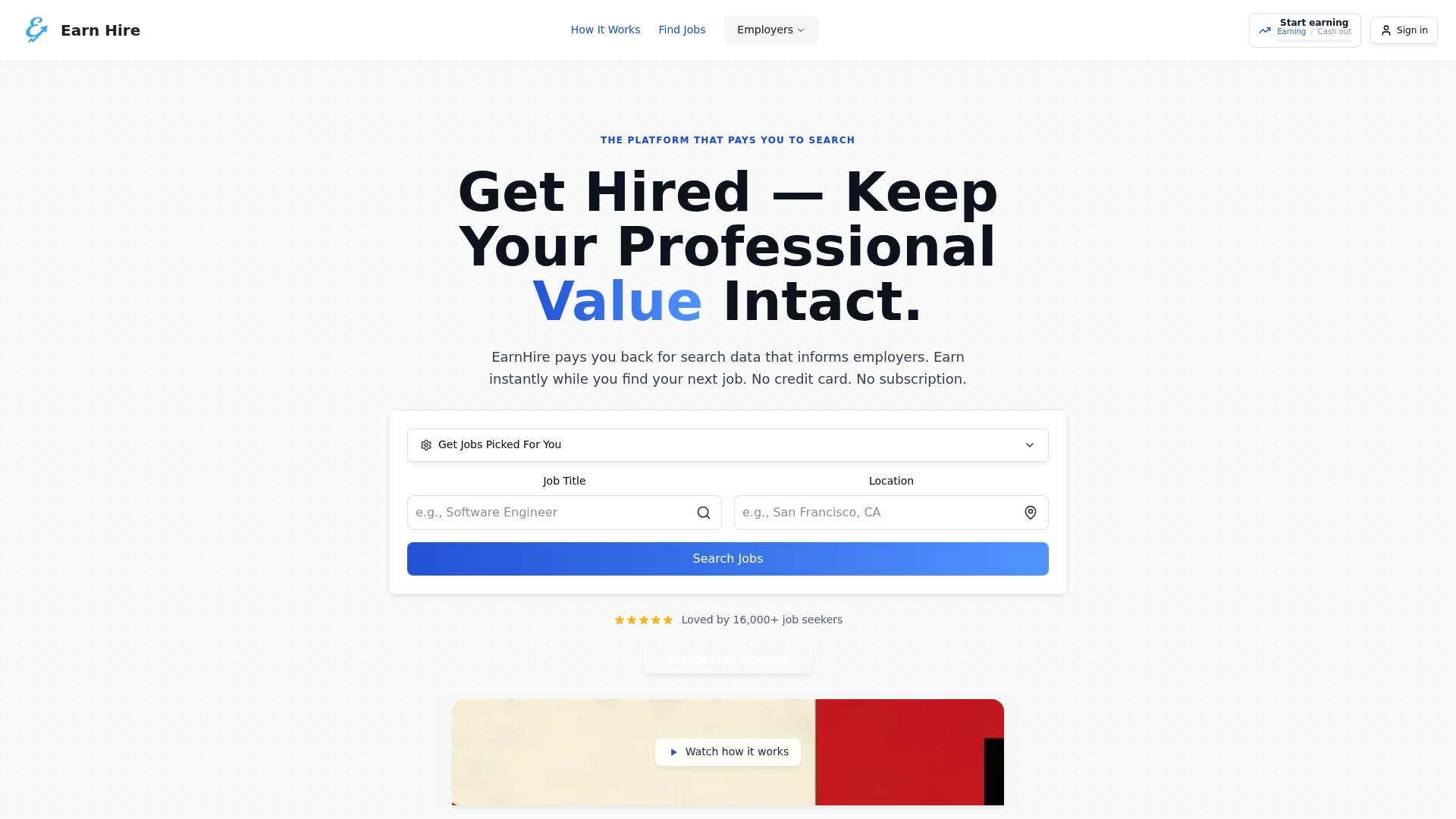
Unlike traditional job boards, Earnhire compensates you for the work of searching. Every tailored resume and saved role contributes to your career identity and gives employers the context they need to make informed decisions. Use Earnhire's resume tailoring tools to generate ATS-ready applications faster, and let the platform do the tracking while you focus on the conversations that lead to offers.
FAQ
What is an optimized job search workflow?
An optimized job search workflow is a structured system combining AI tools, automation, and daily routines to increase application volume and match quality. It replaces manual searching with automated discovery, scoring, and tailoring.
How many tools do i need for an efficient job search?
Two to three core tools are enough. Experts confirm that over-tooling causes fragmented data and wasted effort. A job search CRM, an AI writing tool, and an ATS optimizer cover the full workflow.
Do ai-generated resumes actually work?
AI-generated resumes work when you edit them. Raw AI drafts need personal editing to reflect your voice and specific experience. Generic output without human review gets rejected at the same rate as unoptimized resumes.
How long does a daily automated job search routine take?
A well-structured routine takes 60–90 minutes per day. The Morning Review of AI-curated listings takes under 15 minutes, with the remaining time split between tailoring, submitting, and updating your feedback loop.
What is a source of truth resume file?
A Source of Truth file is a master document containing verified facts about your experience, metrics, and skills. It serves as the input for all AI tailoring sessions and prevents inaccurate or hallucinated content from appearing in your applications.