
Job search burnout is defined as a state of chronic emotional and physical exhaustion caused by the sustained stress of searching for work in a structurally broken hiring system. Nearly 70% of active job seekers experience severe burnout, driven by algorithmic rejection, widespread ghosting, and a feedback void that makes every application feel like shouting into silence. This isn't about effort. The system itself is the problem. Understanding why job searching drains professionals is the first step toward doing something about it.
Why job searching drains professionals: the systemic causes
The modern job search is structurally stacked against you. It's not a personal failure when your applications disappear. It's the design.
Applicant tracking systems, known as ATS, filter out 70–80% of applications before a human ever sees them. These systems rank candidates by keyword matching, not actual qualifications. A 20-year career can get screened out because a resume used "managed" instead of "led."

AI-powered screening has made this worse. Employers now receive hundreds of applications within hours of posting. The volume forces automation at every stage, which means more candidates get rejected faster, with less context. The result is a cycle where effort and outcome have almost no relationship.
Here's what the data shows about the stressful job application process:
- Only 8% of applications lead to interviews, regardless of candidate quality.
- 67% of applications receive no response at all.
- 53% of candidates were ghosted mid-process, after interviews had already started.
- 94.3% of job seekers report never hearing back at some point during their search.
Those numbers explain the exhaustion. When you apply to 50 roles and hear back from four, your brain starts treating effort as pointless. That's not pessimism. That's a rational response to a broken feedback loop.
The distinction worth making here: these outcomes reflect systemic flaws, not individual deficiencies. Professionals with strong track records, polished resumes, and real skills are getting filtered out daily. Recognizing this shifts the frame from "what's wrong with me?" to "how do I work around a flawed system?"
How does job searching increase financial and emotional stress?
The financial cost of a long job search is rarely discussed openly. It should be.
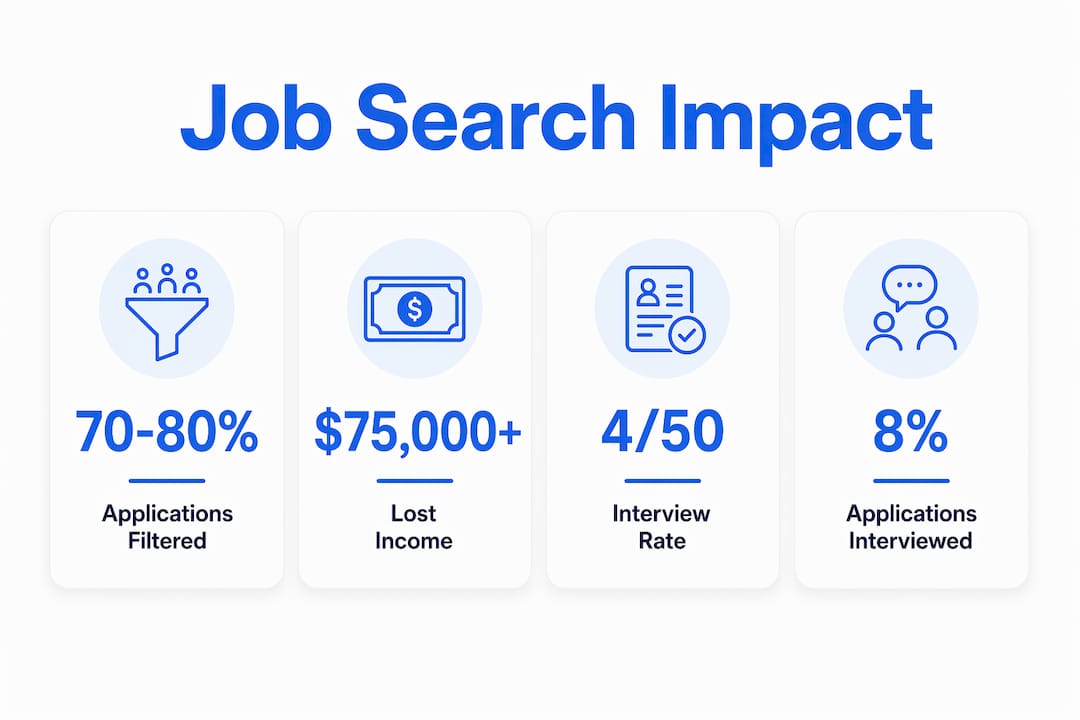
Professionals in searches lasting six months or more lose over $75,000 in combined income and benefits. That figure includes lost salary, lapsed health coverage, and retirement contributions that simply stop accumulating. Over half of job seekers, 55.6%, deplete their savings during a prolonged search. Another 37.8% take on credit card debt just to sustain themselves.
The financial pressure feeds directly into the emotional toll. When your bank account is shrinking while your inbox stays empty, anxiety compounds. Sleep suffers. Confidence erodes. The World Health Organization officially recognizes occupational burnout as a chronic depletion state, and 83% of laid-off professionals attribute their burnout directly to the job search process itself.
"Burnout isn't just feeling tired. It involves elevated cortisol levels, disrupted sleep, and measurable immune suppression. These are physiological consequences, not just emotional ones." — Medical Daily, 2026
The mental toll of job searching shows up in the body. Chronic stress from repeated rejection and prolonged uncertainty triggers the same cortisol response as other high-stakes stressors. Over time, this wears down your ability to perform well in interviews, write compelling cover letters, or think clearly about your next move.
| Stressor | Impact on Professionals |
|---|---|
| Lost income over 6 months | Over $75,000 in combined salary and benefits |
| Savings depletion | 55.6% of job seekers exhaust savings |
| Credit card debt | 37.8% take on new debt to cover expenses |
| Burnout attribution | 83% of laid-off pros link burnout to job search |
| Workforce burnout overall | 66% of American workers report workplace burnout |
These numbers aren't meant to discourage you. They're meant to validate what you're feeling. The stress is real, the financial pressure is real, and neither is your fault.
Why do rejection and silence create a motivation crisis?
The feedback void is one of the most underrated causes of employment fatigue. When you apply and hear nothing, you have no data to work with. You can't improve your resume because you don't know what failed. You can't sharpen your pitch because no one told you what fell flat.
Automated rejection responses cause what researchers describe as emotional autopilot. Candidates keep applying, but the repetition becomes mechanical. The enthusiasm drains out. The cover letters start to blur together. You're going through the motions without believing any of it will work.
This is where the psychological impact of job search gets particularly damaging. Professional identity is closely tied to work. When you're repeatedly passed over, or worse, ignored entirely, it starts to feel like a verdict on your worth. It isn't. But the brain doesn't always make that distinction cleanly.
The job search also functions like an infinite game with no clear endpoint. There's no finish line, no score, no signal that you're getting closer. This ambiguity triggers a cognitive trap where professionals respond by applying more, faster. That response actually lowers application quality and success rates over time. Sending 200 generic applications is less effective than sending 20 targeted ones, but the anxiety of inaction pushes people toward volume anyway.
Ghosting mid-process is its own category of damage. Being interviewed, asked for references, and then never contacted again is a specific kind of professional rejection that hits harder than a standard no. It signals that your time and effort had no value to the other party. Over multiple cycles, that message accumulates.
Pro Tip: If you're feeling stuck in emotional autopilot, try a CV tailoring checklist to reintroduce intentionality into each application. Specificity breaks the cycle of mechanical sending.
What practical strategies help manage job hunt stress?
The good news: the strategies that reduce burnout also improve your results. These aren't just wellness tips. They're tactical shifts that change how the search works.
-
Cut volume, increase targeting. Applying to hundreds of public postings is a losing numbers game. 70–80% of jobs are filled through referrals before they're ever publicly posted. Shifting time toward networking and direct outreach reaches opportunities that ATS filters never touch.
-
Cap your search hours. Limiting focused job search activity to 20–25 hours per week and building in strategic pauses reduces burnout without sacrificing momentum. More hours past that threshold produce diminishing returns and accelerate emotional depletion.
-
Build proof of work. Portfolios, verified skill badges, and published work samples give you something tangible to point to regardless of employer response. Proof of work also enables passive discovery, where companies find you rather than the other way around. That shift in dynamic is genuinely motivating.
-
Tailor every resume submission. Generic resumes fail ATS filters at a much higher rate. Tools that help you adapt your resume to specific job descriptions, like those built into platforms designed for AI-driven hiring, meaningfully improve your chances of reaching a human reviewer.
-
Set search boundaries and protect recovery time. Burnout stems from physiological stress responses that wellness apps alone can't fix. Protecting evenings, scheduling non-search activities, and treating the search like a job with defined hours all help sustain endurance over a long transition.
Pro Tip: Track your search activity in a simple spreadsheet: company, role, date applied, follow-up date, and outcome. Patterns emerge quickly. You'll see which channels produce responses and which are wasting your time.
Key takeaways
Job search burnout is a systemic problem, not a personal one, and the professionals who recover fastest are those who shift from volume to strategy.
| Point | Details |
|---|---|
| ATS filters dominate outcomes | 70–80% of applications are rejected before human review, making resume tailoring non-negotiable. |
| Financial costs are severe | A six-month search costs professionals over $75,000 in lost income and benefits on average. |
| Feedback void fuels burnout | Automated silence prevents learning and creates emotional autopilot that erodes motivation. |
| Volume backfires | Applying more without strategy lowers quality and success rates over time. |
| Networking bypasses the system | 70–80% of roles fill through referrals, making direct outreach far more effective than job boards. |
What i've learned about surviving a long job search
I've watched a lot of talented professionals go through extended job searches, and the pattern I keep seeing is the same. They start strong, get methodical, and then somewhere around month three, something shifts. The applications keep going out, but the energy behind them is gone. They're not searching anymore. They're just surviving.
The hardest part isn't the rejection. It's the silence. Rejection at least tells you something happened. Silence leaves you with nothing to work with, and nothing to push against. That's what breaks people down over time.
What I've found actually helps isn't more hustle. It's more structure. Treating the search like a project with defined hours, clear metrics, and scheduled breaks changes the psychological experience of it. You stop feeling like you're failing every day you don't get an offer. You start measuring progress by activities you control, not outcomes you don't.
The systemic problems in hiring are real and they're not going away fast. ATS filters, AI screening, and ghosting are features of the current market, not bugs that will be patched. The professionals who navigate this best are the ones who stop trying to beat the system at its own game and start building visibility through networking, proof of work, and targeted outreach.
You can't control whether a recruiter responds. You can control whether you show up prepared, specific, and strategically positioned. That's where the energy belongs.
— Eric
How Earnhire helps you search smarter, not harder
The job search challenges described in this article are exactly what Earnhire was built to address. Most job boards take your effort and give nothing back. Earnhire works differently.
With Earnhire, every application, save, and tailored resume builds your professional data worth, giving employers real insight into your expertise while you stay visible between roles. The platform's AI resume tools help you tailor each submission to specific roles, bypassing ATS filters that would otherwise bury your application. The guided job search program replaces the chaos of mass applying with a structured, strategic process designed to reduce burnout and improve outcomes. Your effort should count. With Earnhire, it does.
FAQ
What is job search burnout?
Job search burnout is a state of chronic emotional and physical exhaustion caused by prolonged exposure to rejection, silence, and uncertainty during a job search. The WHO recognizes occupational burnout as a legitimate health condition, and 83% of laid-off professionals report experiencing it during their search.
Why do most job applications get no response?
ATS filters reject 70–80% of applications before a human reviews them, and only 8% of applications lead to interviews. The volume of AI-generated applications has made automated screening the default, which means most candidates never reach a recruiter regardless of their qualifications.
How much does a long job search actually cost?
A job search lasting six months or more costs professionals an average of over $75,000 in lost income and benefits. More than half of job seekers deplete their savings, and nearly 38% take on credit card debt to cover living expenses during the search.
Does applying to more jobs improve your chances?
No. Applying to more jobs without targeting actually lowers your success rate over time. Research shows that 70–80% of roles fill through referrals, and mass applications to public postings produce diminishing returns while accelerating burnout.
How can i maintain motivation during a long job search?
Limit focused search activity to 20–25 hours per week, build proof of work through portfolios or skill badges, and prioritize networking over job board applications. Structured pauses and defined search hours protect your mental health and sustain performance over a longer transition.