
Passive income in the context of job searching is defined as revenue generated from skill-based assets or digital products that continue earning while you actively apply for roles. The best examples of passive income job searching are not random side projects. They are strategic income streams that protect your finances and build your resume at the same time. 44.8% of earners making $150,000 or more use supplemental income strategically during career transitions. That number signals something important: the people who manage job searches best are not just applying. They are building.
1. What are the top examples of passive income job searching?
The strongest passive income ideas for job seekers share one trait: they convert skills you already have into assets that earn without your constant attention. Platforms like Shopify, Gumroad, Udemy, and Fiverr make this faster and cheaper than ever before.
Here are the most practical options to start during a job search:
- Digital products (ebooks, templates, toolkits): Package your professional knowledge into a downloadable product. A project manager can sell Notion templates. A marketer can sell a content calendar. Gumroad and Etsy handle payments and delivery automatically.
- Freelance consulting with productized services: Instead of billing hourly, create fixed-scope packages. A "30-minute career audit for $75" is a product. It scales. Hourly consulting does not.
- Affiliate marketing through a blog or LinkedIn newsletter: Recommend tools you already use and earn a commission when readers buy. Amazon Associates, ShareASale, and Impact are the main networks to start with.
- Print-on-demand stores: Print-on-demand allows sellers to earn with no inventory. Platforms like Printful and Redbubble print and ship your designs directly to buyers.
- AI-assisted resume optimization services: Use tools like ChatGPT or Claude to help other job seekers rewrite their resumes. Package it as a fixed-price service on Fiverr. Early productization of resume services allows a clean transition from hourly work to scalable digital income.
Pro Tip: Start with the skill you use most in your current or last role. The fastest path to income is packaging what you already know, not learning something new from scratch.
2. How to generate passive income through content creation

Content creation is the most scalable path for job seekers who can write, speak, or teach. The upfront effort is real, but the returns compound over time.
Blogging and niche websites
A niche blog monetized through Google AdSense and affiliate links earns passively once it ranks in search. The key word is "niche." A blog about "project management for remote teams" will outperform a generic career blog every time. Tools like WordPress and Squarespace get you live in a day.
YouTube channels
YouTube ad revenue kicks in after 1,000 subscribers and 4,000 watch hours. That takes time. The smarter short-term play is to use YouTube videos to drive traffic to a paid product or affiliate link. A video titled "How I rewrote my resume using AI" can link directly to your Gumroad template.
Paid newsletters
Substack and Beehiiv let you charge subscribers monthly for premium content. A newsletter about your professional niche, say, supply chain trends or UX research, builds an audience that employers also notice. It signals expertise before you even walk into an interview.
Online courses
Udemy and Teachable host your course and handle payments. Digital products, print-on-demand, and freelance services can generate income within weeks with low upfront investment. A course takes longer to build, but a well-positioned course on Udemy can earn for years.
Pro Tip: Record your first course module before you finish building the whole thing. Shipping something imperfect beats waiting for perfect. You can update it later.
Here is a realistic content creation timeline to set expectations:
- Month 1: Choose your niche, set up your platform, publish your first three pieces of content.
- Months 2–4: Build consistency. Publish weekly. Focus on SEO or audience growth, not monetization yet.
- Months 4–6: Add affiliate links, a paid product, or a newsletter tier. Start earning small amounts.
- Months 6–12: Optimize what works. Double down on your top-performing content.
- Month 12 and beyond: Meaningful recurring revenue becomes realistic with consistent effort.
3. What are the real benefits and honest expectations?
The financial reality of building passive income during a job search is more nuanced than most articles admit. True passive income is leveraged income requiring 18–36 months of consistent work before meaningful revenue arrives. That is not a reason to avoid it. It is a reason to start now.
Here is what you can realistically expect:
- Early income range: Job seekers can earn $200–$1,000 monthly within the first few months by leveraging existing skills. That range covers groceries, a bill, or a subscription. It is not a salary replacement, but it removes panic from the equation.
- Financial buffer: The average job search lasts 3–6 months. Passive income during that window prevents the desperation that leads to accepting the wrong offer.
- Resume value: Side hustles act as resume builders by providing quantifiable results and project experience. "Grew a newsletter to 800 subscribers in 4 months" is a metric any hiring manager respects.
- Scalability through systems: Standardizing workflows in service-based side hustles enables scalability and prevents burnout. Build a repeatable process early, even if you are only serving five clients.
"Passive income is not a shortcut. It is a long game that pays off precisely because most people quit before the incubation period ends." — Lilach Bullock, AI implementation consultant
The dual purpose here is what makes this strategy worth your time. You are not just earning. You are building proof of work that strengthens your candidacy while you search.
4. Comparing passive income options: which fits your situation?
Not every income stream fits every job seeker. Your available time, existing skills, and budget all shape which path makes sense. Use this comparison to find your best starting point.
| Income stream | Startup cost | Time to first income | Scalability | Resume value |
|---|---|---|---|---|
| Digital products (templates, ebooks) | Low ($0–$50) | 1–4 weeks | High | Strong |
| Online courses (Udemy, Teachable) | Low ($0–$100) | 1–3 months | Very high | Very strong |
| Print-on-demand (Printful, Redbubble) | Zero | 2–6 weeks | Medium | Moderate |
| Affiliate blog or newsletter | Low ($10–$50/month) | 3–6 months | High | Strong |
| AI resume services (Fiverr) | Zero | Days to 1 week | Medium | Very strong |
| YouTube channel | Low ($0–$200 for gear) | 6–12 months | Very high | Strong |
Two scenarios stand out. If you need income within the next 30 days, AI-assisted resume services on Fiverr and digital product sales on Gumroad are your fastest paths. If you are playing a longer game and want assets that grow over time, a niche blog or Udemy course will outperform everything else at the 12-month mark.
The overlooked option on this list is the paid newsletter. It builds an audience, signals expertise to employers, and can monetize within weeks if you already have a LinkedIn following. Most job seekers ignore it entirely.
Pro Tip: Balancing time, money, and skill is the core decision. Pick the stream that costs the least in the area where you are most constrained right now.
Key takeaways
The most effective passive income strategy for job seekers combines low-cost digital assets with existing skills to generate income and build resume proof simultaneously.
| Point | Details |
|---|---|
| Start with existing skills | Package what you already know into a digital product or service before building anything new. |
| Expect an incubation period | Most passive income streams take 18–36 months to generate meaningful recurring revenue. |
| Early income is realistic | Leveraging skills can produce $200–$1,000 monthly within the first few months of effort. |
| Side hustles strengthen resumes | Quantifiable results from income projects give you concrete metrics to share in interviews. |
| Systems prevent burnout | Standardizing your workflow early makes any income stream scalable and sustainable. |
Why I think most job seekers start passive income too late
I have watched a lot of professionals treat passive income as something to build after they land a job. That thinking costs them twice. They miss the financial buffer during the search, and they miss the resume material that a side project generates in real time.
The job search gap is not dead time. It is the best window you will ever have to build something. You have flexibility, motivation, and a clear professional identity to draw from. A job search that drains professionals does so partly because it feels passive and one-sided. Building an income stream flips that dynamic.
My honest observation: the people who burn out during a job search are usually the ones doing nothing between applications. The ones who stay sharp are building something, even if it is small. A Gumroad template that earns $40 a week does more for your confidence than you might expect.
One warning I will give you: do not try to build five income streams at once. Pick one. Commit to it for 90 days. Productize it before you scale it. The most passive income projects need 12–36 months of upfront effort, and quitting before that window closes is the single most common reason people fail. Treat your income stream like a career investment, not a lottery ticket.
— Eric
How Earnhire helps you build value while you search
Your job search should never feel like wasted effort. Earnhire is built on exactly that principle.
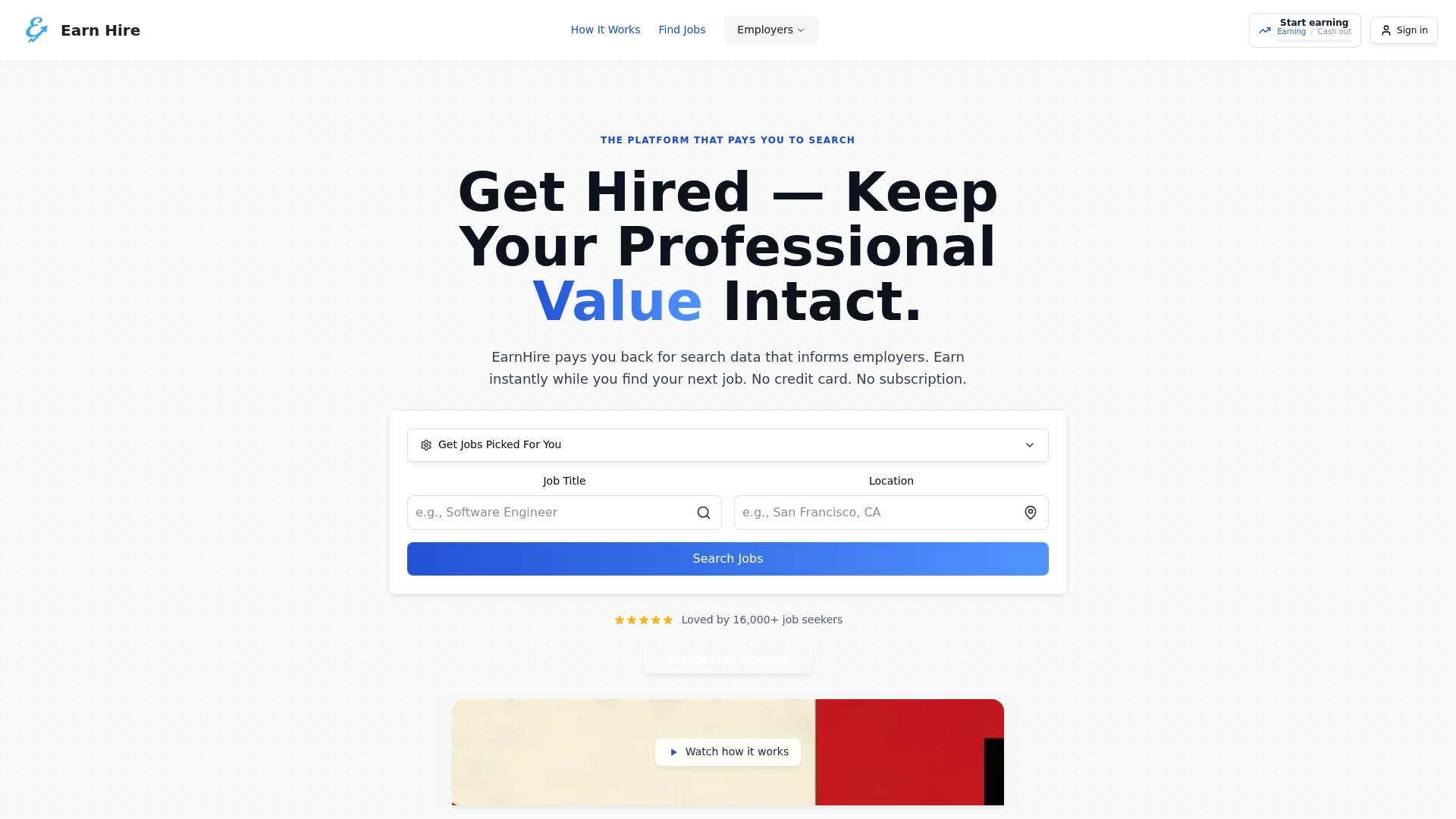
Earnhire is the only platform where every search action, every saved job, and every tailored resume builds your data worth as a job seeker. Employers use that data to make better hiring decisions, and you get compensated for the work of searching. Pair that with Earnhire's AI-powered resume tools to sharpen your professional profile, and you have a job search that works for you on both fronts. If you want a structured path that combines income-building with a focused search strategy, the guided job search program is where to start.
FAQ
What is passive income from job searching?
Passive income from job searching refers to revenue generated through skill-based assets, digital products, or content created during a job search period. These streams earn with minimal ongoing effort while you continue applying for roles.
How quickly can I earn passive income during a job search?
Digital products and AI-assisted services on platforms like Fiverr or Gumroad can generate income within days to a few weeks. Content-based streams like blogs or YouTube channels typically take 3–12 months to produce meaningful returns.
Do side hustles actually help your resume?
Side hustles provide quantifiable results and real project experience that strengthen job applications. Metrics like subscriber counts, revenue figures, or client outcomes give interviewers concrete evidence of your skills.
What is the best passive income idea for job seekers with no startup budget?
AI-assisted resume services on Fiverr require zero upfront investment and can earn within the first week. Affiliate marketing through an existing LinkedIn or social media presence is another zero-cost starting point.
How many passive income streams should I build during a job search?
Start with one stream and commit to it for at least 90 days before adding another. Spreading effort across multiple projects too early is the fastest way to see results from none of them.