
A job search platform comparison checklist is a structured evaluation tool that helps you measure platforms against criteria proven to affect application success, including ATS compatibility, AI resume builders, and industry focus. Most job seekers pick platforms by name recognition alone. That approach wastes time. Platforms like LinkedIn, Google for Jobs, Huntr, and Glassdoor each serve different purposes, and the right mix depends on your industry, career level, and how hiring managers in your field actually screen candidates. This checklist gives you a data-driven framework to choose smarter.
1. what criteria belong on your job search platform comparison checklist?
The most important criteria are the ones that directly affect whether your application reaches a human. Start here before you evaluate any platform.
- ATS compatibility: 71% of U.S. hiring managers use applicant tracking systems to screen applications before a person ever reads them. A platform that submits poorly formatted applications will hurt you regardless of your qualifications.
- AI matching quality: Look for platforms that use transparent match scoring rather than keyword ranking or paid placement. The difference matters more than most job seekers realize.
- Industry and role specificity: General platforms cast wide nets. Niche boards connect you to hiring managers who are actively recruiting in your field.
- Application-to-interview conversion rate: This is the number that actually tells you whether a platform works. Google for Jobs converts at 7.12%, more than twice LinkedIn's 2.94%. That gap is significant.
- Application process friction: One-click "Easy Apply" buttons feel convenient but carry low conversion rates relative to direct career site or referral applications.
- Integration with employer career pages: Platforms that link directly to company career sites tend to produce higher quality applications and better outcomes.
Pro Tip: Before you commit to any platform, search for three to five job titles you are actively targeting. If the results look thin or irrelevant, that platform is not where your industry's hiring managers are posting.
2. how top job search platforms compare on key features

Here is a side-by-side look at the platforms most job seekers consider, evaluated against the checklist criteria above.
| Platform | ATS-Friendly | AI Features | Industry Focus | Conversion Strength |
|---|---|---|---|---|
| Strong | Profile matching, alerts | Broad, all sectors | Moderate (2.94%) | |
| Google for Jobs | Strong | Aggregation, relevance scoring | Broad, all sectors | High (7.12%) |
| Glassdoor | Moderate | Salary insights, company reviews | Broad | Moderate |
| Huntr | Strong | Job tracking, AI resume tools | Broad, career changers | High |
| FlexJobs | Strong | Curated listings, spam filtering | Remote and flexible work | High (niche) |
| Indeed | Strong | Resume builder, alerts | Broad, all sectors | Moderate |
A few things stand out from this comparison. LinkedIn dominates networking and job saves, but its lower application conversion means it works best as a visibility and research tool rather than your primary application channel. Google for Jobs aggregates listings from across the web, which explains its higher conversion rate. You are applying directly to the source rather than through a middleman layer.
Niche platforms like FlexJobs and Huntr offer something the generalist boards cannot: curated, filtered listings that reduce noise. Industry-focused platforms consistently yield higher quality leads than general boards because the hiring managers posting there are specifically looking for candidates with your background.
3. what strategic platform mix maximizes your results?
Spreading your search across too many platforms is one of the most common mistakes job seekers make. Fragmenting attention across more than five platforms lowers efficiency without improving interview rates. The data points to a clear optimal structure.
- Choose 2–3 primary platforms aligned with your industry and career level. For most professionals, this means one generalist board (Google for Jobs or Indeed), one networking platform (LinkedIn), and one niche board specific to your field.
- Add 1–2 niche boards based on your target role. Remote workers should include FlexJobs. Tech professionals should consider specialized boards in their stack. Career changers benefit from Huntr's tracking and AI tools.
- Apply directly through employer career sites. Direct career site applications produce the highest volume of hires of any application source. This step is non-negotiable if you are serious about conversion.
- Set up targeted alerts on your primary platforms. Targeted alerts and optimized profiles on two to three platforms consistently outperform manual browsing across many. Alerts bring relevant jobs to you instead of requiring daily searches.
- Build referral pathways. Referral applications convert at significantly higher rates than cold applications. Use LinkedIn to identify connections at target companies, then apply through the company's career site with a warm introduction.
Pro Tip: Treat your job search like a project. Block 60–90 minutes each morning for applications and platform management. Consistency beats volume every time.
The average job search now takes 108 days from start to offer. That timeline makes a disciplined, focused platform strategy more important than ever. You cannot afford to scatter your energy.
4. how do ai-powered features on job boards actually work?
"AI-powered" is one of the most overused phrases in the job board space right now. Knowing what it actually means helps you separate useful tools from marketing noise.
A true AI-powered job board does three things well. It aggregates and normalizes job data across sources for accurate matching. It provides transparent match scoring so you understand why a role was surfaced for you. And it filters spam and low-quality listings before they reach your feed. Effective AI platforms use data normalization and transparent scoring rather than simply ranking by paid placement.
Most platforms that call themselves AI-powered are doing something much simpler: keyword matching with a machine learning layer on top. That is not the same thing. Here is how to tell the difference:
- Transparent match scores: Can you see why a job was recommended? If not, the platform is guessing.
- Resume tailoring tools: Does the AI help you align your resume to a specific job description, or does it just generate a generic document?
- Skill gap identification: The best tools tell you what is missing from your profile relative to a target role.
- Alert relevance: Are the jobs in your alerts actually relevant, or do they require constant manual filtering?
The risk of over-relying on AI-generated resumes is real. 80% of hiring managers recognize AI-generated resumes, and over-reliance leads to automated rejections. Use AI to tailor and sharpen your resume, not to write it from scratch.
The smartest use of AI in your job search is as a strategy tool. Use it to analyze job descriptions, identify gaps in your experience, and tailor your language to match what hiring managers are screening for. Platforms like Huntr and Earnhire's job analysis tools do this well. The goal is relevance, not automation.
5. how smart job boards differ from traditional platforms
Traditional job boards are essentially digital bulletin boards. They post listings, collect applications, and pass them along. Smart job boards, also called data-driven or AI-powered platforms, do significantly more.
The core difference is what happens to your data and your effort. On a traditional board, your application disappears into a black box. You get no feedback, no signal on fit, and no insight into how employers viewed your profile. On a data-driven platform, your activity generates information that improves your search and, in some cases, creates direct value for you.
Earnhire takes this further than any other platform. Every search, save, and tailored resume you complete on Earnhire builds your data worth, which are insights employers use to make more informed hiring decisions. You can explore how this works through Earnhire's optimized search workflows guide. Unlike traditional boards, Earnhire compensates job seekers for the work of searching. That is a structural difference, not a feature upgrade.
Key takeaways
The most effective job search platform strategy combines a focused platform mix, ATS-compatible applications, and AI tools used for tailoring rather than full automation.
| Point | Details |
|---|---|
| ATS compatibility is non-negotiable | 71% of hiring managers use ATS screening; your application format must pass it first. |
| Conversion rates vary widely | Google for Jobs converts at 7.12% vs. LinkedIn's 2.94%; choose platforms by results, not popularity. |
| Limit your platform count | Use 2–3 primary platforms plus 1–2 niche boards; more platforms dilute your effort. |
| Direct applications outperform boards | Employer career site applications produce the highest hire volume of any source. |
| Use AI strategically, not as a shortcut | AI resume tools work best for tailoring to specific roles, not generating generic documents. |
What i've learned after watching thousands of job searches go wrong
I've spent years watching professionals approach their job search the same way they approach social media: more platforms, more posts, more activity. The assumption is that volume creates results. It doesn't.
The job seekers I've seen get hired fastest share one habit. They pick two or three platforms where their industry's hiring managers are actually active, and they go deep on those. They optimize their profiles, set precise alerts, and apply directly through company career sites whenever possible. They treat LinkedIn as a research and networking tool, not an application channel. And they check their assumptions every few weeks by looking at where their interviews are actually coming from.
The AI conversation is worth addressing directly. I've seen candidates hand their entire resume over to an AI generator and wonder why they're not getting callbacks. Hiring managers recognize the output. The better approach is using AI to analyze a job description and identify the three or four phrases your resume is missing. That takes ten minutes and meaningfully improves your fit score.
The why job searching drains professionals piece resonates with me because the exhaustion is real. But most of it comes from unfocused effort, not from the search itself. A clear checklist, a tight platform mix, and a daily routine cut that exhaustion significantly. Reassess your platform choices every four to six weeks. If a platform isn't generating interviews, replace it with something more targeted. Adaptation is the skill that separates a 60-day search from a 108-day one.
— Eric
Start your search smarter with Earnhire
If you've built your checklist and you're ready to put it to work, Earnhire is built for exactly this moment. Unlike traditional boards that take your effort and give nothing back, Earnhire's Guided Job Search tracks your search activity, builds your professional data worth, and gives employers the hiring insights they need to find you.
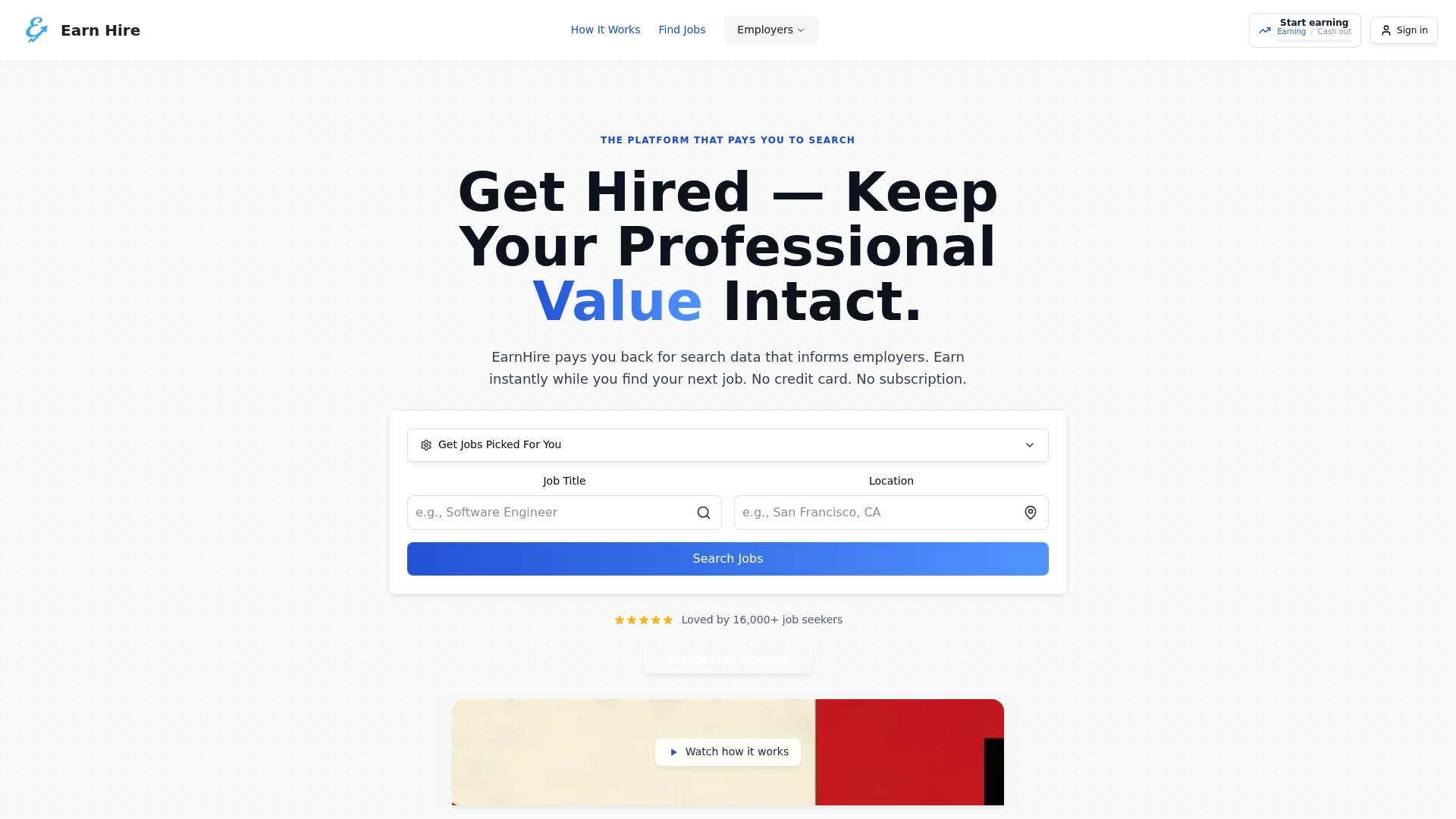
Earnhire's platform includes AI resume tailoring through its resume tools, job description analysis, and a guided workflow designed for professionals who want results, not just listings. You put in the work either way. Earnhire makes sure that work counts for something. Start your guided search today and see what a data-driven platform actually looks like in practice.
FAQ
What is an ai-powered job board?
An AI-powered job board uses machine learning to match candidates to roles based on skills, experience, and job description data rather than simple keyword ranking. The best platforms provide transparent match scoring and filter low-quality listings automatically.
How many job search platforms should i use at once?
Use 2–3 primary platforms plus 1–2 niche boards aligned with your industry. Spreading across more than five platforms lowers efficiency without improving your interview rate.
Which job search platform has the highest conversion rate?
Google for Jobs leads with a 7.12% application-to-interview conversion rate, compared to LinkedIn's 2.94%. Direct employer career site applications produce even higher hire volumes overall.
Should i use AI to write my resume?
Use AI to tailor your resume to specific job descriptions, not to generate it from scratch. 80% of hiring managers recognize AI-generated resumes, and over-reliance on them leads to automated rejections.
How does Earnhire differ from traditional job boards?
Earnhire builds your data worth as you search, turning your activity into hiring insights that employers use to make better decisions. Traditional boards collect your application and offer no feedback or compensation for your effort.