
Job board data is defined as the structured record of candidate behavior and progression across every stage of the hiring funnel, from the first click on a job posting to the final hire decision. Recruiters who treat job boards as simple application funnels miss the deeper signal: the role of job board data in hiring is to reveal which sources produce quality candidates, not just volume. Platforms like Indeed, Appcast, and specialized niche boards each generate distinct data signatures that tell you where your best hires actually come from. Getting that signal right is the difference between a lean, efficient recruiting operation and one that burns budget on applicants who never make it past the first screen.
How job board data shapes real hiring decisions
Candidate disposition data is the backbone of data-driven hiring. Disposition data tracks every stage a candidate moves through: Applied, Reviewed, Screened, Interviewed, Offered, and Hired. That full-funnel view exposes something a raw application count never can: where candidates drop out and why.
Most recruiters focus on cost-per-application (CPA). That metric is easy to pull and easy to report. The problem is that a low CPA can mask a very high cost-per-hire (CPH) when candidates from a given source consistently fail at the interview stage. Disposition data clarifies true costs by connecting recruiter time, interview resources, and offer rates back to the original source channel.
Here is what that looks like in practice:
- A general job board delivers 400 applications at $3 each. Total CPA spend: $1,200.
- Only 2% of those applicants reach the offer stage. That is 8 offers from 400 applications.
- A niche board delivers 80 applications at $12 each. Total CPA spend: $960.
- 15% reach the offer stage. That is 12 offers from 80 applications, at a lower true cost.
The niche board looks expensive at the top of the funnel. It is actually cheaper where it counts.
Pro Tip: Connect your ATS disposition stages directly to your job board source codes. Without that link, you are calculating CPH by guesswork, not by data.

Do general job boards outperform specialized ones?
The answer is no, and the numbers make that clear. Job boards accounted for 61% of applications but only 42% of hires in 2024. That gap between application share and hire share is the clearest signal that volume does not equal quality.
Referrals tell the opposite story. Referral candidates were 10 times more likely to result in a placement than job board applicants. That conversion advantage reflects something job boards structurally cannot replicate: pre-vetted trust between the referrer and the hiring team.
Specialized and industry-specific boards sit between those two extremes, but much closer to referrals in conversion quality. Specialized boards are 14 times more likely to produce hires than general job boards. The reason is audience alignment. A cybersecurity professional browsing a security-focused board is already self-selected for relevance.
| Source type | Application share | Hire conversion quality |
|---|---|---|
| General job boards | High (61% of apps) | Lower (42% of hires) |
| Specialized/niche boards | Moderate | 14x higher than general boards |
| Referrals | Low volume | 10x more likely to place |
| Company careers pages | Moderate | Higher than general boards |
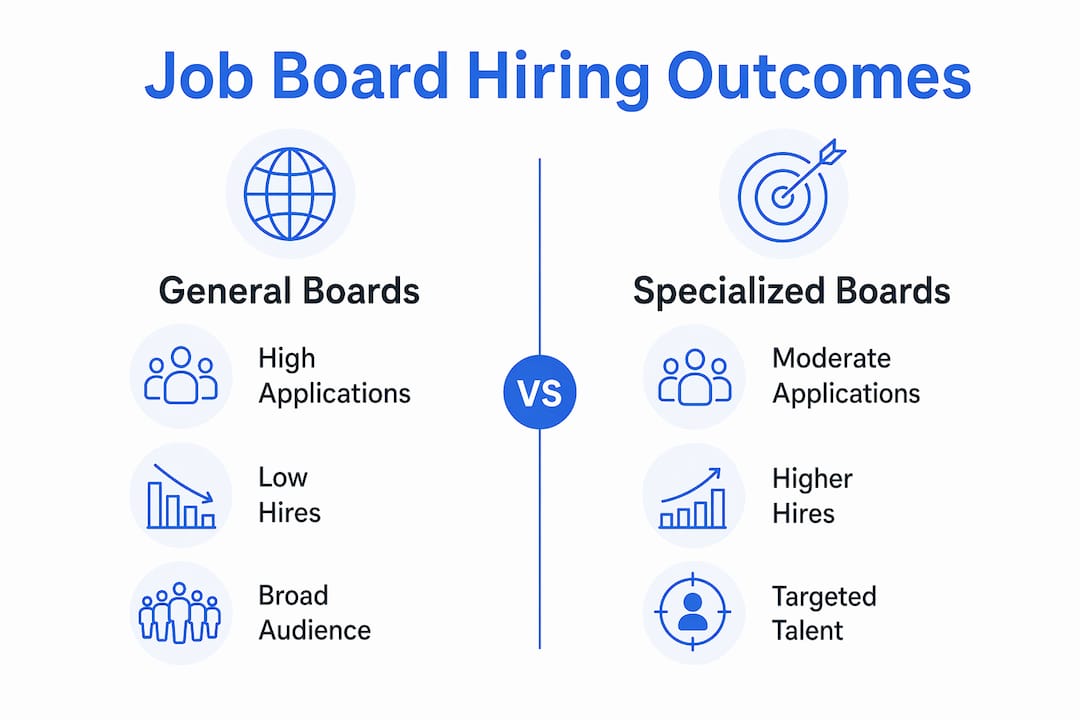
The practical implication for sourcing strategy is direct: reduce spend on general boards for hard-to-fill or specialized roles. Redirect that budget toward niche boards and referral programs where conversion data consistently outperforms.
Does identity verification on job portals improve hiring outcomes?
Yes, and the effect is larger than most recruiters expect. Research published in the American Economic Review: Insights found that combining job advertising with identity verification on portals increases hiring rates by 68% and improves vacancy fill rates by 11%.
The mechanism matters here. Verified identity reduces the friction that causes employers to hesitate. When a recruiter knows a candidate's credentials and identity are confirmed, the screening process shortens and confidence in fit increases. That confidence translates directly into faster offers and better retention.
The research also revealed a counterintuitive finding: providing only advertising or only verification produces weaker results than combining both. Firms with neither component actually outperformed firms that used only one. The synergy between visibility and verified trust is what drives the outcome.
What this means for your job board strategy:
- Prioritize platforms that offer verified candidate profiles alongside standard job advertising.
- Treat unverified, high-volume applications with more skepticism at the screening stage.
- Factor identity verification capability into your job board selection criteria, not just pricing or reach.
- Use verified candidate data as a quality filter before investing recruiter time in phone screens.
Data quality is not a nice-to-have. It is the variable that determines whether your job board investment pays off.
How job boards signal labor market demand
Job posting indexes are one of the most underused tools in workforce planning. Indeed's Job Posting Index (JPI) returned to its pre-pandemic baseline by may 2026, sitting at 100.4 after peaking at 160 in 2022. That normalization tells workforce planners something concrete: the post-pandemic hiring surge is over, and demand has stabilized.
The JPI functions as a proxy for labor demand. When posting volume rises sharply in a sector, it signals that employers are competing for a limited candidate pool. When it falls, it may indicate either reduced demand or a shift toward internal mobility and referrals.
| JPI level | What it signals | Planning implication |
|---|---|---|
| Above 120 | High employer demand, tight labor market | Increase sourcing spend, widen channels |
| 100–120 | Normalized demand, moderate competition | Maintain current sourcing mix |
| Below 100 | Cooling demand or sector contraction | Shift budget to retention and internal mobility |
The caution here is real. Job posting volume alone does not tell you whether those postings are converting to hires. Indeed's JPI should be read alongside vacancy-to-unemployment ratios and turnover data for an accurate picture of hiring capacity.
Pro Tip: Use job board posting trends as an early warning system for talent competition. A spike in postings for your target roles means your competitors are hiring. That is the moment to accelerate your own sourcing, not wait.
Recruiters who treat posting volume as a hiring target, rather than a demand signal, consistently overshoot their capacity and underdeliver on fill rates. The job board analytics that matter most are the ones you connect to real business outcomes, not just market noise.
Key Takeaways
Job board data drives hiring quality only when recruiters track full-funnel disposition metrics, not just application volume, to identify true cost-per-hire by source.
| Point | Details |
|---|---|
| Disposition data beats CPA | Track candidates from Applied to Hired to reveal true channel cost and quality. |
| Specialized boards convert better | Niche boards are 14x more likely to produce hires than general job boards. |
| Verification multiplies results | Combining job advertising with identity verification increases hiring rates by 68%. |
| JPI signals demand, not capacity | Indeed's Job Posting Index shows market trends but requires context from vacancy and unemployment data. |
| Referrals outperform boards | Referral candidates are 10x more likely to be placed than job board applicants. |
What I've learned about job board data that most recruiters ignore
I've watched recruiting teams celebrate a 500-application week on a general board and then struggle to fill a single role. The application count felt like progress. The disposition data told a different story.
The most common mistake I see is treating top-of-funnel metrics as success metrics. Application volume is a signal of reach, not of quality. When you pull the disposition data and see that 480 of those 500 applicants never made it past the resume review stage, the "success" evaporates fast.
The second mistake is siloing job board data from ATS data. If your applicant tracking system and your job board analytics do not talk to each other, you cannot calculate cost-per-hire by source. You are flying blind on your biggest recruiting expense. Integrating those two data streams is the single highest-return change most recruiting teams can make right now.
My honest recommendation: audit your current sourcing channels using disposition stage conversion rates, not CPA. You will almost certainly find that one or two channels are producing the majority of your actual hires at a fraction of the cost you assumed. Redirect budget there. Cut the channels where candidates disappear after the first screen. The data already knows the answer. You just have to look at the right numbers.
— Eric
Earnhire gives recruiters the data that job boards don't
Recruiters need more than application counts. They need to know which candidates are genuinely engaged, what their career trajectory looks like, and whether their skills match the role before the first call.
Earnhire is built on that premise. Every candidate interaction on the platform, from job saves to resume tailoring to job analysis, generates structured data that informs hiring decisions. Recruiters using Earnhire get sourcing insights that connect candidate behavior to hiring outcomes, not just click counts. The platform's AI-powered tools analyze job fit, surface career transition signals, and give hiring teams a clearer picture of candidate quality before the screen. If you want to move beyond vanity metrics and build a sourcing strategy grounded in real conversion data, explore Earnhire's guided search tools and see what informed hiring actually looks like.
FAQ
What is candidate disposition data?
Candidate disposition data tracks a candidate's progress through each hiring stage, from Applied to Hired. It gives recruiters a full-funnel view that reveals where candidates drop out and which sources produce actual hires.
Why do general job boards produce fewer hires than applications suggest?
General job boards attract broad, unfiltered audiences. In 2024, job boards generated 61% of applications but only 42% of hires, because applicant-to-hire conversion rates are significantly lower than on referral or niche channels.
How does identity verification improve job board hiring outcomes?
Combining job advertising with identity verification on portals increases hiring rates by 68% and vacancy fill rates by 11%, according to research in the American Economic Review: Insights. Verification reduces recruiter hesitation and shortens the screening process.
What is Indeed's Job Posting Index and why does it matter?
Indeed's Job Posting Index (JPI) measures job posting volume relative to a pre-pandemic baseline of 100. It serves as a proxy for labor demand and helps workforce planners spot hiring competition trends before they affect fill rates.
How should recruiters use job board data to reduce cost-per-hire?
Recruiters should connect ATS disposition data to job board source codes, then calculate cost-per-hire by channel. Channels with low cost-per-application but poor downstream conversion should be deprioritized in favor of sources with higher offer and hire rates.