
Predictive career planning is defined as the practice of using structured job market data, personal career history, and AI models to forecast your most likely and most rewarding next career move. Professionals in transition who use job data to predict career moves make decisions based on signals, not guesses. The Bureau of Labor Statistics projects 23% growth for operations research analysts by 2033. That number signals a broader shift: data fluency is becoming a career asset across every field, not just tech. If you are between roles right now, this is the moment to treat your job search as a data problem worth solving.
How to use job data to predict career moves: the data you need first
Career trajectory prediction starts with knowing which data actually matters. Not all job data is equal. The most useful inputs fall into four categories: your personal job history, current labor market trends, salary benchmarks, and skills demand signals from real-time job postings.
Your personal job history is the baseline. It includes every role, title, industry, and tenure period you have accumulated. Labor market trend data comes from government sources like the Bureau of Labor Statistics Occupational Outlook Handbook, which publishes growth projections by occupation. Salary data from aggregated compensation surveys tells you where the market is paying a premium. Skills demand data comes from live job postings, which reveal which competencies employers are actively requesting right now.

The consistency of this data matters as much as the volume. Standardized taxonomies like O*NET and ESCO map job titles to skill clusters, which removes the noise created by inconsistent title naming across companies. A "Senior Analyst" at one firm and a "Data Insights Lead" at another may require identical skills. Without a taxonomy, a model treats them as unrelated.
| Data type | Primary source | What it contains |
|---|---|---|
| Occupational projections | Bureau of Labor Statistics | Growth rates, median wages, job outlook by role |
| Skills demand signals | Real-time job posting APIs | Required competencies, certifications, tools |
| Career trajectory datasets | Academic and HR analytics platforms | Sequences of roles, transitions, mobility patterns |
| Salary benchmarks | Compensation survey aggregators | Pay ranges by role, industry, and geography |
| Standardized skill taxonomies | O*NET, ESCO | Normalized skill and occupation mappings |
Pro Tip: Before feeding your career history into any predictive tool, map your past titles to ONET or ESCO codes. This single step dramatically improves the relevance of any model output you receive.*
How do AI models actually forecast your career trajectory?
The industry term for this process is career trajectory prediction, and it sits at the intersection of machine learning and labor economics. The most common methods include Markov chains, Bayesian networks, and graph neural networks. Each approach handles the problem differently.
Markov chains model career moves as a sequence of states, where your next role depends on your current one. Bayesian networks add a layer of probabilistic reasoning, which is useful when your data is incomplete or ambiguous. Bayesian frameworks handle uncertainty and missing data better than deterministic models, making them more reliable for real career paths that rarely follow a clean sequence.
The most accurate systems today use hybrid models. These combine clustering (grouping similar career profiles), classification (predicting the most likely next role category), and natural language processing to read job descriptions and resumes. AI-driven hybrid models achieve up to 87% predictive accuracy in skill-to-career matching. That is a meaningful benchmark. It means the model gets the direction right most of the time, even if the exact title varies.
Here is what these models actually output in practice:
- A ranked list of roles most consistent with your current skill profile
- Transition probability scores between your current role and target roles
- Skill gap flags showing which competencies you are missing for each path
- Time-to-transition estimates based on historical career sequence data
Graph neural networks go further by mapping entire career communities. They identify which roles act as feeders into high-growth paths, which roles serve as hubs connecting multiple industries, and which roles are structural dead-ends that limit future progression. That last category is the one most professionals never think to check.
Pro Tip: Ask any AI career tool whether it uses explainable outputs. If it cannot tell you why it recommended a specific role, you cannot evaluate whether the recommendation fits your actual situation.
How to apply career data analysis in your own planning process
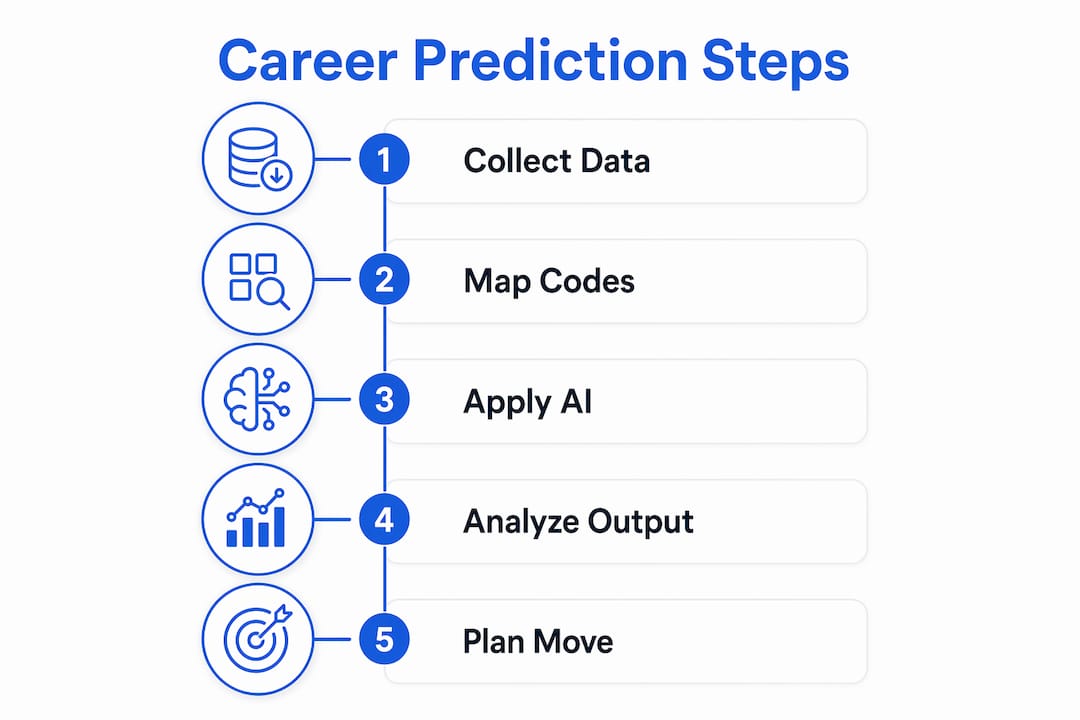
Applying predictive analytics to your career is a workflow, not a one-time event. Here is a practical sequence that works for professionals in active transition.
-
Gather your baseline data. Export your full work history with titles, dates, industries, and key responsibilities. Add any certifications, tools, and skills you have used. This becomes your personal career dataset.
-
Pull current market data. Use real-time job market data sources to identify which roles in your target field are growing, which skills appear most frequently in postings, and which industries are hiring at volume right now.
-
Run a skill-gap analysis. Compare your skill profile against the competency requirements of your three to five target roles. AI career systems close skill gaps by comparing individual competencies with industry benchmarks from real-time APIs. The output tells you exactly where to focus your learning time.
-
Evaluate your transition options. Research shows that intra-firm occupation changes are the strongest driver of upward mobility, outperforming lateral moves and company switches. If you are still employed, an internal move may carry more career value than you realize.
-
Interpret outputs with context. AI recommendations are probabilistic, not prescriptive. Use them to narrow your options, then apply your own judgment about culture fit, geography, and personal priorities.
-
Update your data continuously. The job market shifts fast. The evolving role of data professionals in 2026 emphasizes causal analysis and decision support over routine dashboarding. Skills that were optional two years ago are now required. Static data gives you a static picture.
The most common mistake professionals make is treating a single model output as a final answer. Predictive analytics gives you a probability distribution, not a guarantee. Use it to inform your decisions, not replace them. Earnhire's job analysis tools help you connect real-time market signals to your specific career profile, so your planning stays grounded in current data.
What biases and risks should you watch for in career predictions?
Predictive models are only as fair as the data they learn from. This is the part of career data analysis that most articles skip, and it is the part that matters most if you are a woman, a person of color, or anyone whose career path deviates from the historical norm.
Historical data reflects intersectional bias, with women and Black professionals receiving lower upward mobility returns from identical job moves compared to white male counterparts. A model trained on that history will reproduce those patterns in its recommendations. This is not a flaw in the math. It is a flaw in the training data.
Other risks worth knowing:
- Noisy job title data produces unreliable outputs. If your titles are inconsistent or non-standard, normalize them to O*NET or ESCO codes before using any model.
- Structural dead-ends are roles that look stable but have almost no transition pathways leading out. Graph analytics can identify these, but most consumer-facing tools do not surface this information.
- Overconfidence in high accuracy scores is a real trap. A model that is 87% accurate is still wrong 13% of the time. For a decision as significant as a career move, that margin deserves respect.
"AI-based career recommendations must consider intersectional bias in training data. Transparency and explainability tools are not optional features. They are the mechanism by which professionals can audit whether a recommendation actually serves their interests."
The safest approach is to treat model outputs as one input among several. Cross-reference AI recommendations with data equity considerations and your own knowledge of your field. If a recommendation feels structurally wrong for your situation, it probably is.
Key Takeaways
The most effective approach to predicting career moves is combining standardized job data, hybrid AI models, and continuous market monitoring while actively auditing outputs for bias.
| Point | Details |
|---|---|
| Start with clean data | Map your job history to O*NET or ESCO codes before using any predictive tool. |
| Use hybrid AI models | Systems combining clustering, NLP, and classification reach up to 87% accuracy in career matching. |
| Prioritize intra-firm moves | Internal role changes produce stronger upward mobility than lateral or company-switch moves. |
| Audit for bias | Models trained on historical data reproduce inequalities. Always apply your own judgment to outputs. |
| Update continuously | Real-time API data keeps your career plan aligned with current market demand, not last year's trends. |
Why I think most professionals underuse career data
I have watched a lot of professionals treat their job search as a purely intuitive process. They know their field, they know their network, and they trust their gut. That works until it doesn't. The moment the market shifts, gut instinct has no data to update on.
What I find genuinely underused is the combination of probabilistic modeling and continuous monitoring. Most people check the job market when they need a job. The professionals who move well check it constantly, even when they are employed. They notice when a skill starts appearing in 40% more postings than it did six months ago. They notice when a role category starts shrinking. That is not paranoia. That is how you stay ahead.
The bias issue also gets dismissed too quickly. I have seen professionals receive AI recommendations that were technically accurate but structurally wrong for their demographic reality. Explainable AI outputs are not a nice-to-have feature. They are the only way you can actually interrogate a recommendation and decide whether it applies to you. If a tool cannot explain its reasoning, you are flying blind in a different way than before.
The 2026 shift toward causal analysis and decision support in data roles is a signal worth taking seriously. The skills the market is rewarding now are not the same ones it rewarded three years ago. The professionals who will move well in the next two years are the ones building those skills today, not waiting for their next performance review to find out they are behind.
— Eric
Earnhire gives your job search real data value
Searching for a job generates data. Most platforms discard it. Earnhire is built differently.
Earnhire's platform turns every search, save, and application into measurable career signal. The guided job search connects your activity to real-time market data, so you are not just browsing postings. You are building a picture of where the market is moving and where you fit. The AI resume tools tailor your profile to match the skill language employers are actually using. And the job analysis features surface the competency gaps between your current profile and your target roles. If you are in transition and want your search to produce insight, not just applications, Earnhire is where that work happens.
FAQ
What types of job data are most useful for career predictions?
The most useful data types are personal job history, real-time skills demand from job postings, occupational growth projections from the Bureau of Labor Statistics, and salary benchmarks. Standardized taxonomies like O*NET and ESCO improve prediction accuracy by normalizing inconsistent job titles.
How accurate are AI models at predicting career moves?
AI-driven hybrid models combining clustering, classification, and NLP achieve up to 87% predictive accuracy in skill-to-career matching. Accuracy varies by data quality and model type, so outputs should be treated as probabilities, not certainties.
What is a structural dead-end role and how do I identify one?
A structural dead-end is a role with very few transition pathways leading to higher-level positions. Graph analytics tools that map career communities can identify these roles by analyzing how frequently professionals move out of them into growth-oriented positions.
Does career data analysis account for bias?
Most predictive models reflect historical bias, with research showing women and Black professionals receive lower upward mobility returns from identical moves. Professionals should use explainable AI tools that surface their reasoning and cross-reference recommendations with their own knowledge of their field.
How often should I update my career data analysis?
Career data analysis works best as a continuous practice rather than a one-time exercise. Real-time job market APIs update skills demand signals constantly, and the roles and competencies the market rewards shift faster than annual reviews can capture.