
Real-time job market data is continuously updated information on active job listings that reflects hiring conditions as recently as yesterday, sourced directly from job boards and employer career pages. This is the industry term for what many professionals call "live labor market data" or "current job market information." If you've ever applied for a role only to find the market had shifted weeks before you noticed, this data is what you were missing. Understanding how it works, where it comes from, and how to use it gives you a real edge in your job search.
What is real-time job market data and how is it collected?
Real-time job market data is gathered through automated systems that pull listings from thousands of sources simultaneously. Job boards, employer career pages, and recruitment platforms all feed into aggregation engines via APIs and automated file transfer protocols. The result is a continuously refreshed picture of who is hiring, for what roles, and at what pay.

Platforms like Google Jobs and LinkedIn sit at the center of this ecosystem. Google Jobs indexes over 60% of U.S. public job postings and tracks posting velocity with daily snapshots. That scale makes it one of the most useful signals for detecting early shifts in hiring demand.
Update frequency varies by platform. Some sources refresh every few hours; others push daily batches. The freshness of the data depends on how often the source employer updates their career page and how quickly the aggregator picks up the change.
- Job boards such as Indeed and ZipRecruiter aggregate listings from thousands of employers and update continuously.
- Employer career pages are the original source of most postings and are indexed directly by platforms like Google Jobs.
- Recruitment platforms like LinkedIn add a social layer, showing not just open roles but also hiring manager activity and company growth signals.
- APIs and FTP feeds are the technical pipelines that move raw listing data from source to aggregator at scale.
Pro Tip: Check posting dates on listings carefully. A job that appears "new" on an aggregator may have been live on the employer's site for days before it was indexed.
How does real-time job data differ from traditional labor statistics?
The gap between real-time job data and traditional labor statistics is not just about speed. It is about what each type of data actually measures and how reliable each is for different decisions.
Government sources like the Bureau of Labor Statistics publish the Current Employment Statistics report, but BLS employment figures are preliminary and revised multiple times after initial release. That means the number you read today may change significantly in the following months. Real-time feeds offer early signals, but official data remains the canonical record.
Private real-time data fills the gap in timeliness. During the 2025 federal government shutdown, private data sources became critical as official releases halted entirely. That episode showed just how dependent analysts and job seekers had become on live feeds when government reports went dark.
| Feature | Real-time job data | Traditional labor statistics |
|---|---|---|
| Update frequency | Daily or near-daily | Monthly or quarterly |
| Source | Job boards, career pages | Government surveys |
| Granularity | Role-level, skill-level | Sector and occupation-level |
| Timeliness | Current to yesterday | Lags by weeks or months |
| Revision risk | Low (reflects live listings) | High (multiple revision cycles) |
| Best use | Spotting hiring trends now | Understanding long-term patterns |
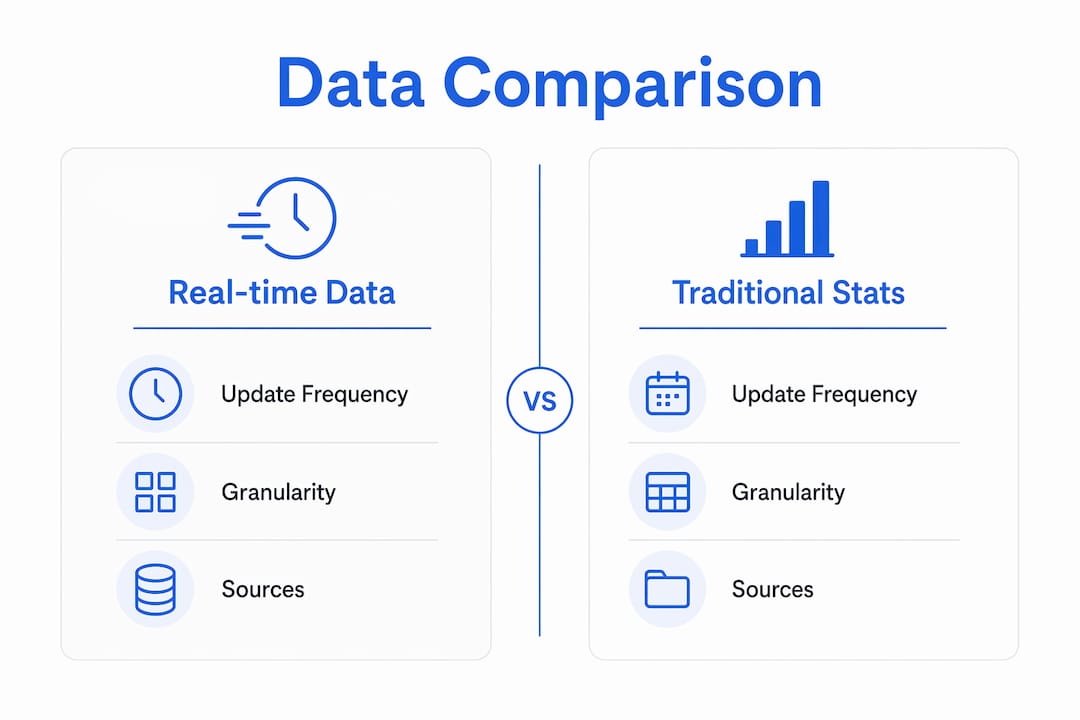
Real-time data also wins on granularity. Microeconomic shifts in employer needs show up in job descriptions weeks before they appear in any government report. You can track demand for a specific skill by city or industry in near real time. Traditional statistics simply cannot do that.
The Chicago Fed takes a hybrid approach. Its labor market indicators combine private-sector real-time data with official statistics, updating twice monthly ahead of BLS reports. That combination gives a more frequent and complete view than either source alone.
Pro Tip: Never rely on a single data source. Cross-reference real-time job postings with BLS occupational data to separate short-term hiring spikes from genuine long-term demand.
What benefits does real-time job market data offer career professionals?
Real-time employment trends give you something traditional job searching never could: a live read on what employers actually want right now. That shift from guessing to knowing changes how you search, what you apply for, and how you present yourself.
Job seekers who use real-time analytics can answer two questions that matter most: what is hiring now, and what skills are in demand. Those answers are not static. They shift by week, by region, and by industry. Checking them regularly keeps your search aligned with actual market conditions.
Here is what live job market statistics make possible for you:
- Salary benchmarking from current listings. Real postings show actual pay ranges, not averages from surveys conducted 18 months ago. You negotiate with current data, not outdated figures.
- Resume language alignment. When you read 50 active job descriptions in your target role, you learn exactly which keywords and phrases employers are using right now. Your resume reflects that language.
- Early detection of emerging roles. A surge in postings for "AI prompt engineer" or "climate risk analyst" shows up in real-time feeds months before it registers in official occupation statistics.
- Targeted skill development. If Python appears in 80% of data analyst postings in your city, that is a clear signal about where to invest your learning time.
- Smarter application targeting. Posting volume by company tells you which employers are actively scaling. Those are the organizations most likely to move quickly through hiring.
The data-driven job search approach built on these signals is not just for analysts or tech workers. Any professional in any field benefits from knowing which roles are growing and which are contracting in real time.
How to use real-time job market data effectively
Knowing the data exists is one thing. Using it without getting misled is another. Real-time feeds have quirks that can send you in the wrong direction if you do not know what to watch for.
-
Confirm posting persistence before acting on a trend. Single-day spikes in job posting volumes can be misleading due to indexing churn. A role that appears hundreds of times in one day may be a system re-index, not a genuine hiring surge. Wait for multi-day confirmation before concluding that demand has spiked.
-
Triangulate across multiple platforms. Each dataset reflects only part of the labor market, shaped by platform choices and definitional scopes. Check Google Jobs, LinkedIn, and direct employer career pages together. Patterns that appear across all three are far more reliable than signals from one source.
-
Use job market analytics tools built for career professionals. Platforms that aggregate and visualize posting data save you hours of manual searching. Look for tools that show posting velocity, skill frequency, and salary distribution by role and region.
-
Apply the job search as market research framework. Every search session generates data about what employers want. Track which job titles appear most often, which skills repeat across listings, and which companies post repeatedly. That pattern is your market signal.
-
Separate noise from signal with time windows. Look at 30-day and 90-day posting trends, not just today's listings. Short windows catch false spikes. Longer windows reveal genuine shifts in hiring demand.
Pro Tip: Set up saved searches on at least two platforms for your target role. Compare what each shows weekly. Divergence between platforms often reveals a data quality issue worth investigating before you apply.
Key takeaways
Real-time job market data is the most current and granular source of labor market intelligence available to job seekers, but it requires triangulation across platforms and time windows to be reliable.
| Point | Details |
|---|---|
| Definition and source | Real-time data pulls from job boards and career pages via APIs, updated daily or faster. |
| Speed advantage | It reflects hiring conditions as recently as yesterday, weeks ahead of official BLS reports. |
| Granularity benefit | It tracks skill and role-level demand by region, far beyond what government surveys capture. |
| Triangulation is required | Each platform covers only part of the market, so cross-referencing multiple sources improves accuracy. |
| Avoid false signals | Single-day posting spikes need multi-day confirmation before you treat them as real hiring trends. |
Why I think most job seekers underuse this data
I've watched professionals spend weeks tailoring resumes to job descriptions that were already outdated by the time they applied. The market had moved. The skills employers wanted had shifted. And the job seeker had no idea because they were working from static information.
Real-time labor market insights change that equation completely. When you analyze job market trends with live data, you stop reacting and start anticipating. You see which roles are gaining traction before the crowd does. You align your resume to language employers are using this week, not last year.
The honest truth is that most professionals treat job searching as a one-time sprint rather than an ongoing read of market signals. That is the gap. The data is available. The tools exist. What is missing is the habit of checking it regularly and letting it shape your decisions.
My advice: treat your job search like a market research project. Check posting velocity weekly. Note which skills appear in new listings that were absent three months ago. That discipline separates professionals who land roles quickly from those who wonder why their applications go quiet.
The future of job market analytics is moving toward personalized, real-time feeds that surface relevant signals without requiring manual research. That shift is already underway, and the professionals who build the habit now will have a significant head start.
— Eric
Earnhire puts real-time market signals to work for you
Earnhire is built for professionals who want their job search to mean something beyond just sending applications. Every search you run on Earnhire contributes to your data worth, the measurable professional value that employers use to make informed hiring decisions.

Earnhire's guided job search connects you to live market data and walks you through applying it to your actual search. The resume tools align your resume language to what employers are posting right now, not what was trending 18 months ago. You get AI-powered job analysis, tailored resume suggestions, and a platform that compensates you for the work of searching. Your effort builds real career momentum, not just a longer application history.
FAQ
What is real-time job market data?
Real-time job market data is continuously updated information on active job listings, sourced from job boards and employer career pages via APIs and automated feeds. It reflects hiring conditions as recently as yesterday, giving job seekers a live view of current demand.
How does real-time data differ from BLS employment statistics?
BLS statistics are survey-based, released monthly, and revised multiple times after publication. Real-time job postings update daily and show role-level and skill-level detail that government reports do not capture.
Can I trust a single job board for real-time market insights?
No. Each platform covers only part of the labor market, shaped by its own methodology and employer relationships. Triangulating across Google Jobs, LinkedIn, and direct employer career pages produces a more accurate picture.
What causes false spikes in job posting data?
Single-day surges often result from system re-indexing or large employer batch uploads rather than genuine hiring increases. Multi-day confirmation across multiple platforms is the standard check for reliable trend detection.
How do job seekers access real-time job market analytics?
Job seekers can access live job market statistics through platforms that aggregate and visualize posting data, including Google Jobs, LinkedIn, and career analytics tools. Earnhire's guided job search also surfaces real-time market signals tailored to your professional profile.