
Data equity in job markets is the practice of ensuring that data used in hiring accurately and fairly represents all candidates, reducing bias and improving employment outcomes. The role of data equity in job markets has moved from an academic concern to a practical issue that shapes whether your resume gets seen, your skills get scored fairly, and your career trajectory gets a real shot. Frameworks like ML-BAMS and methods like counterfactual paired testing now give researchers and employers concrete tools to measure and fix bias. If you are searching for a job or changing careers, understanding how data equity affects jobs is no longer optional. It is the difference between a fair shot and a filtered-out application.
How does data equity influence fairness and hiring outcomes?
Algorithmic hiring systems can embed historical inequity directly into their scoring logic. When training data reflects decades of biased hiring decisions, the algorithm learns to replicate those patterns. A candidate from an underrepresented group may have identical qualifications to a peer but receive a lower score because the model was trained on data that systematically undervalued similar profiles.
The numbers behind this problem are striking. Applying the ML-BAMS lifecycle bias framework to hiring systems produces measurable fairness gains across multiple metrics:
- Demographic parity: +32.4%
- Equal opportunity: +28.7%
- Equalized odds: +25.9%
- Treatment equality: +19.2%
- Output stability: +70%
Those gains matter because they show that fairness is not a fixed ceiling. Targeted interventions at each stage of the hiring lifecycle produce real improvements, not just marginal tweaks.
The data equity impact goes beyond raw scores. Biased proxy signals, like zip code, school name, or employment gap length, can distort evaluations even when two candidates have the same skills. A model that penalizes employment gaps, for example, disproportionately harms caregivers and people who faced layoffs, groups that skew toward women and workers of color.

Hiring fairness also involves what researchers call the fairness trilemma: you cannot simultaneously maximize efficiency, match group representation, and maintain neutrality with a single decision rule. Firms must choose which constraint to prioritize. That choice is a values decision, not a technical one. Job seekers rarely know which trade-off their prospective employer has made.
Managing fairness across the entire hiring lifecycle, rather than as a one-time fix before the model runs, produces more durable equity for candidates. A system that is fair at the resume screen stage can still be unfair at the interview scheduling or offer stage.
What are common challenges and misconceptions about data equity in hiring?
The biggest misconception is that neutral automation produces fair outcomes. It does not. Neutrality with one threshold can produce disproportionate group outcomes even when protected attributes like race or gender are removed from the data. The model finds correlated proxies and uses those instead.
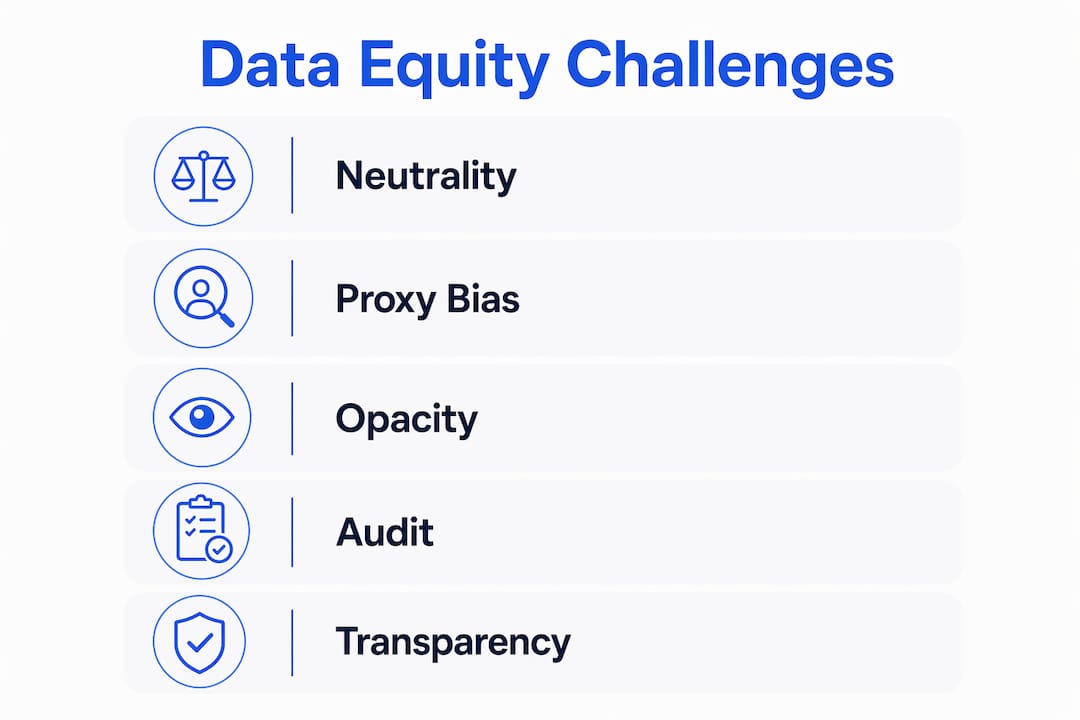
A second challenge is data aggregation. Aggregate labor-market data can look balanced at the surface while over-selecting or under-selecting certain groups for specific positions. A company might show overall demographic balance in hiring while systematically excluding underrepresented candidates from senior or technical roles. That position-level disparity is invisible in the aggregate numbers.
Three more challenges compound the problem:
- Proprietary opacity: Most hiring AI tools are internal and proprietary, making external fairness audits nearly impossible without granular, position-level data.
- Fairness trilemma trade-offs: Changing the decision rule to improve one fairness metric often degrades another. There is no free lunch.
- Structural downstream factors: Data equity alone does not guarantee decision equity. Structural factors at the interview, offer, and onboarding stages can undo upstream fairness gains.
Pro Tip: If you are applying through a company that uses AI screening, ask HR whether their tools have been independently audited for bias. The answer tells you a lot about how seriously they take job market equality.
The opacity problem is particularly frustrating for job seekers. You cannot appeal a decision made by a system you cannot see. Understanding that these gaps exist is the first step toward advocating for yourself and choosing employers who prioritize fair data usage in their hiring processes.
Which frameworks and methods improve data equity in job markets?
Several concrete methods now exist to detect and reduce bias in hiring systems. Each targets a different point in the process.
| Framework | What it does | Best for |
|---|---|---|
| ML-BAMS | Applies bias mitigation across the full hiring lifecycle | Organizations running end-to-end AI recruitment |
| Counterfactual paired testing | Varies one attribute at a time in identical candidate profiles | Auditing specific model decisions |
| hyperFA*IR | Adjusts selection fairness dynamically in finite candidate pools | Diverse hiring from small or shifting applicant pools |
| Data governance documentation | Records data origin, exclusions, and decision rationale | Building defensible, transparent hiring systems |
Counterfactual paired testing is one of the most direct audit techniques available. Variants of a single résumé change exactly one attribute at a time, such as a name that signals ethnicity or a school that signals socioeconomic background, to isolate whether the model responds to that signal. If the model scores the two profiles differently despite identical qualifications, bias is confirmed.
The hyperFA*IR method takes a different approach. It uses a hypergeometric distribution to dynamically adjust candidate selection probabilities as pool composition changes. This avoids the rigidity of hard quotas while still promoting fair representation. It also addresses a measurement gap: fairness evaluation should consider the entire candidate ranking pool, not just the top selections, because lower-ranked candidates still benefit through waitlists and fallback options.
Data governance ties all of these methods together. Documenting data origin, exclusions, and decision processes is what makes fairness trade-offs visible and defensible. Without documentation, a company cannot explain why its model made a particular decision, and external auditors cannot assess whether the system is fair.
Pro Tip: When evaluating job search platforms, look for tools that explain how they use your data and whether they apply any bias-mitigation logic. Transparency in data usage is a signal of a platform that respects your data worth as a job seeker.
How does data equity affect job seekers and their strategies?
The role of open data in job markets matters most when you are the one being evaluated. Here is how data equity affects you directly and what you can do about it.
-
Understand that AI screening is widespread. Many large employers use automated resume screening before a human ever sees your application. Knowing this, you can tailor your resume language to match job descriptions closely, which reduces the chance that a model misclassifies your skills.
-
Watch for proxy bias signals. Employment gaps, school names, and even formatting choices can trigger biased scoring. Use a clean, standard resume format. Explain gaps briefly and factually. A data-driven job search approach helps you identify which signals matter most for each role.
-
Advocate for transparency. Ask employers directly whether their hiring tools have been audited. Request feedback when you are screened out. Companies that prioritize data inclusion strategies will have answers. Companies that do not will tell you something important about their culture.
-
Use your professional network strategically. Referrals often bypass automated screening entirely. Fair data representation in professional networks matters because who you know can determine whether your application reaches a human reviewer. Build and maintain connections across industries and seniority levels.
-
Choose platforms that respect your data. Not all job boards treat your search activity the same way. Some sell your behavioral data without compensation or transparency. Others, like Earnhire, are built on the principle that your search activity has measurable value and that you should benefit from it.
Job market equality is not something that happens to you passively. You can make choices that put you in front of fairer systems and better-informed employers. The data equity impact on your career is real, but so is your ability to navigate it with the right information.
Key Takeaways
Data equity in job markets requires lifecycle-wide fairness management, transparent governance, and informed job seeker strategies to produce genuinely equitable hiring outcomes.
| Point | Details |
|---|---|
| Bias lives in training data | Algorithms trained on biased historical data replicate those patterns unless actively corrected at every stage. |
| Fairness trilemma is real | No single decision rule maximizes efficiency, representation, and neutrality simultaneously. Employers must choose. |
| Audit methods exist | Counterfactual paired testing and hyperFA*IR give auditors concrete tools to detect and reduce hiring bias. |
| Aggregate data misleads | Overall demographic balance can mask position-level disparities. Always ask for role-specific data. |
| Job seekers can act | Tailoring resumes, advocating for transparency, and choosing fair platforms are practical steps with real impact. |
What I've learned watching data equity reshape hiring
I have watched the conversation around hiring fairness shift from a compliance checkbox to a genuine engineering challenge. That shift is real progress. But I want to be honest about what still frustrates me.
Most job seekers have no idea that a model scored their resume before a human read it. They assume rejection means they were not qualified. Sometimes that is true. But sometimes it means a proxy signal, a school name, a zip code, a gap year, triggered a penalty that had nothing to do with their ability to do the job. That gap in awareness is the part I find most troubling.
The frameworks are getting better. ML-BAMS, hyperFA*IR, counterfactual testing. These are real tools with real results. But they only help if employers actually use them, and most proprietary hiring tools are never audited externally. The opacity of hiring AI is a structural problem that no individual job seeker can solve alone.
My advice: treat your job search as market research. Pay attention to which employers explain their process and which ones go silent after an automated rejection. That behavior tells you more about a company's culture than any Glassdoor review. And use platforms that treat your search activity as data worth something, because it is.
— Eric
Earnhire puts data equity to work for you
If you are tired of sending applications into a black box and never hearing back, Earnhire was built to change that experience.
Earnhire is the only job board that turns your search activity into measurable professional value. Every job you analyze, every resume you tailor, and every application you track builds a signal that employers can actually use to make informed hiring decisions. The platform's AI job analysis tools help you understand what each role is really asking for, so you can position your skills clearly and fairly. The resume tools are built with awareness of how AI screening works, giving you a real advantage. And unlike traditional boards, Earnhire compensates you for the work of searching. Your effort is never wasted. Start building your data worth on a platform that respects it.
FAQ
What is data equity in hiring?
Data equity in hiring is the practice of ensuring that candidate data accurately and fairly represents all applicants, reducing bias in algorithmic and human decision-making. It requires both inclusive data collection and transparent governance of how that data is used.
Does removing protected attributes from hiring algorithms make them fair?
No. Neutral automation does not guarantee fair outcomes because algorithms find correlated proxy signals like zip code or school name that produce the same biased results even without explicit demographic data.
How can job seekers detect bias in hiring systems?
Job seekers can ask employers whether their AI tools have been independently audited and request feedback after automated rejections. Choosing platforms with transparent data practices and using a job search platform checklist also helps identify fairer systems.
What is the fairness trilemma in hiring?
The fairness trilemma means no single hiring decision rule can simultaneously maximize efficiency, match group representation, and maintain neutrality. Employers must explicitly choose which fairness constraint to prioritize, and that choice has real consequences for candidates.
Why does aggregate hiring data hide disparities?
Aggregate data can show overall demographic balance while masking over-selection or under-selection of specific groups for particular roles. Position-level analysis is required to detect these gaps, and most proprietary hiring tools do not make that data publicly available.