
Job search behavior is defined as the full set of actions a candidate takes during a search, from how they target roles to how they follow up after interviews, and it directly shapes hiring decisions beyond qualifications alone. Employers read these patterns as signals of future performance. Referred candidates are 11 times more likely to be hired than cold applicants, yet most job seekers still default to mass applications. The role of job search behavior in hiring is not a soft concept. It is a measurable factor that determines who gets the offer and who gets the silence. Earnhire is built on exactly this insight.
How do different job search behaviors affect employment outcomes?
Job search behavior falls into two broad camps: high-volume, low-targeting approaches and focused, relationship-driven strategies. The data is clear on which one wins.
48% of job seekers use a "spray and pray" approach, blasting applications to dozens of roles without tailoring. That behavior signals desperation to hiring teams, not ambition. Meanwhile, up to 70% of jobs are filled through connections rather than public postings. That gap between where job seekers spend their time and where jobs actually get filled is the core problem.

Networking is the highest-yield behavior in any search. Yet 85% of job seekers spend most of their time on online applications, and only 15% focus mainly on networking. Referrals generate higher interview rates, shorter hiring timelines, and better role fit. The math strongly favors relationship-building over inbox-flooding.
AI tools are changing the equation too. Job seekers who frequently use AI tools are more than twice as likely to receive job offers, with a 76% offer rate compared to 33% for those who do not. That gap reflects better resume targeting, sharper application positioning, and faster iteration on what works.
- Networking actively: Reaching out to second-degree connections, attending industry events, and asking for referrals
- Targeted applications: Applying only to roles where your skills match at least 70–80% of the requirements
- AI-assisted tailoring: Using AI tools to customize resumes and cover letters for each specific role
- Self-regulation: Setting weekly goals, tracking progress, and adjusting tactics based on what generates responses
Pro Tip: Track your response rate by application type. If tailored applications get callbacks and generic ones do not, that data tells you exactly where to spend your time.
Why does quality of job search behavior matter more than quantity?
Employers do not just evaluate your resume. They evaluate how you searched. Employers interpret job search patterns as signals of future performance and reduce hiring risk accordingly. A candidate who applies to 200 roles across wildly different industries sends a signal of confusion, not ambition.
High volume with unclear positioning actively reduces your appeal. Hiring managers notice when a candidate's LinkedIn profile, resume, and cover letter tell three different stories. Consistency across touchpoints matters more than resume polish alone. When your story is coherent, you reduce the cognitive load on the hiring team. That reduction in friction directly increases your odds of moving forward.
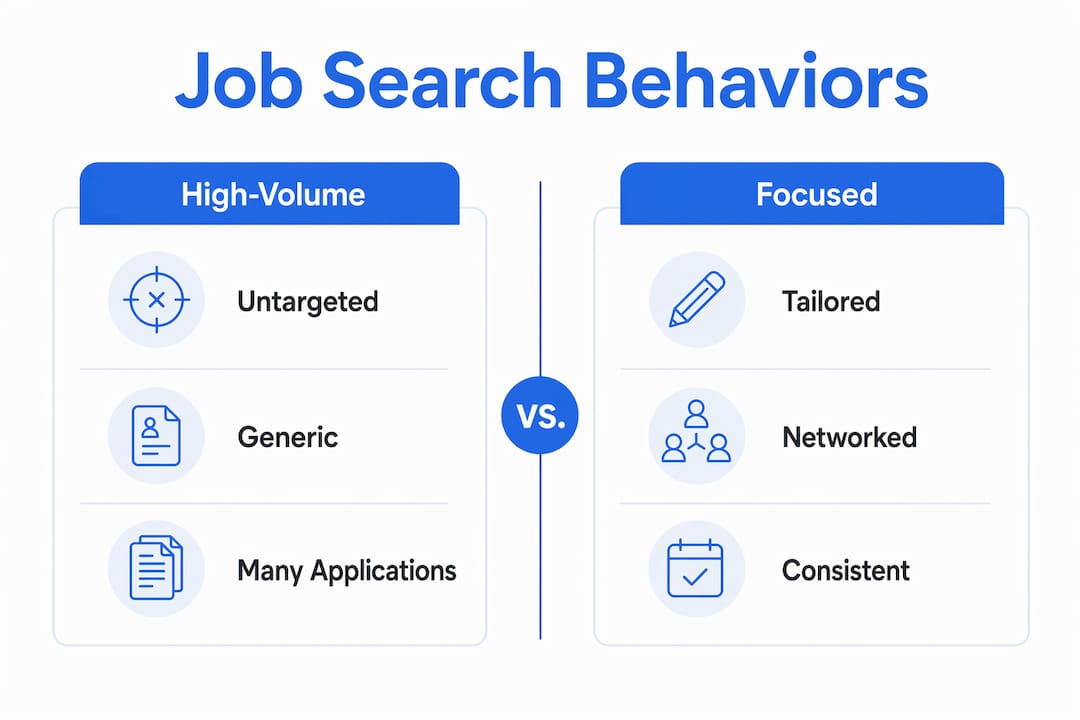
The contrast between quality-driven and volume-driven approaches is stark:
| Behavior type | Employer signal | Likely outcome |
|---|---|---|
| Broad, untargeted applications | Unclear positioning, high risk | Lower callback rate |
| Targeted, tailored applications | Focused expertise, lower risk | Higher interview rate |
| Inconsistent messaging across channels | Uncertainty about fit | Reduced hiring confidence |
| Consistent narrative across all touchpoints | Clear value proposition | Faster hiring decisions |
Job search success is also multiplicative. Improving one component increases the yield of all others. Targeting gets you in front of the right roles. Tailoring gets your resume past the first screen. Networking gets you a referral. Self-regulation keeps you sharp through a long search. Optimizing only one of these while ignoring the rest produces disappointing results.
Pro Tip: Before sending any application, ask yourself: does my resume, LinkedIn profile, and cover letter all tell the same story about who I am professionally? If the answer is no, fix that first.
What practical job search behaviors generate the most hiring value?
The most effective behaviors reduce uncertainty for the hiring team. Here is a step-by-step framework for building a search that generates real results:
-
Narrow your target list. Identify 20–30 companies where your skills and values genuinely align. Apply to roles where you meet the core requirements. Broad targeting wastes time and dilutes your positioning.
-
Tailor every application. Generic resumes get filtered out fast. Match your language to the job description, mirror the role's key terms, and lead with the experience most relevant to that specific employer.
-
Build your referral pipeline. Reach out to former colleagues, professors, and LinkedIn connections at target companies. A warm introduction to a hiring manager is worth more than 50 cold applications. Referrals yield higher interview rates across every industry and seniority level.
-
Track learning, not just volume. Tracking how many applications you send leads to fatigue. Tracking what you learn from each application cycle, such as which roles respond, which formats work, and where you drop off in the funnel, builds a feedback loop that improves your search over time.
-
Set balanced goals. Long searches cause learned helplessness. Setting achievable weekly targets, like five tailored applications and three networking conversations, keeps momentum without burning out. Adjust goals based on results, not anxiety.
Pro Tip: Use a simple spreadsheet to log every application: role, company, date sent, response received, and one lesson learned. After four weeks, patterns will emerge that tell you exactly what to change.
Understanding the psychological toll of job searching is just as important as the tactical steps. Burnout kills persistence, and persistence is what separates job seekers who land roles from those who give up.
How can job seekers use behavioral insights and tools to enhance hiring prospects?
Behavioral insight methods give you a structured way to align your natural strengths with the right roles. The Birkman Method, for example, uses self-awareness tools to align natural strengths with roles, leading to better recruiter engagement and stronger interview outcomes. Knowing how you work best, what environments you thrive in, and how you communicate under pressure makes your positioning sharper and more credible.
AI-powered platforms take this further. When you combine behavioral self-knowledge with AI resume tailoring and job analysis, you close the gap between how you see yourself and how employers see you. A data-driven job search treats every application as a data point, not just an attempt. You iterate faster, waste less time, and build a clearer picture of where you fit.
Research confirms the compounding effect of combining skill-building with structured motivation. A meta-analysis shows that combining skill-building with structured motivation increases employment odds by 2.67 times. That is not a marginal improvement. It is the difference between a three-month search and a nine-month search.
- Use behavioral assessments like the Birkman Method to identify your strongest role fit before you apply
- Apply AI resume tools to tailor each application to the specific language and priorities of the job description
- Track funnel metrics such as application-to-response rate, response-to-interview rate, and interview-to-offer rate
- Build a guided search system that integrates direction (what roles to target), proof (tailored materials), access (networking), and conversion (interview preparation)
Earnhire's platform is built around this exact framework. Every search action on Earnhire, from saving a job to tailoring a resume, generates data worth that informs employers and preserves your professional value between roles.
Key Takeaways
Job search behavior is the primary driver of hiring outcomes because targeted, consistent, and relationship-driven actions reduce employer uncertainty and multiply your chances of getting hired.
| Point | Details |
|---|---|
| Behavior signals future performance | Employers read your search patterns as indicators of how you will perform on the job. |
| Networking beats volume | Referred candidates are 11 times more likely to be hired than cold applicants. |
| Quality multiplies results | Targeting, tailoring, networking, and self-regulation reinforce each other when used together. |
| Track learning, not just applications | Monitoring what you learn from each cycle builds a feedback loop that improves your search. |
| AI tools double offer rates | Job seekers using AI tools receive offers at more than twice the rate of those who do not. |
What I've learned about job search behavior that most guides won't tell you
Most job search advice focuses on tactics: update your resume, write a better cover letter, practice your elevator pitch. That advice is not wrong. It just misses the bigger picture.
What I've seen, again and again, is that job seekers who treat their search as a system win faster than those who treat it as a series of individual attempts. The difference is not talent or credentials. It is behavioral coherence. Every touchpoint, your LinkedIn profile, your follow-up email, the way you describe your last role in an interview, either reinforces a clear story or muddies it.
The candidates who struggle longest are usually the ones sending the most applications. They are busy, but they are not building anything. Each application is an isolated event with no feedback loop and no learning. That is the trap. Volume feels productive. It rarely is.
The pivot that actually works is treating your search like a structured job search workflow: define your target, build your proof, activate your network, and track what moves the needle. When you do that, the search gets shorter and the offers get better. Not because you got lucky. Because you reduced the uncertainty that employers are trying to manage every time they make a hire.
— Eric
Earnhire turns your search activity into measurable career value
Most job boards treat your applications as transactions. Earnhire treats them as data. Every action you take on the platform, from analyzing a job description to tailoring your resume, builds a record of your professional effort that employers can actually use to make better hiring decisions.
Earnhire's guided job search system gives you a structured framework that integrates targeting, tailoring, and behavioral insight into one place. The platform's AI resume tools help you match your experience to each role with precision, so your applications tell a consistent, compelling story every time. If you are ready to search smarter and get credit for the work you put in, Earnhire is where that starts.
FAQ
What is the role of job search behavior in hiring?
Job search behavior shapes how employers perceive a candidate's fit, focus, and future performance. Targeted, consistent behaviors reduce hiring risk and increase the likelihood of receiving an offer.
Why does networking outperform mass applications?
Referred candidates are 11 times more likely to be hired, and up to 70% of jobs are filled through connections rather than public postings. Networking gives you access to roles that never reach job boards.
How do AI tools improve job search outcomes?
Job seekers who frequently use AI tools receive job offers at a 76% rate, compared to 33% for those who do not. AI tools improve resume targeting, application consistency, and iteration speed.
What job search metrics should I track?
Track your application-to-response rate, response-to-interview rate, and what you learn from each rejection or silence. Tracking learning rather than volume builds a feedback loop that improves results over time.
How does behavioral self-awareness help in a job search?
Tools like the Birkman Method align your natural strengths with the right roles, leading to stronger recruiter engagement and better interview outcomes. Self-awareness sharpens your positioning before you ever send an application.