
Employer data is the collection and analysis of recruitment and labor market information that guides hiring decisions. Understanding how employer data drives hiring explained through measurable signals is the foundation of modern, evidence-based recruiting. HR professionals who master this data layer move from reactive to proactive. They fill roles faster, reduce bias, and build hiring processes that hold up to scrutiny. Earnhire is built on this principle: every job search interaction generates real hiring signals that inform smarter employer decisions.
What types of employer hiring signals exist?
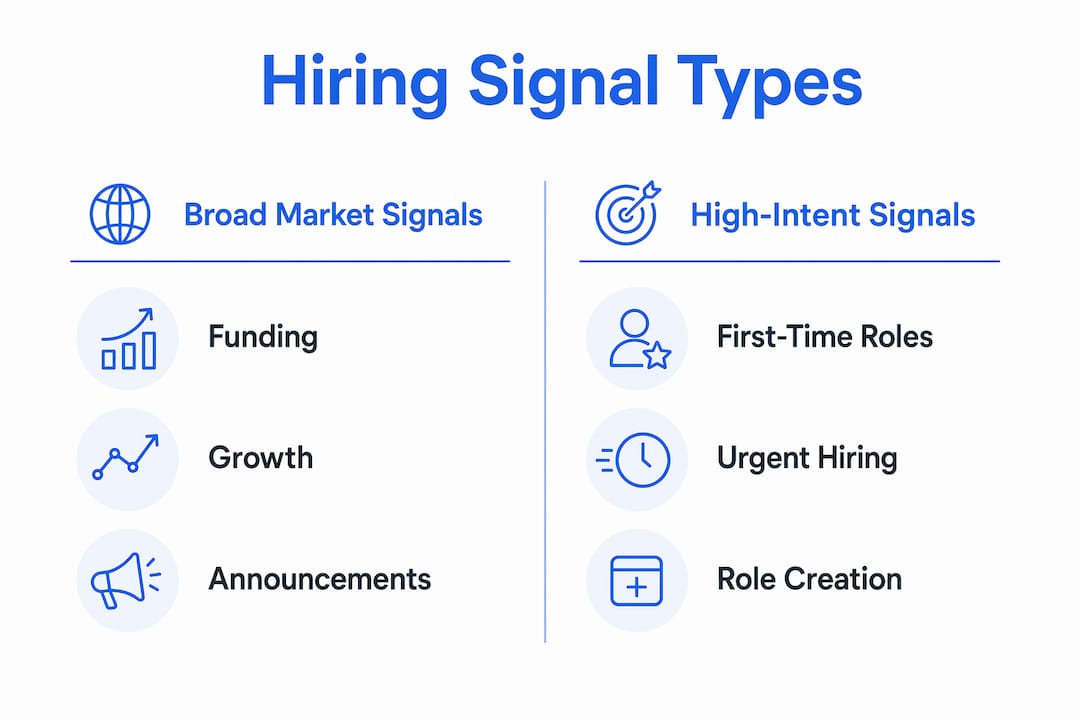
Employer hiring signals fall into two distinct categories: broad market signals and high-intent signals. Knowing the difference changes how you allocate recruiting resources.
Broad market signals include funding announcements, headcount growth trends, industry expansion news, and general job posting volume. These signals tell you a company is growing. They do not tell you which roles are urgent or when hiring will happen.
High-intent signals are far more specific. They include:
- First-time role creation. A company posting a function for the first time signals a structural shift, not a backfill. First-time role creation correlates with 2–3 times higher hiring urgency compared to replacement hires. That gap in urgency matters when you are deciding where to focus outreach.
- Rapid sequential postings. When a company posts three or more roles in the same function within 30 days, it signals a team build, not routine turnover.
- Role reactivation after a freeze. A role that was paused and relisted signals budget approval and renewed commitment.
- Compensation range increases. An employer raising the listed salary band mid-search signals difficulty filling the role and willingness to pay more.
Recruiters who read high-intent hiring signals initiate outreach 2–4 months before roles go public. That lead time is the competitive edge most recruiting teams leave on the table.
Pro Tip: Set up alerts for first-time role postings in your target sectors. These are the highest-urgency opportunities and the ones most likely to convert quickly.
How do employers integrate internal and external hiring data?
The most actionable layer of labor market intelligence is internal recruitment data, yet most organizations underuse it. Internal recruitment data is the most overlooked source of hiring insight available to employers. It sits inside your ATS, your CRM, and your offer acceptance records, waiting to be read.
Combining internal metrics with external labor market data creates a complete picture. Here is how the two layers compare:
| Data type | Source examples | Primary use |
|---|---|---|
| Internal recruitment data | ATS records, screening scores, offer data, retention rates | Diagnose pipeline gaps, calibrate hiring bars |
| External labor market data | Job postings, compensation benchmarks, professional networks | Benchmark salaries, identify talent pools |
| Employer survey data | Tax filings, hires and separations reports | Track near real-time employment shifts |
| Candidate behavior data | Application patterns, click signals, resume tailoring activity | Gauge candidate intent and fit |
Employer surveys and tax filings provide near real-time employment change estimates. These external signals tell you what the market is doing. Your internal data tells you how your organization is responding to it.

The most common mistake HR teams make is treating time-to-fill as the primary success metric. Time-to-fill measures speed, not quality. The metrics that actually predict hiring success are screening-stage evidence and net-hire-at-90 retention. Screening evidence and 90-day retention correlate more strongly with successful hires than volume-based KPIs. A fast hire who leaves in 60 days costs more than a slower hire who stays three years.
Pro Tip: Pull your net-hire-at-90 data quarterly. If retention drops after a specific sourcing channel, that channel is generating noise, not quality candidates.
What are the practical benefits and limits of data-driven hiring?
Data-driven hiring improves decision consistency, reduces bias, and creates measurable outcomes. Those are real benefits. But the limits are just as real, and ignoring them leads to bad hires dressed up in good-looking dashboards.
The core benefits include:
- Consistency. Structured data creates a repeatable evaluation process. Every candidate gets assessed against the same criteria, not the interviewer's mood on a Tuesday.
- Reduced bias. Calibrated scoring rubrics and audit trails in hiring reduce the influence of unconscious preference. The data creates a record that can be reviewed and challenged.
- Measurable outcomes. When you track screening-stage evidence and retention, you can connect sourcing decisions to business results.
The limits are equally concrete. AI recruiting tools draw from diverse data sources including candidate submissions, ATS history, public profiles, and labor market benchmarks. When any of those inputs are flawed or biased, the output reflects that flaw at scale.
"71% of U.S. adults oppose using technology alone for final hiring decisions." That number is not a rejection of data. It is a clear signal that data must support human judgment, not replace it.
The human oversight requirement is not a weakness in the system. It is the system working correctly. Recruiters who treat AI output as a recommendation rather than a verdict make better decisions and build more defensible hiring records.
How do employers use hiring analytics for better candidate selection?
Hiring analytics improve candidate selection when they are built into a structured governance process. Without structure, analytics become noise. With structure, they become a repeatable hiring advantage.
Here is how high-performing HR teams apply hiring analytics in practice:
-
Establish calibrated scoring rubrics. Define what "qualified" means for each role before sourcing begins. Rubrics tied to capability signals, not credentials alone, reduce the influence of interviewer bias and create a consistent evaluation baseline.
-
Build audit trails for every decision point. Document why candidates advance or are declined at each stage. Standardized audit trails support adverse impact monitoring and give legal and compliance teams the evidence they need.
-
Use screening-stage data to predict role readiness. Candidates who score well on structured assessments at the screening stage show stronger time-to-productivity outcomes. This connection between early-stage data and on-the-job performance is the core value of data equity in hiring.
-
Monitor for geographic and demographic bias. Large organizations hiring across regions face the risk of applying different standards in different markets. Analytics that flag these gaps allow HR teams to recalibrate before bias compounds.
-
Report hiring outcomes to stakeholders. Data creates trust when it is shared. Presenting hiring quality metrics, not just fill rates, to leadership builds the case for continued investment in structured recruiting.
The governance benefits extend beyond compliance. When hiring managers see that structured data predicts better hires, they become advocates for the process. That internal buy-in is what makes data-driven hiring stick across an organization.
What emerging trends should HR pros watch in employer data use?
The most important shift in employer data use right now is the move away from volume metrics toward quality signals. This is not a minor adjustment. It changes what you measure, what you report, and what you act on.
- Job opening counts are unreliable urgency signals. A persistent backlog of open roles often reflects structural labor market friction, not active hiring intent. Relying on job openings alone misleads urgency analysis. The gap between openings and actual hires is the more honest signal.
- Net-hire-at-90 is becoming the standard quality metric. Teams that track 90-day retention by sourcing channel, hiring manager, and role type gain a feedback loop that improves every subsequent hire.
- Signal layering is replacing single-source analysis. No single data point tells the full story. The best recruiting teams layer job posting data, compensation benchmarks, internal screening scores, and candidate behavior signals to build a complete picture. Earnhire's job market analytics tools are built for exactly this kind of layered analysis.
- AI-generated application noise is a growing problem. As AI tools make it easier to submit applications at scale, volume-based metrics like application count become less meaningful. Screening-stage evidence and structured assessment scores become more valuable precisely because they filter out noise.
- Real-time labor market data is replacing lagging indicators. Employer surveys and hires-and-separations data now provide near real-time employment estimates. Teams that analyze job market trends with current data make sourcing decisions faster and with more confidence.
The recruiters who will lead in 2026 are not the ones with the most data. They are the ones who know which signals to trust and which to ignore.
Key Takeaways
Employer data drives better hiring when teams prioritize quality signals over volume metrics and combine internal analytics with external labor market intelligence.
| Point | Details |
|---|---|
| Signal type determines urgency | First-time role creation signals 2–3x higher hiring urgency than backfill roles. |
| Internal data is underused | ATS records and screening scores are the most actionable hiring intelligence most teams ignore. |
| Human oversight is non-negotiable | 71% of U.S. adults oppose tech-only hiring decisions; data supports judgment, not replaces it. |
| Quality metrics beat volume metrics | Net-hire-at-90 and screening-stage evidence predict hiring success better than time-to-fill. |
| Governance creates defensible hiring | Audit trails and calibrated rubrics reduce bias and satisfy compliance requirements. |
What I've learned about trusting employer data
I've spent years watching HR teams collect more data than they know what to do with. The dashboards get bigger. The reports get longer. The hiring quality stays flat. That pattern taught me something uncomfortable: data volume is not the problem most recruiting teams think they have.
The real problem is signal selection. Most teams measure what is easy to count, not what actually predicts a good hire. Time-to-fill is easy to count. Net-hire-at-90 requires follow-through. Guess which one most teams report to leadership.
My honest view is that the 2026 recruiting environment rewards restraint. The teams winning right now are not the ones with the most sophisticated tech stack. They are the ones who picked three or four quality signals, built governance around them, and held the line when pressure came to cut corners. That discipline is harder than it sounds when a hiring manager is screaming for a fill.
The human oversight piece matters more than most people admit. I have seen AI-assisted screening tools surface genuinely strong candidates who would have been filtered out by keyword matching. I have also seen those same tools amplify bad data at scale. The tool is only as good as the inputs and the human reading the output. That will not change in 2026 or 2030.
— Eric
Earnhire puts employer data to work for you
HR professionals who want to move from data collection to data action need tools built for that purpose. Earnhire connects the dots between candidate behavior signals and employer hiring decisions, giving recruiting teams a clearer picture of who is actively searching and what they bring to the table.
Earnhire's guided job search platform generates the kind of structured candidate data that makes employer hiring decisions more accurate and defensible. Every tailored resume and job analysis interaction on Earnhire creates measurable signals that reflect real candidate intent, not just application volume. If you want to see how that data layer works in practice, Earnhire's job analysis tools are the place to start.
FAQ
What is employer-side hiring data?
Employer-side hiring data is the collection of recruitment metrics, labor market signals, and candidate behavior information that organizations use to guide hiring decisions. It includes internal ATS records, external job posting data, compensation benchmarks, and real-time employment estimates.
How do employers use hiring analytics in candidate selection?
Employers use hiring analytics to build calibrated scoring rubrics, monitor for bias, and create audit trails that support defensible hiring decisions. Screening-stage evidence and 90-day retention rates are the most predictive metrics for candidate quality.
What is the difference between broad and high-intent hiring signals?
Broad signals like funding announcements indicate general growth. High-intent signals like first-time role creation indicate immediate hiring urgency, with first-time roles showing 2–3 times higher urgency than backfill positions.
Why are job opening counts unreliable as hiring urgency signals?
A large backlog of open roles often reflects structural labor market friction rather than active hiring intent. The gap between posted openings and actual hires is a more accurate measure of true recruiting urgency.
How do job applications feed employer data?
Each application, resume submission, and candidate interaction generates data points that employers use to assess pipeline health, sourcing channel quality, and candidate intent. Platforms like Earnhire structure this data so it reflects genuine candidate effort rather than automated application volume.