
Consent-based data hiring is defined as the practice of obtaining explicit, documented, and legally valid permission from job candidates before collecting, processing, sharing, or retaining their personal data beyond a specific job application. This is not just a compliance checkbox. It is the foundation of ethical data hiring that protects candidates and shields your organization from regulatory risk. Frameworks like the GDPR and the California Consumer Privacy Act (CCPA) set the legal floor for what valid consent looks like. Earnhire builds these principles directly into its platform, giving recruiters a clear path from intent to compliant practice.
What is consent-based data hiring under GDPR and other legal standards?
Consent-based data hiring is the formal process of securing informed, specific permission from candidates to use their personal data in ways that go beyond evaluating them for a single open role. The industry term for this broader practice is "lawful basis processing," and consent is one of several recognized lawful bases under GDPR Article 6.

Under GDPR 2026, valid consent must meet four conditions: it must be freely given, specific, informed, and unambiguous. Each condition carries real weight. "Freely given" means a candidate cannot be penalized for refusing. "Specific" means you cannot bundle consent for ten different uses into one vague statement. "Informed" means candidates know exactly what they are agreeing to. "Unambiguous" means a pre-ticked box does not count.
Here is where most recruiters get tripped up. Consent is not the right legal basis for core recruitment processing, such as reviewing a resume or scheduling an interview. Legitimate interest is often the more appropriate lawful basis for those activities. The reason is the power imbalance: a candidate who wants the job cannot freely refuse data processing tied to their application. Consent given under that kind of pressure is legally fragile.
Consent becomes the correct basis in specific situations:
- Adding a candidate to a talent pool for future roles
- Sharing candidate data with third-party partners not involved in the original hire
- Using candidate data for research, analytics, or marketing purposes
- Retaining data significantly beyond the standard retention period
Understanding when consent is required versus when legitimate interest applies is the most important distinction in data hiring practices. Get this wrong, and your consent notices create false security rather than real compliance.
How to implement consent-based hiring in your recruitment workflow
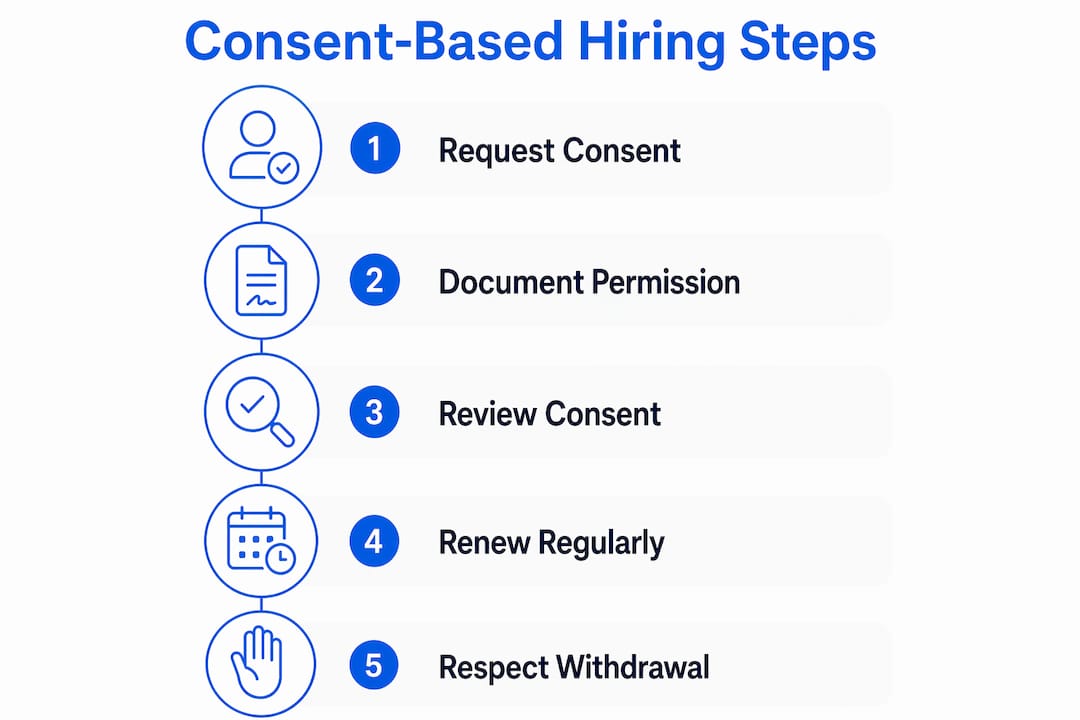
Practical implementation is where good intentions meet real friction. The goal is to capture consent that is granular, documented, and easy to withdraw, without making it a barrier to applying.
Follow these steps to build a consent workflow that holds up under scrutiny:
-
Separate consent from the application. Never make consent a condition of submitting a job application. Consent for talent pool inclusion or data sharing must be a standalone, optional step presented after the application is submitted or at a clearly distinct point in the process.
-
Write specific, plain-language consent notices. Each notice must cover the purpose of data collection, the types of data involved, how long data will be retained, who will have access, and how candidates can withdraw. Transparency in data processing is not optional. Vague language like "we may use your data for recruitment purposes" fails the specificity test.
-
Capture granular, timestamped records. A checkbox is not enough. Your system must record which version of the privacy notice the candidate saw, when they consented, and what they specifically agreed to. Audit trails with timestamps are the legal proof you need if a regulator or candidate challenges your records.
-
Build in easy withdrawal. Candidates must be able to withdraw consent at any time, and processing for that purpose must stop immediately. A buried email address in a footer does not meet this standard. Provide a clear, accessible mechanism, such as a self-service portal or a one-click unsubscribe.
-
Schedule consent renewals for talent pools. Consent is not a one-time event. For talent pool records, renewal is required periodically, typically annually, to reflect changes in candidate preferences and keep data accurate.
-
Use your ATS to automate consent capture. Modern applicant tracking systems can trigger consent requests at the right moment, store version-controlled records, and flag records approaching renewal deadlines. Manual processes create gaps.
Pro Tip: Set a calendar reminder or automated workflow to audit your talent pool consent records every 10–11 months. Catching expired consent before it lapses keeps you compliant and avoids the awkward position of deleting a strong candidate's record mid-hiring cycle.
Common pitfalls in consent-based hiring to avoid
Most compliance failures are not the result of bad intentions. They come from habits that feel reasonable but fall apart under legal scrutiny.
-
Bundling consent with the application. Tying consent to job submission makes it mandatory by default. GDPR requires consent to be freely given. If refusing consent means the candidate cannot apply, the consent is invalid from the start.
-
Using vague or broad consent language. Statements like "your data may be used for future opportunities" do not specify which opportunities, which teams, or for how long. Broad language fails the specificity requirement and gives candidates no real understanding of what they are agreeing to.
-
Failing to maintain proper audit trails. A simple checkbox with no timestamp, no version reference, and no record of what the candidate actually read is legally worthless. Simple checkboxes are insufficient as proof of valid consent during a regulatory audit.
-
Ignoring or delaying withdrawal requests. When a candidate withdraws consent, processing must stop immediately for that specific purpose. Delays, even brief ones, create liability. Ignoring requests entirely is a GDPR violation.
-
Over-collecting or retaining data too long. Collecting data "just in case" and holding it indefinitely are both red flags. Data minimization and defined retention periods are core GDPR principles, not suggestions.
"Consent is only as strong as the transparency behind it. If a candidate cannot clearly understand what they are agreeing to, the consent does not protect you. It just creates the appearance of compliance while leaving the legal risk exactly where it started."
What are the real benefits of consent-based hiring for candidates and employers?
Ethical data hiring is not just about avoiding fines. It actively improves recruitment outcomes. Effective consent-based hiring improves candidate trust, engagement, and positive employer branding, which translates directly into better offer acceptance rates.
Think about it from the candidate's perspective. When you clearly explain what data you collect, why you collect it, and how they can remove it, you signal that your organization respects people. That signal carries weight, especially among experienced professionals who have seen their data misused on other platforms.
The benefits of consent-based hiring extend across the entire recruitment funnel:
- Higher candidate engagement. Candidates who trust your data practices are more likely to complete applications, respond to outreach, and stay engaged through a longer hiring process.
- Stronger employer brand. Transparent consent practices become a visible differentiator. Candidates talk. A reputation for respecting data privacy attracts higher-quality applicants.
- Better talent pool quality. When candidates opt into your talent pool knowingly and willingly, the pool contains people who actually want to hear from you. That makes future outreach far more effective.
- Reduced legal and reputational risk. Documented, valid consent is your best defense against regulatory complaints and data breach fallout.
The connection between candidate data rights and employer outcomes is direct. Respecting those rights is not a cost. It is a competitive advantage.
Key Takeaways
Consent-based data hiring requires explicit, documented, and purpose-specific permission from candidates, with clear withdrawal rights and regular renewal for talent pools.
| Point | Details |
|---|---|
| Consent vs. legitimate interest | Use legitimate interest for core hiring; reserve consent for talent pools and secondary data uses. |
| Four GDPR consent conditions | Consent must be freely given, specific, informed, and unambiguous to be legally valid. |
| Audit trail requirements | Record timestamps, privacy notice versions, and specific consent scope. A checkbox alone is not sufficient. |
| Withdrawal must be immediate | Candidates can withdraw at any time, and processing for that purpose must stop without delay. |
| Talent pool renewal | Renew consent for talent pool records periodically, typically on an annual cycle, to maintain compliance. |
My honest take on consent versus compliance theater
I have watched HR teams spend real effort building consent workflows that look thorough on paper but collapse the moment a candidate asks a direct question about their data. The gap is almost always the same: the team treated consent as a legal requirement to satisfy rather than a communication to make.
Here is what I have found actually works. Stop leading with the legal framework and start leading with the candidate's question: "What are you going to do with my information?" If your consent notice answers that question clearly, in plain language, without burying the answer in legal boilerplate, you are most of the way there.
The trickier judgment call is when to use consent versus legitimate interest. My experience is that most recruiters default to consent because it feels safer. It is not. Consent given under the pressure of a job application is fragile, and regulators know it. Legitimate interest, documented with a proper balancing test, is often the more defensible choice for core evaluation activities.
The teams that get this right treat consent as an ongoing relationship with candidates, not a one-time gate. They renew it, they honor withdrawal requests the same day, and they use plain language that a candidate can actually read in 60 seconds. That approach builds the kind of trust that shows up in acceptance rates and referrals, not just audit logs.
— Eric
How Earnhire supports ethical and compliant data hiring
Earnhire is built for recruiters who take data hiring practices seriously.
Earnhire's employer features include timestamped consent records, version-controlled privacy notices, and self-service withdrawal tools that candidates can access without contacting your team. Every consent event is logged with the exact notice version the candidate reviewed, giving you a clean audit trail without manual effort. Recruiters also get automated alerts when talent pool consent records approach renewal deadlines, so no record lapses unnoticed. If you want hiring data that is both useful and defensible, Earnhire gives you the infrastructure to collect it the right way.
FAQ
What is consent-based data hiring in simple terms?
Consent-based data hiring is the practice of getting explicit, documented permission from candidates before using their personal data for purposes beyond evaluating them for a specific role. It is required under frameworks like GDPR and CCPA for secondary data uses such as talent pools.
Is consent required for all recruitment data processing?
No. Legitimate interest is often the more appropriate legal basis for core recruitment activities like reviewing applications and conducting interviews. Consent is specifically required for secondary uses, such as adding candidates to talent pools or sharing data with third parties.
How should candidates withdraw consent?
Candidates must be able to withdraw consent at any time through a clear, accessible mechanism. Processing for that specific purpose must stop immediately upon withdrawal, with no delays.
How long is consent valid for talent pools?
Consent for talent pool inclusion is not permanent. Best practice under GDPR guidance requires renewal, typically on an annual basis, to reflect changes in candidate preferences and maintain data accuracy.
What makes a consent notice legally valid?
A valid consent notice must identify the purpose of data collection, the types of data involved, the retention period, who has access, and how candidates can withdraw. Vague or bundled consent statements do not meet the GDPR specificity requirement.