
Job search ROI is the measurable return on the time, money, and effort professionals invest to secure meaningful employment and higher compensation. Most mid-career professionals track the wrong things. They count resumes sent and applications submitted, then wonder why months pass without an offer. The real measure is outcome: interview rates, offer rates, and salary gained relative to search costs. The job search ROI examples professionals find most useful share one trait. They replace activity counts with financial and career metrics that actually predict success.
1. Job search ROI examples professionals should benchmark first
The recruitment ROI formula is straightforward: subtract recruitment cost from the value of the hire, divide by recruitment cost, then multiply by 100. A hire contributing $90,000 in value against a $6,000 recruitment cost yields 1,400% ROI. That number reframes how you should think about your own search. Every dollar you spend on coaching, resume tools, or a targeted job platform is an investment with a calculable return.
The average U.S. cost per hire is $4,700. Employers feel that cost acutely, which is why they favor candidates who signal clear value quickly. When you understand the employer's ROI math, you can position yourself as the low-risk, high-return choice.

2. How shortening your search timeline multiplies financial return
Time is the largest hidden cost in any job search. Every month you spend searching is a month of lost salary. Cutting a nine-month search down to four months saves five months of income.
At $10,000 per month in salary, five months saved equals $50,000. That is a concrete, calculable return. It also means the $799 to $1,899 you might invest in professional reverse recruiting pays for itself many times over. Professionals who use reverse recruiting services report saving 150 hours of search effort and unlocking more than $105,000 in financial impact in the first year alone.
The math is not complicated. Shorter search equals more salary earned. More salary earned equals higher ROI on every dollar spent on your search.
- Months saved: Each month cut from your search adds one month of full salary back to your pocket.
- Coaching cost vs. return: A $1,500 coaching investment that shortens your search by two months at $8,000 per month nets $14,500 in pure return.
- Negotiation impact: A $5,000 salary increase compounded over five years adds $25,000 or more in total earnings.
Pro Tip: Track your monthly salary equivalent as a "search cost meter." Every week without an offer is a measurable financial loss, not just a frustrating delay.
3. Structured coaching and targeted tactics that deliver fast results
The clearest proof of coaching ROI comes from real placements. One candidate went from layoff to a signed contract in 62 days using targeted coaching, daily LinkedIn visibility, cold outreach, and selective applications with a 60–70% job match rate. The contract was valued between $15,000 and $25,000 over four months. That is immediate, measurable ROI from a focused search strategy.
What made the difference was not volume. It was selectivity. Applying only to roles with a strong match rate meant every application carried real weight. Cold emailing hiring managers directly bypassed the resume black hole entirely.
The tactics that drove this result:
- Daily LinkedIn activity: Posting, commenting, and connecting kept the candidate visible to recruiters without paid promotion.
- Selective applications: Only applying to roles with 60%+ match rate eliminated wasted effort on long-shot positions.
- Cold outreach: Direct emails to hiring managers produced responses that the applicant tracking system never would have.
- Coaching accountability: Weekly check-ins with a coach kept the search focused and prevented the drift that kills most job searches after week six.
Pro Tip: Build a "proof-of-work" project relevant to your target role. Mid-career professionals who demonstrate skills practically, rather than just listing them, accelerate interview success and stand out in competitive pools.
4. Why tracking job search metrics transforms wasted effort into measurable ROI
Most professionals treat their job search like a lottery. They send applications and hope. Tracking converts hope into data. The three metrics that matter most are application-to-chat rate, chat-to-interview rate, and interview-to-offer rate.
A healthy application-to-interview rate is 20%. If yours sits below 10%, your resume is likely failing automated screening filters before a human ever reads it. The overall application-to-offer rate averages about 2% for most job seekers. That means 50 applications typically produce one offer. Knowing your personal rate tells you exactly where your funnel breaks down.
Tracking after 20–30 applications gives you enough data to redirect effort to high-yield channels. You learn which resume version gets callbacks, which job boards produce interviews, and which outreach methods get replies. Without tracking, you repeat the same low-return behavior indefinitely.
- Application-to-chat rate: Measures resume effectiveness and job fit accuracy.
- Chat-to-interview rate: Reveals how well your initial conversations convert to formal interviews.
- Interview-to-offer rate: Shows how strong your interview performance and negotiation skills are.
- Channel performance: Identifies whether LinkedIn, direct applications, or referrals produce your best results.
Pro Tip: Set up a simple spreadsheet after your first 10 applications. Log the role, source, resume version used, and outcome at each stage. After 20–30 applications, patterns emerge that tell you exactly where to focus.
The benefits of job search ROI tracking go beyond efficiency. Tracking your search behavior and outcomes also builds a record of your professional market value, which matters long after you accept an offer.
5. How AI tools in sourcing increase ROI for job seekers
AI has changed the economics of hiring. Companies using AI sourcing tools achieve 3–10x ROI by cutting agency fees and reducing manual sourcing time by 80%. That efficiency gain benefits job seekers too. Faster hiring cycles mean shorter gaps between application and offer.
For professionals, the practical implication is clear. Platforms with AI-powered resume tailoring and job matching put your application in front of the right roles faster. They also help you pass the automated filters that screen out most candidates before a recruiter sees the resume. Earnhire's AI resume tailoring tools are built specifically for this gap, matching your experience to job requirements with precision that manual editing rarely achieves.
AI also captures early ROI signals like hiring manager confidence and candidate experience scores before final offers are made. Speed of decision directly reduces lost opportunity costs on both sides of the hiring table. When you use platforms that surface these signals, you move faster and waste less time on roles that were never going to convert.
Key takeaways
The most effective job search ROI strategy combines shortened search timelines, outcome-based tracking, and targeted coaching to produce measurable financial returns for mid-career professionals.
| Point | Details |
|---|---|
| Time is the biggest cost | Every month of search at $10k/month equals $10,000 in lost salary. Shorten the search, increase the return. |
| Track outcomes, not activity | Application-to-interview and interview-to-offer rates reveal where your search breaks down. |
| Coaching delivers calculable ROI | A $1,500 coaching investment that saves two months of search time nets a return many times its cost. |
| AI tools cut wasted effort | Platforms with AI matching and resume tailoring reduce the time between application and offer. |
| Selectivity beats volume | Applying to 60%+ match roles produces better conversion than blasting 100 low-fit applications. |
My take on what mid-career professionals get wrong about job search ROI
I've watched professionals with strong track records spend six months in a search that should have taken two. The pattern is almost always the same. They measure effort instead of outcomes. They count applications sent and feel productive. They don't notice that their application-to-interview rate is 4% until month four, when the frustration finally forces them to look at the data.
The shift that changes everything is treating your job search like a business problem. You have a budget of time and money. You have a target return: a specific role, salary, and timeline. Every activity either moves you toward that return or it doesn't. Most don't.
The other thing I'd push back on is the idea that investing in your search feels risky. Spending $1,500 on coaching feels expensive until you realize that one extra month of unemployment at your salary costs far more. The ROI math is not close. It's not even a debate.
What I've found actually works is a combination of three things: a clear target role with specific criteria, a tracked funnel so you know your conversion rates at each stage, and at least one external accountability mechanism, whether that's a coach, a peer group, or a platform like Earnhire that turns your search data into professional value. The professionals who treat their search as a data-driven process consistently outperform those who rely on volume and hope.
— Eric
Earnhire turns your search effort into measurable career value
Most job boards take your clicks and give you nothing back. Earnhire works differently. Every application, resume tailoring session, and job analysis you complete builds your professional data worth, the kind of signal employers use to make faster, better hiring decisions.
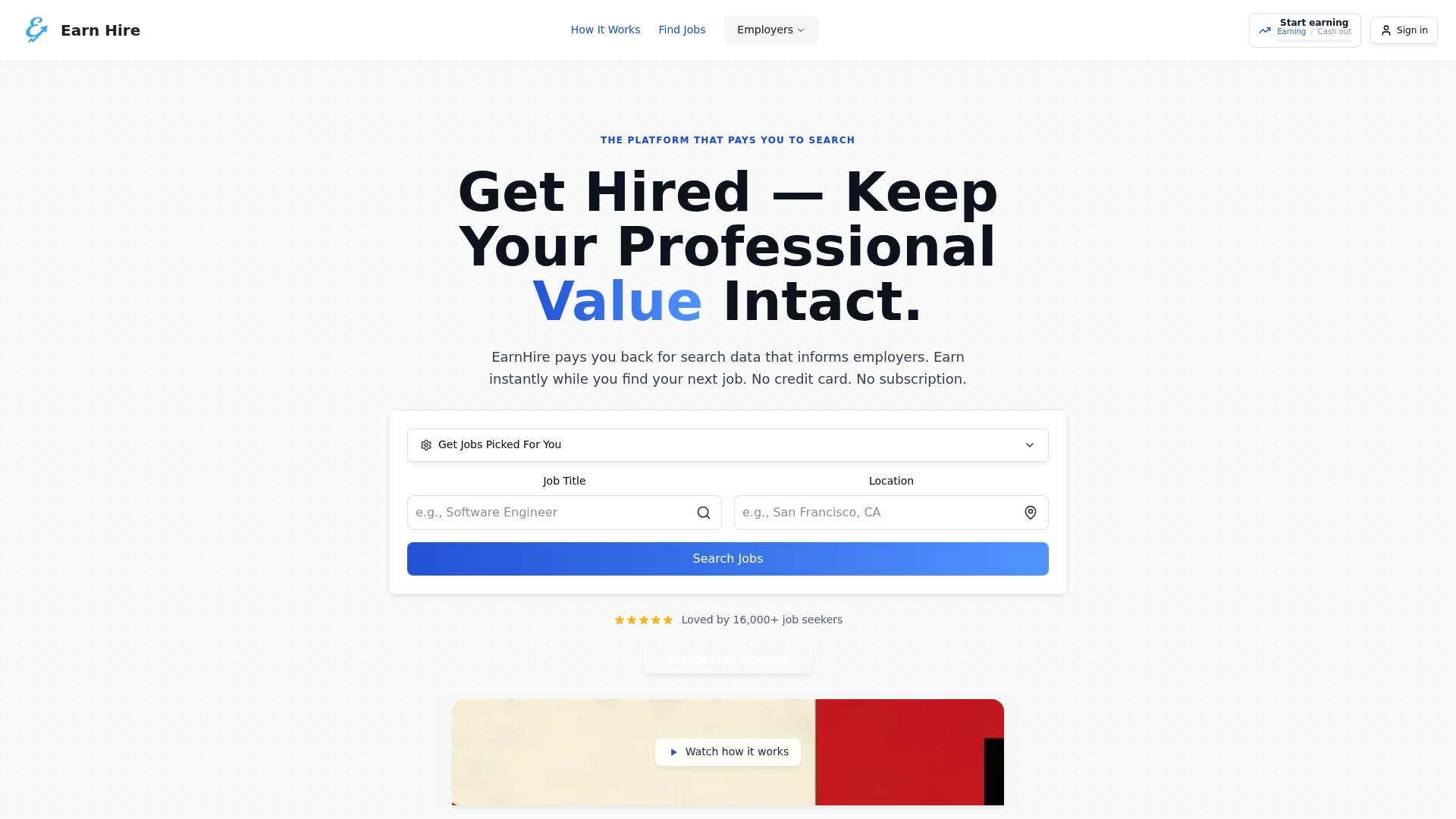
Earnhire's guided job search services are built to shorten your search timeline and improve your interview conversion rate. The AI resume tools help your application clear automated filters and reach the hiring manager. If you're a mid-career professional who wants your search effort to count for something beyond a stack of rejection emails, Earnhire's platform is where that work gets recognized and rewarded.
FAQ
What is job search ROI and how do you calculate it?
Job search ROI measures the financial and career return on the time, money, and effort you invest in finding a new role. The core formula subtracts your search costs from the value gained (salary increase, shorter gap, better role), then divides by costs.
What is a good application-to-interview rate for professionals?
A healthy application-to-first-interview rate is around 20%. Rates below 10% typically signal that your resume is not passing automated screening filters before a recruiter reviews it.
How much can coaching actually shorten a job search?
Professional reverse recruiting and coaching can compress a nine-month search to four months, saving five months of lost salary. At $10,000 per month, that equals $50,000 in recovered income, far exceeding typical coaching costs.
How many applications does it take to get an offer?
The average application-to-offer rate is about 2%, meaning roughly 50 applications produce one offer. Targeting roles with a 60%+ match rate and tracking your funnel metrics improves that rate significantly.
Why does tracking job search data improve ROI?
Tracking application outcomes after 20–30 submissions reveals which resume versions, job boards, and outreach methods produce real results. That data lets you cut low-return activities and concentrate effort on channels that actually convert.