
Job market signal data is defined as aggregated, deduplicated job posting information that acts as a forward-looking indicator of labor demand and employer priorities in real time. Unlike traditional labor statistics, this data captures operational hiring decisions before they appear in government reports or financial disclosures. Career professionals who understand job market signals gain a measurable edge. They can spot where industries are growing, which skills employers are prioritizing, and when companies are shifting strategy. That intelligence shapes smarter job searches and stronger career decisions.
What is job market signal data, and why does it matter?
Job market signal data is the industry term for real-time, deduplicated job posting information that reflects employer hiring behavior ahead of official labor statistics. The broader practice of reading and interpreting this data is called job market signal analysis. Together, they form the foundation of modern job market analytics.
The data matters because it moves faster than anything else in the labor market. Job posting activity acts as a forward-looking signal of labor demand, revealing shifts months before official statistics catch up. That gap between signal and official report is where career professionals can gain real advantage.

Bain & Company research shows that in early 2026, job postings contracted by 25% in France and 23% in the US compared to 2025, with sharp declines in research, design, and development roles. Those numbers appeared in posting data well before any government employment report confirmed the trend. For job seekers, that kind of early warning is the difference between reacting to a market shift and anticipating it.
Earnhire is built on this exact principle. Every search, save, and application on the platform generates data worth that reflects real labor market behavior, not just passive browsing.
How is job market signal data collected and processed?
The collection process starts with aggregation across multiple sources. Job postings appear on career sites, employer pages, niche boards, and general platforms simultaneously. A single role can appear across dozens of sources within hours of being posted.
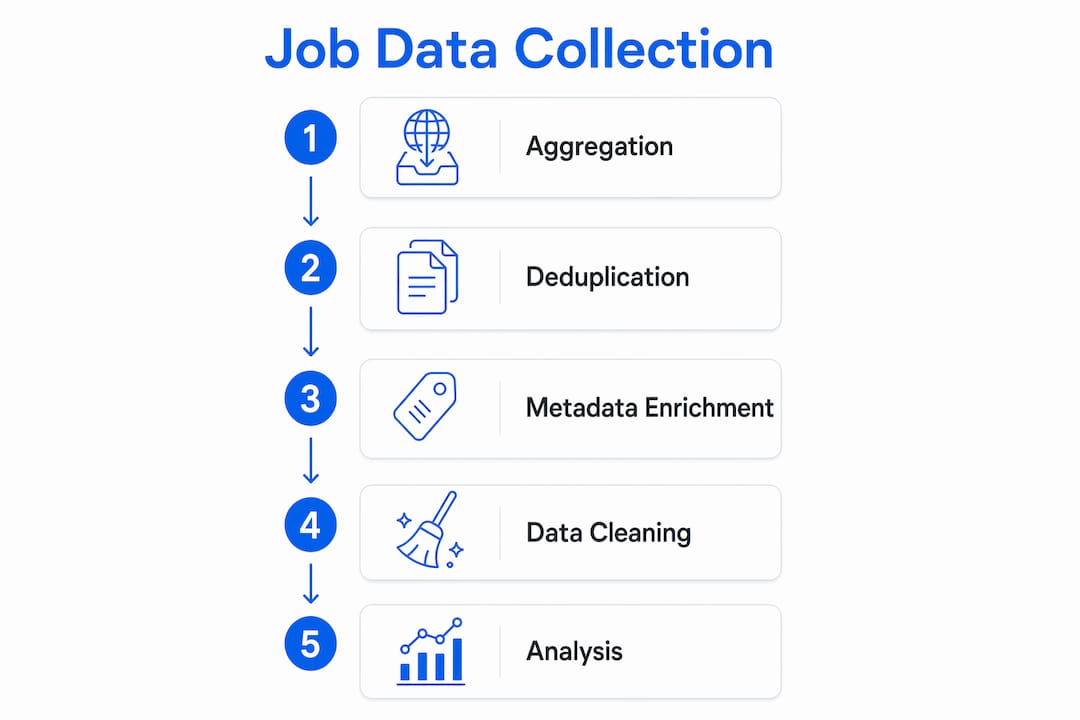
That multi-source reality creates a core problem: inflated vacancy counts. Professional platforms aggregate and deduplicate data from over 70,000 sources to produce a clean labor market view. Without deduplication, the same role counted three to five times skews every downstream insight. Deduplication is not optional. It is the baseline requirement for accurate job market analytics.
After deduplication, the data gets enriched with metadata. That enrichment process adds:
- Skill clusters: groups of required skills that reveal role function and industry alignment
- Seniority level: signals whether a company is in planning, execution, or scaling mode
- Geography: shows where hiring is concentrated or expanding
- Timing: tracks how long a role stays open and how frequently it gets reposted
Each metadata layer adds interpretive depth. A posting that stays open for 90 days tells a different story than one filled in two weeks.
Data cleaning is the final step, and it is where noise gets removed. Noise includes test postings, duplicate listings that survived deduplication, and roles with incomplete or contradictory metadata. Clean data produces reliable job market indicators. Dirty data produces false signals.
Pro Tip: When you analyze job market trends, always check whether the source deduplicated its postings. Platforms that skip this step routinely overcount vacancies by a wide margin.
What insights can job seekers gain from job market signal data?
Job postings are not just invitations to apply. They are operational commitments that reveal company strategy, budget priorities, and workforce direction. Reading them as signals rather than listings changes how you approach your entire job search.
Here is a practical framework for extracting career intelligence from posting data:
-
Track hiring velocity. A company posting five roles in the same function over 30 days is scaling that function. One posting in six months is filling a gap. Velocity tells you whether a company is growing or maintaining.
-
Read skill clusters. Shifts in required skills appear in postings before they show up in financial disclosures. If every data role in a sector suddenly requires machine learning experience, that skill has crossed from emerging to expected.
-
Analyze seniority patterns. Director and VP roles signal planning or market entry phases. Manager and individual contributor roles signal active scaling. High seniority postings at a company you are targeting tell you they are building architecture, not yet executing.
-
Look for three-clue clusters. Multiple corroborating openings, repeated skill requirements, and recurring internal initiative titles together form a high-confidence signal. A single isolated posting is low confidence. Three aligned signals pointing the same direction are worth acting on.
-
Assign confidence levels. Signals fall into three tiers: high confidence (multiple corroborating openings), medium confidence (sparse but persistent postings), and low confidence (isolated or novelty roles). Assigning confidence levels helps you prioritize where to focus your skills development and applications.
Pro Tip: Treat a company's job postings as a leaked roadmap. If you see a cluster of product, engineering, and go-to-market roles posted within the same 60-day window, that company is likely preparing a product launch or market expansion.
How does job market signal data differ from traditional labor reports?
Traditional labor market reports, like the U.S. Bureau of Labor Statistics monthly jobs report, measure what already happened. They rely on employer surveys, payroll records, and household interviews. The data collection, processing, and publication cycle takes weeks. By the time the report is public, the market has already moved.
Job market signal data operates differently. Employers' shifts in hiring volume and role composition signal strategic budget allocations weeks or months before public announcements. That is operational data, not sentiment data. It reflects actual decisions, not survey responses about how hiring managers feel about the economy.
The table below shows the core differences between the two data types:
| Dimension | Job market signal data | Traditional labor reports |
|---|---|---|
| Timeliness | Real-time or near real-time | Weeks to months delayed |
| Data source | Actual job postings | Employer surveys, payroll records |
| Type of insight | Operational hiring decisions | Aggregate employment trends |
| Predictive value | High, leads official stats | Low, confirms past activity |
| Granularity | Role, skill, seniority, location | Sector and occupation level |
The practical implication is clear. If you wait for official reports to confirm a trend, you are already late. Job market signal analysis gives you the same intelligence that investors and workforce planners use, applied to your own career decisions.
What are the most common mistakes when interpreting job signal data?
The biggest mistake job seekers make is treating every hiring spike as a growth signal. Academic research shows that increases in job postings are positively associated with future firm performance, but only when they indicate growth hiring rather than replacement. A company posting the same role repeatedly may be struggling with retention, not expanding its team.
Here are the most common misreads and how to avoid them:
- Assuming volume equals growth. High posting volume in a single role often signals turnover, not expansion. Cross-check against new role types appearing in the same company.
- Ignoring seniority context. A flood of entry-level postings without senior leadership roles suggests execution without strategy. That is a different signal than a company building out a new function from the top down.
- Overweighting novelty roles. Isolated or novelty job postings, unless at the senior executive level, often represent experiments. They do not confirm broader company direction.
- Reading one signal in isolation. A single data point is noise. A pattern across multiple postings, skills, and seniority levels is a signal worth trusting.
Pro Tip: Before you pivot your skills development based on a single job posting trend, wait for corroborating evidence. Look for the same skill appearing across at least three different companies in your target sector before treating it as a market-wide shift.
Key Takeaways
Job market signal data gives career professionals real-time, operational intelligence that traditional labor reports cannot match, making it the most practical tool for anticipating hiring trends and directing skill development.
| Point | Details |
|---|---|
| Definition of signal data | Deduplicated, real-time job posting data that reflects employer hiring decisions before official reports. |
| Deduplication is critical | Without it, vacancy counts inflate by 3–5x, producing misleading job market indicators. |
| Seniority reveals strategy | Director and VP postings signal market entry; manager and contributor roles signal active scaling. |
| Three-clue clusters matter | Multiple aligned signals (openings, skills, initiatives) produce high-confidence career intelligence. |
| Signal data beats traditional reports | Posting data leads official labor statistics by weeks or months, giving job seekers earlier insight. |
Why I think most job seekers are reading the market backward
Most job seekers wait for a job to appear, then decide whether to apply. That is backward. The real question is: what is the market telling you before the posting even goes live?
I have watched professionals use job board data the way investors use earnings calls. They track which functions a company is building out, which skills keep appearing across competitors, and which seniority levels are clustering in a given sector. That intelligence shapes their upskilling decisions six months before a role opens.
The professionals who do this consistently are not lucky. They are reading signals that everyone else ignores. When a sector starts posting VP-level roles in a new function, that is a 90-day warning that execution roles are coming. If you have already built the relevant skills, you are first in line.
The gap between job seekers who use signal data and those who do not is growing. Official reports confirm trends. Signal data predicts them. The career professionals who treat job search as market research will consistently outpace those who treat it as a reactive process.
— Eric
How Earnhire helps you act on job market signals
Earnhire is built for job seekers who want their search to mean something beyond the next application.

Every action you take on Earnhire, from saving a role to tailoring your resume, generates data worth that reflects real hiring behavior. The platform's AI-powered tools help you read job market indicators, match your skills to emerging role clusters, and build a career profile that stays relevant between transitions. The guided job search feature uses real-time posting data to help you target roles with precision, while the resume tools align your application to the exact skills employers are signaling right now. Your search effort builds professional value. That is the Earnhire difference.
FAQ
What is job market signal data in simple terms?
Job market signal data is aggregated, deduplicated job posting information that shows where employers are hiring, what skills they need, and how their workforce priorities are shifting in real time.
How is job market signal data different from a job board?
A job board lists individual postings. Job market signal data aggregates, deduplicates, and enriches thousands of postings across sources to reveal patterns, trends, and strategic hiring behavior that no single listing shows.
Can job seekers actually use job market signal data?
Yes. Job seekers use it to identify high-growth companies, track emerging skill demand, and time their applications to match hiring velocity. Platforms like Earnhire make this data accessible through guided search and AI-powered job analysis tools.
What does hiring velocity tell you about a company?
Hiring velocity measures how quickly and frequently a company posts roles in a given function. High velocity in a new function signals active scaling. Repeated postings for the same role often signal retention problems rather than growth.
How do you assign confidence levels to job market signals?
Confidence levels reflect how many corroborating signals align. Multiple openings, repeated skill requirements, and recurring initiative titles together produce a high-confidence signal. A single isolated posting is low confidence and should not drive career decisions alone.