
Common hidden fees on job search platforms include subscription charges, premium upsells, ghost job listings, and indirect costs like lost benefits that can push your total job search expense well past $20,000. Most job seekers focus on the obvious costs and miss the ones that quietly drain their savings over weeks and months. The fees associated with job apps go far beyond a monthly credit card charge. Recognizing the full picture is the first step toward protecting your budget and shortening your search.
What are the common hidden fees on job search platforms?
Job platform fees fall into two categories: direct charges you can see and indirect costs you feel later. Direct fees include monthly subscriptions, pay-per-feature upgrades, and premium access tiers. Indirect costs include the financial damage from wasted time, ghost job listings, and lost employer benefits.
The most common direct charges on premium platforms run $30 to $70 monthly. That range reflects the gap between entry-level career tiers and full business access. Specialized niche platforms often charge around $15 monthly, which sounds affordable until you subscribe to three or four at once.

Most job seekers do not realize how quickly these fees stack up. A three-month search with two active subscriptions costs $180 to $420 before you factor in a single premium feature purchase.
Pro Tip: Before subscribing to any premium tier, list the specific features you plan to use weekly. If you cannot name three, the free tier is probably enough.
Subscription tiers and what they actually include
Premium subscriptions typically bundle several features:
- Resume critique tools: Automated scoring and feedback on your resume's keyword match rate
- InMail credits: Direct messages to recruiters outside your network
- Job match alerts: Priority notifications for new postings
- Applicant insights: Data showing how your profile compares to other applicants
- Learning access: Courses tied to career development
The problem is that most job seekers use only one or two of these features regularly. Paying for a full tier to access a single tool is a common and avoidable mistake.
How ghost jobs and dark patterns create hidden costs
Ghost jobs are real job listings that companies post without any intention of filling them soon, or ever. Approximately 38% of U.S. job postings are ghost jobs. That means nearly four out of ten applications you send may never reach a real hiring decision.
Ghost jobs extend your search by two to four weeks on average. At a typical professional salary, that delay translates to $4,600 to $9,200 in lost gross income. The time cost alone makes ghost jobs one of the most expensive hidden fees in the job search process.
Dark patterns compound the problem. These are interface design tricks that push you toward paying or sharing data without realizing it. Platforms use fake urgency timers and hidden subscription prompts to increase revenue at your expense. Some platforms also push resumes through ATS systems that are incompatible with your formatting, causing a nearly 40% automatic rejection rate.
| Dark pattern | What it does | How to avoid it |
|---|---|---|
| Fake urgency timers | Pressures you to apply or upgrade immediately | Ignore countdown clocks; verify posting date manually |
| Hidden subscription prompts | Buries opt-out options during sign-up | Read every checkbox before submitting |
| ATS-incompatible templates | Causes automatic resume rejection | Use plain text or ATS-tested formats |
| Pre-checked data sharing | Shares your data with third parties by default | Uncheck all pre-selected boxes |
| Ghost job listings | Wastes application time on unfillable roles | Check posting age; avoid listings older than 30 days |
Recognizing these patterns before they cost you time or money is a skill worth building early in your search. The job seeker data exploitation problem runs deeper than most people expect.
What are the broader financial costs of a long job search?
The indirect costs of a prolonged search are where the real financial damage happens. Lost employer benefits add $10,000 to $23,000 to your total job search cost over six months. COBRA health insurance alone runs $600 to $2,000 per month, and that does not include lost retirement contributions or employer-matched savings.
Savings depletion is widespread. 55.6% of job seekers deplete personal savings during an extended search. That is more than half of all active job seekers burning through their financial cushion while paying platform fees on top of living expenses.
Extended search duration compounds costs through lost benefits, interest payments on debt, and reduced future earning power. These indirect costs often exceed simple subscription fees many times over.
Debt is the next layer. 37.8% of job seekers take on credit card debt during their search. Credit card interest at 20% to 25% APR turns a $3,000 balance into a long-term financial burden that outlasts the job search itself.
The opportunity cost of unpaid search labor adds another layer. 46+ hours of unpaid application work combined with lost benefits produces an estimated $10,000 to $15,000 in total opportunity cost. That figure does not include subscription fees or premium service purchases.
- Lost health insurance: $600–$2,000/month via COBRA
- Lost retirement contributions: varies by employer match
- Credit card interest: compounds monthly on search-related debt
- Unpaid application labor: 46+ hours average per successful placement
- Delayed career progression: reduced future earning power
Pro Tip: Calculate your monthly "search burn rate" by adding COBRA costs, subscription fees, and living expenses. Knowing your exact number creates urgency to shorten the search, which is the most effective cost-reduction strategy available.
Are premium career services worth the cost?
Premium services like career coaching, AI resume tools, and platform upgrades promise faster placement. The reality is more complicated. Experts consistently find that free networking and resume improvements yield better returns than costly premium subscriptions for most job seekers.
LinkedIn Premium is the most widely purchased upgrade. The Career tier costs $39.99/month and includes five InMail credits, which works out to $8 per message. The Business tier at $69.99/month includes 15 credits at $4.66 each. If you send fewer than five InMails per month, the per-message cost is high relative to the outcome.
The one exception worth noting: LinkedIn Learning access may justify the subscription if you would otherwise pay for those courses separately. That is a legitimate ROI calculation, not a marketing claim.
| Service category | Typical monthly cost | Best for | Likely ROI |
|---|---|---|---|
| Platform premium tier | $30–$70 | High-volume networkers | Low to moderate |
| AI resume tools | $15–$30 | ATS-heavy application processes | Moderate |
| Career coaching | $100–$300/session | Senior or executive transitions | High if targeted |
| Niche job board access | $15–$20 | Specialized industries | Moderate |
| Free networking | $0 | All job seekers | High |
The pattern is clear. Free tools and direct networking outperform paid upgrades for most professionals. Investing in a strong resume before purchasing any premium access is the highest-return move you can make. Use the platform comparison checklist to evaluate any platform before committing money.
How to avoid hidden job search fees
The best defense against hidden costs is a clear vetting process before you sign up for anything. Here is what that looks like in practice:
- Check the cancellation policy first. If canceling requires a phone call or a multi-step process, that is a dark pattern signal.
- Use free tiers for the first 30 days. Most platforms reveal their value within a month without requiring payment.
- Audit your active subscriptions monthly. Job seekers often forget about subscriptions that auto-renew.
- Verify job posting dates. Listings older than 30 days have a significantly higher ghost job rate.
- Prioritize platforms that are transparent about fees. If pricing requires three clicks to find, that is intentional.
- Use community resources. LinkedIn groups, professional associations, and Reddit communities provide job leads at no cost.
- Shorten your search duration. Every week you cut from your search saves more money than any subscription cancellation.
Job boards primarily serve employers as their paying customers. Job seekers are the product, not the client. Keeping that dynamic in mind helps you evaluate every platform decision with clearer eyes.
Pro Tip: Set a hard monthly budget for job search tools before you start. Treat it like a business expense with a cap. When you hit the cap, stop adding subscriptions and focus on free channels.
Key Takeaways
The most effective way to reduce job search costs is to shorten your search duration, not to cancel subscriptions after the damage is done.
| Point | Details |
|---|---|
| Direct fees add up fast | Premium subscriptions run $30–$70/month; multiple platforms multiply costs quickly. |
| Ghost jobs waste real money | 38% of listings are ghost jobs, costing 2–4 weeks and up to $9,200 in lost income. |
| Indirect costs dwarf subscription fees | Lost benefits and debt can exceed $23,000 over a six-month search. |
| Free tools often outperform paid ones | Networking and resume quality improvements deliver better ROI than most premium tiers. |
| Shorter searches save the most | Cutting search time by even two weeks saves more than canceling any single subscription. |
What I've learned watching job seekers pay for platforms that pay them nothing
I've spent years watching professionals make the same mistake. They sign up for three premium platforms in the first week of their search, convinced that more access equals faster results. Six weeks later, they've spent $400 on subscriptions and haven't landed a single interview.
The uncomfortable truth is that most job platforms are not designed to help you get hired faster. They are designed to keep you subscribed longer. Ghost jobs, dark patterns, and premium upsells all serve the platform's revenue model, not your career goals. Job boards treat seekers as unpaid data sources, not as customers.
What actually works? A strong resume, direct outreach to hiring managers, and consistent networking in your industry. These cost nothing but time, and they produce results that no InMail credit can replicate.
My advice: spend your first week auditing every platform you are considering. Read the cancellation terms. Check the posting dates. Calculate your monthly burn rate. Then make a deliberate decision about where your money goes, rather than letting platform design make it for you.
The job seekers who navigate this well are not the ones who spend the most. They are the ones who stay informed, stay strategic, and refuse to let urgency timers and ghost listings dictate their decisions.
— Eric
Earnhire helps you search smarter, not more expensively
Most job platforms charge you to search and give nothing back. Earnhire works differently. Every application, save, and tailored resume you complete on Earnhire builds your data worth, the professional signal that employers use to make informed hiring decisions.
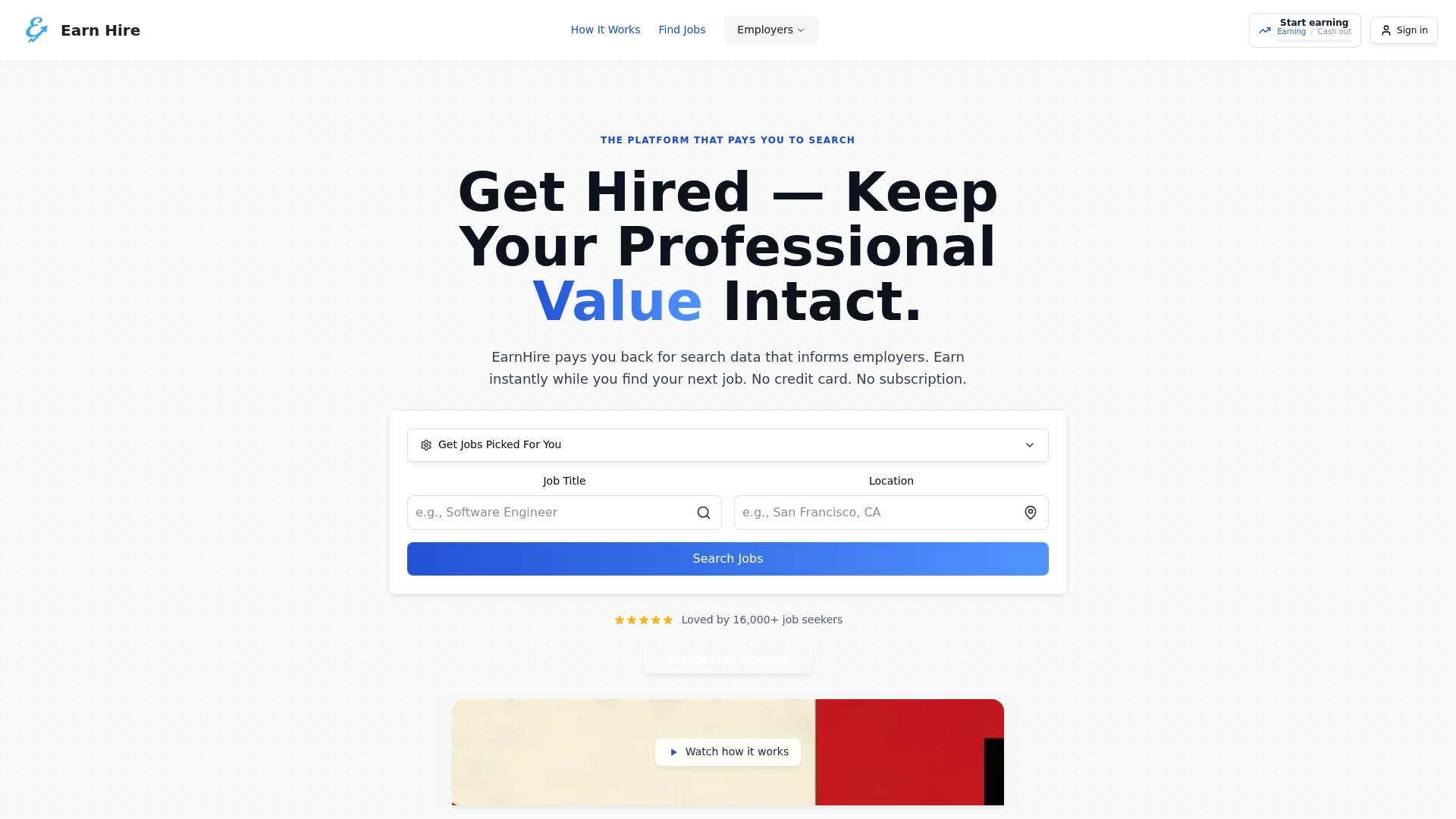
Earnhire's AI-powered resume tools help you clear ATS filters without paying for a third-party service. The guided job search keeps your search focused and efficient, reducing the weeks of wasted effort that drive up indirect costs. You preserve your career identity between roles and stay competitive without burning through savings on subscriptions that serve the platform more than they serve you. Start your search on Earnhire and make every hour count.
FAQ
What are the most common hidden fees on job search platforms?
The most common hidden costs include monthly subscription tiers ($30–$70), pay-per-feature charges like InMail credits, and indirect costs from ghost job listings that extend your search by two to four weeks.
Are job search platform fees worth paying?
Premium subscriptions deliver limited ROI for most job seekers. Free networking and a strong resume consistently outperform paid platform upgrades in placement outcomes.
How do ghost jobs increase my job search costs?
Ghost jobs waste application time on listings that will never be filled. That lost time extends your search by two to four weeks, costing up to $9,200 in lost gross income at an average professional salary.
How can I avoid unintentional subscription charges on job apps?
Read every checkbox during sign-up, check cancellation policies before subscribing, and audit your active subscriptions monthly to catch auto-renewals before they compound.
What is the total financial cost of a six-month job search?
Lost employer benefits alone add $10,000 to $23,000 over six months. Combined with subscription fees, credit card debt, and unpaid application labor, the total cost for a typical professional search runs well above $20,000.