
Your professional data worth is defined as the measurable body of evidence you create, document, and present to prove your value to employers. It goes beyond credentials and job titles. It is the record of real problems you solved, tools you used, and outcomes you delivered. Job seekers who build data worth as a job seeker gain a concrete advantage: they walk into interviews with proof, not just promises. This article covers the skills, projects, resume tactics, and negotiation moves that turn your search into a career asset.
What does it mean to build data worth as a job seeker?
Data worth, in professional terms, is the collection of documented, quantified contributions that signal your readiness to deliver results. Think of it as your professional track record made visible and searchable. A hiring manager cannot measure "team player" or "hard worker." They can measure "reduced reporting time by 40% using SQL and Tableau." That gap between vague claims and specific evidence is exactly where data worth lives.
The concept overlaps with what career coaches call a "brag document," a running log of wins, tools used, and impact delivered. The difference is that data worth is designed to travel. It lives in your portfolio, your resume, your LinkedIn profile, and increasingly in AI-powered personal presentations. Employers hire for results, not just experience, which means your job is to make your results impossible to ignore.
Building this kind of professional equity is not a one-time task. You add to it with every project, every role, and every skill you pick up. The job seekers who treat it as ongoing documentation, rather than a last-minute resume update, are the ones who negotiate from strength.

What data skills and tools matter most for job seekers?
The technical foundation of data worth starts with four tools: SQL, Excel, Tableau, and Python. SQL appears in 97% of data analyst job postings, making it the single most critical skill to learn first. That number tells you something direct: if you cannot write a SQL query, you are invisible to a large portion of the market.
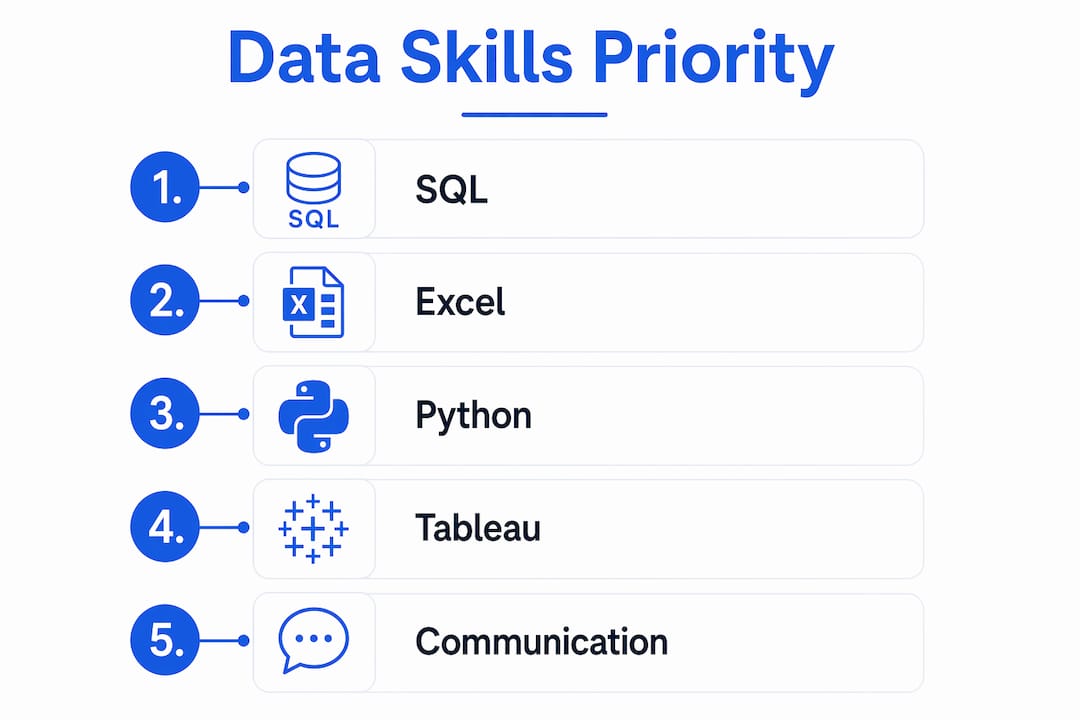
Excel is not optional either. Over half of data analyst postings list Excel as a core competency, which means it is a baseline expectation, not a differentiator. Python and Tableau round out the core stack, with Python especially valuable for automation, data cleaning, and building repeatable workflows. Learning SQL and Excel first, then adding Python or a BI tool based on your target role, is the most efficient path.
Here is a quick view of the skill categories and their demand signals:
| Skill category | Key tools | Why it matters |
|---|---|---|
| Query and database | SQL, PostgreSQL | Appears in nearly all data roles |
| Spreadsheet analysis | Excel, Google Sheets | Baseline for most business roles |
| Visualization | Tableau, Power BI | Communicates findings to non-technical teams |
| Programming | Python (pandas, NumPy) | Automates analysis and builds pipelines |
| Storytelling | Slide decks, written reports | Translates data into decisions |
Technical skills alone do not close the deal. Hiring managers want candidates who can explain what the numbers mean to a business audience. The ability to pair a SQL query with a clear business narrative is what separates a data technician from a data-driven professional.
Pro Tip: Pick one tool from each row of the table above and build one project with it. Four projects, four tools, four proof points. That is a portfolio.
How do you create projects that showcase your data worth?
Projects are the most credible form of evidence you can present. A certificate says you completed a course. A project says you solved a real problem. The distinction matters to hiring managers who review dozens of applications a day.
Start by choosing a problem that is specific and relevant to the roles you want. Do not build a generic sales dashboard. Build a dashboard that analyzes a real dataset from your industry, identifies a pattern, and recommends an action. The more specific the problem, the more it signals domain knowledge.
Document your work before you write a single line of code. Writing a README that describes the problem, who it is for, the key decisions you made, and what you learned signals seniority in a way that clean code alone never will. Hiring managers and senior engineers look for evidence of thinking, not just execution.
A portfolio that explains why you made each decision is worth more than one that only shows what you built. Reflection and rationale are the signals that separate junior candidates from those ready for senior responsibility.
When you present each project, lead with the business impact. A "Key Facts" box at the top of each project page lets a hiring manager grasp your value in ten seconds. Include the problem, the tool you used, and the measurable outcome. That structure respects their time and puts your strongest evidence first.
- Pick a real problem. Use public datasets from your target industry or document a workflow you improved in a past role.
- Write the README first. Describe the problem, your approach, your decisions, and what you would do differently.
- Quantify the outcome. Reduced processing time, improved accuracy rate, or revenue impact are all fair game.
- Add a visual. A chart or dashboard screenshot makes the project scannable and memorable.
- Publish it. GitHub, a personal site, or a PDF portfolio all work. The key is that it is accessible with one click.
Pro Tip: Use the X-Y-Z formula for every project summary: "Accomplished [X], measured by [Y], by doing [Z]." It forces you to be specific and gives recruiters a ready-made talking point.
How do you optimize your resume and LinkedIn profile to express data worth?
Your resume is not a narrative. It is a query system. Resumes that align closely with job description keywords and present structured evidence outperform those written as flowing prose. That means reading the job posting carefully, pulling the exact terms used, and matching them with your documented evidence.
Here is what strong data-worth bullet points look like:
- Weak: "Worked with data to improve reporting processes."
- Strong: "Built automated SQL reports in Tableau, cutting weekly reporting time from 6 hours to 45 minutes for a team of 12."
The difference is specificity. The strong version names the tools, quantifies the impact, and identifies the scope. Using the X-Y-Z accomplishment formula and action verbs like "built," "reduced," "automated," and "delivered" makes each bullet a standalone proof point.
AI tools now make resume tailoring faster and more precise. AI-powered tailoring reduces the time spent customizing applications from hours to minutes, and tailored resumes consistently outperform generic ones in recruiter screening. That means you can apply to more roles with stronger applications in less time. Earnhire's resume tailoring tools are built specifically for this workflow, helping you match your documented skills to each posting without starting from scratch.
On LinkedIn, treat your "About" section as a structured summary of your data worth. List your tools, your industries, and your top two or three quantified outcomes. Recruiters search LinkedIn the same way they search a database, so your profile needs to return the right results for the right queries.
How do you use your data worth to negotiate better opportunities?
Documented data worth changes the negotiation dynamic. You are no longer asking an employer to trust your potential. You are showing them a record of past results and asking them to pay for proven performance. That is a fundamentally stronger position.
- Lead with your portfolio in interviews. Before salary comes up, walk the interviewer through one or two projects. Show the problem, the tool, and the outcome. This establishes your value before the number is on the table.
- Connect transferable skills to business outcomes. Transferable skills linked to specific business results help you move into adjacent roles without needing an exact title match. Frame your SQL experience as "cost reduction" or your Python work as "process automation" depending on the role.
- Use microcredentials as gap-fillers. A Google Data Analytics certificate or a Tableau certification signals commitment and fills skill gaps that your portfolio might not yet cover.
- Present your data worth as intellectual property. Your documented projects, your GitHub repository, and your portfolio travel with you between roles. They are yours. That permanence is a negotiating signal: you bring a body of work, not just a resume.
Pro Tip: Before any salary negotiation, pull three bullet points from your portfolio that show direct business impact. Anchor the conversation there. Numbers give you ground to stand on.
Earnhire's guided job search experience helps you track your applications and surface the data points that matter most when you are ready to negotiate. Every search action you take on Earnhire builds a record of your professional engagement, which you can use to demonstrate focus and intent to employers.
Key Takeaways
Building and presenting data worth is the most direct path from job seeker to hired candidate, because employers pay for proven results, not potential.
| Point | Details |
|---|---|
| Define your data worth | Document measurable outcomes from past roles and projects, not just job titles or responsibilities. |
| Master the core skill stack | SQL, Excel, Python, and Tableau cover the majority of data-related job postings in 2026. |
| Build projects with intention | Write the README before you code; explain your decisions and quantify your results. |
| Treat your resume as a query | Match job description keywords with structured evidence using the X-Y-Z formula. |
| Negotiate with proof | Lead interviews with portfolio results to anchor salary conversations in documented impact. |
Why "show, don't tell" is the only career advice that ages well
I have reviewed a lot of job search advice over the years, and most of it circles back to the same frustrating loop: update your resume, network more, apply to more jobs. That advice is not wrong. It is just incomplete. What it misses is the underlying problem: most job seekers have no concrete evidence to show.
The professionals I have seen negotiate the best offers are not always the most credentialed. They are the ones who walk in with a portfolio, a GitHub repository, or even a simple PDF that says, "Here is a problem I solved, here is how I solved it, and here is what it was worth to the business." That specificity does the heavy lifting.
What I find most interesting is how AI tools have changed this. You can now use AI to build an interactive personal website or a chatbot that walks a recruiter through your work. That is not a gimmick. It is a signal that you understand how to use modern tools to solve real problems, which is exactly what employers are hiring for.
The mistake most job seekers make is treating data worth as a one-time project. Build the portfolio, get the job, move on. The professionals who consistently earn more treat it as ongoing documentation. Every project, every result, every tool you learn adds to a record that compounds over time. Start now, document everything, and let the evidence speak.
— Eric
Earnhire helps you put your data worth to work
Building your professional data worth is only half the equation. The other half is making sure the right employers see it at the right moment.
Earnhire is built for exactly this. Every application you submit, every resume you tailor, and every job you analyze on the platform adds to a record of your professional engagement. Earnhire's AI-powered tools help you match your skills to job postings quickly, so your documented data worth lands in front of hiring managers in the most relevant form. You can also explore data-driven job search strategies to sharpen how you present your evidence across every application. Your search is work. Earnhire makes sure it counts.
FAQ
What is data worth for a job seeker?
Data worth is the measurable, documented record of skills, projects, and business outcomes a job seeker presents to prove their professional value. It replaces vague claims with specific, quantified evidence that employers can evaluate.
Which data skills should I learn first?
SQL appears in 97% of data analyst job postings, making it the highest-priority skill to learn. Add Excel next, then Python or Tableau based on your target role.
How do I showcase data skills without work experience?
Build portfolio projects using public datasets, document your process in a README, and publish your work on GitHub or a personal site. Quantified project outcomes carry real weight with hiring managers even without formal job history.
Does tailoring my resume actually improve my chances?
Yes. AI-powered resume tailoring reduces customization time and consistently improves interview rates compared to generic applications. Matching your resume to the exact language in a job posting makes you more discoverable to both ATS systems and recruiters.
How do I use my data worth in salary negotiations?
Lead with your portfolio before salary comes up. Present two or three projects with quantified business impact, then anchor your compensation ask to those results. Transferable skills tied to business outcomes give you a concrete basis for negotiating above the posted range.