
A data-backed resume is defined as one that quantifies your achievements and mirrors the exact language of a job posting, making it the most effective tool for passing automated filters and earning interviews. Understanding how data-backed resumes win jobs is no longer optional. Recruiters spend seconds on each resume, and applicant tracking systems (ATS) screen most candidates before a human ever reads a word. Jobscan data shows that matching exact job titles on your resume improves interview chances by 10.6x. That single number tells you everything about the gap between a generic resume and a targeted one.
How do ATS systems decide which resumes get seen?
ATS software scans your resume for keywords that match the job description. If your resume does not contain the right terms, it gets filtered out before any recruiter sees it. This is not a flaw in the system. It is the system working exactly as designed.
Keyword matching is the foundation of ATS visibility. The most direct way to pass these filters is to mirror the exact language in the job posting, including job titles, required skills, and tool names. A job description that says "data visualization" needs those exact words on your resume, not "chart creation" or "reporting."

Formatting matters just as much as word choice. ATS systems cannot read keywords placed inside images, graphics, or complex tables. If your resume design buries critical terms in a header graphic or a styled sidebar, those words are invisible to the scanner. Keep all keyword-critical content in plain, indexable text.
Here is what ATS-compatible formatting looks like in practice:
- Use standard section headings like "Work Experience," "Skills," and "Education"
- Place your job title, employer name, and dates in plain text, not inside a table
- Avoid text boxes, columns, and decorative graphics in the main body
- Save PDF formatting only if the job posting explicitly accepts it; otherwise use .docx
Pro Tip: Paste the job description and your resume into a keyword scanning tool to see your match rate before you apply. A match rate below 60% is a signal to revise.
What metrics and achievements should you quantify?
The core principle from Duke University's Career Hub is direct: a data resume should demonstrate problem-solving with measurable outcomes, not just list the tools you used. Saying you "used Python" tells a recruiter nothing. Saying you "built a Python pipeline that cut reporting time by 40%" tells them exactly what you are worth.
The distinction matters because recruiters and hiring managers are looking for evidence of impact. Anyone can list a tool. Fewer candidates can show what changed because of their work. That gap is where you win.
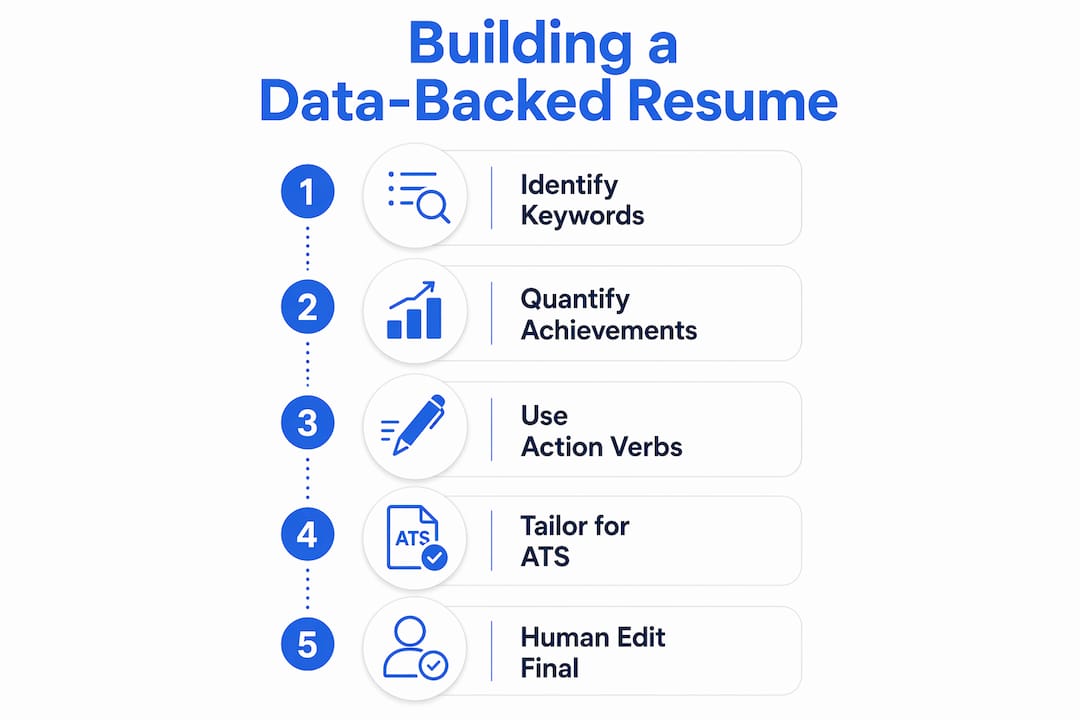
Duke University also recommends converting technical bullet points into outcome statements using metrics like adoption rate, cycle time, cost reduction, or revenue growth. The formula is simple: action verb + what you did + measurable result.
Common quantifiable achievements by job function:
- Sales: Revenue generated, quota attainment percentage, new accounts closed
- Operations: Cost savings, process time reduced, error rate decreased
- Marketing: Campaign ROI, lead volume increase, cost per acquisition
- Engineering: System uptime improved, deployment frequency, bug resolution time
- Data and analytics: Model accuracy, data processing speed, dashboard adoption rate
- Customer success: Retention rate, NPS score improvement, ticket resolution time
Every bullet point on your resume should answer one question: what changed because you were there?
Does human editing outperform AI-generated resumes?
Professionally written resumes produce callback rates 20–30% higher than resumes generated by AI alone. That gap exists because modern ATS systems have moved beyond simple keyword matching. They now use semantic search to evaluate context, relationships between terms, and the overall coherence of your experience narrative.
AI tools are good at generating keyword-dense text. They are not good at explaining a career gap, contextualizing a lateral move, or emphasizing the one project that makes you the right fit for a specific role. Human judgment does that work.
A resume that reads like a keyword density exercise is easy to spot. Recruiters see hundreds of them. The ones that get callbacks tell a coherent story, lead with the most relevant experience, and use numbers to back up every claim.
Here is what human editorial judgment adds that AI alone cannot:
- Contextual framing of gaps or non-linear career paths
- Emphasis on the most relevant experience for a specific role
- Natural language that reads well to both scanners and humans
- Judgment about what to leave out, not just what to include
Pro Tip: Use AI to generate a first draft and identify keyword gaps. Then rewrite every bullet point yourself to add context, specificity, and a clear outcome.
What practical steps build a winning data-driven resume?
Tailored resumes generate roughly twice as many interview opportunities as generic ones. That finding alone should change how you approach every application. A resume you send to 50 jobs without changing it is not a resume. It is a form letter.
Here is a step-by-step process for building a resume that performs:
- Pull the job description apart. Copy every required skill, tool, and job title into a separate document. These are your target keywords.
- Check your current resume against those terms. Identify gaps between what the posting requires and what your resume currently says.
- Reorder your skills section. Put the skills most relevant to this specific role at the top. Recruiters scan from the top down.
- Rewrite your bullet points using the outcome formula. Action verb + task + measurable result. Every single bullet.
- Add a brief project section if your work history is thin. Include the tools used, the problem solved, and the result achieved.
- Run a final keyword scan. Use a tool like Jobscan to confirm your match rate before submitting.
Action verbs and quantified accomplishments are the two elements that most consistently attract recruiter attention. Flat language like "responsible for" or "helped with" signals passivity. Verbs like "reduced," "built," "increased," and "led" signal ownership.
The table below shows the difference between weak and strong resume language:
| Weak phrasing | Strong phrasing |
|---|---|
| Responsible for data analysis | Analyzed sales data to identify $200K in cost savings |
| Helped with marketing campaigns | Led email campaign that increased open rates by 35% |
| Worked on software development | Built API integration that reduced load time by 50% |
| Assisted with customer onboarding | Onboarded 120 enterprise clients with 94% retention rate |
Avoid vague statements, non-ATS-friendly formatting, and any bullet point that does not answer "so what?" Those are the three most common reasons a strong candidate gets filtered out.
Key Takeaways
Data-backed resumes win jobs by combining exact keyword alignment with quantified achievements and human editorial judgment to pass ATS filters and compel recruiters to act.
| Point | Details |
|---|---|
| Match job titles exactly | Matching exact job titles improves interview chances by 10.6x, per Jobscan. |
| Quantify every achievement | Convert tool-based descriptions into outcome statements with real metrics. |
| Keep keywords in plain text | ATS systems cannot read keywords inside images, tables, or graphics. |
| Tailor every application | Tailored resumes generate roughly twice as many interviews as generic ones. |
| Human editing closes the gap | Professionally written resumes produce callback rates 20–30% higher than AI-only versions. |
What I have learned after watching thousands of resumes succeed and fail
Here is the uncomfortable truth: most job seekers treat their resume as a static document. They write it once, maybe update it when they change jobs, and send the same version everywhere. That approach was marginal ten years ago. In 2026, it is a near-guarantee of silence from employers.
I have watched candidates with genuinely strong experience get filtered out because they described their work in the wrong language. A project manager who wrote "coordinated cross-functional teams" got ignored. The same candidate, after rewriting to "led 8-person product team that shipped a $1.2M feature on time and under budget," started getting calls within a week. The work did not change. The signal did.
The other mistake I see constantly is over-reliance on AI-generated resumes without any editing. AI tools are useful for a first pass. They are not useful for the judgment calls that make a resume feel like a real person wrote it. Recruiters can tell the difference. The resumes that read like they were assembled from a template get treated like templates.
My honest advice: treat your resume as a living document you revise for every serious application. Keep a master version with every achievement and metric you have ever produced. Then pull from that master to build a targeted version for each role. It takes 20 minutes per application. It is the highest-return activity in your job search.
The job seekers who win are not the ones with the most impressive backgrounds. They are the ones who communicate their value most clearly. Data does that better than anything else.
— Eric
How Earnhire helps you build resumes that get results
Job searching is work. Earnhire is built on that premise. The platform gives you AI resume tailoring tools that help you align your resume with specific job postings, identify keyword gaps, and reframe your achievements with the kind of specificity that ATS systems and recruiters both respond to.
Every tailored resume you build on Earnhire adds to your data worth, the professional signal that informs employers about your fit before they even speak to you. The guided job search service pairs you with structured support to customize your resume for each application, so your effort compounds instead of disappearing into the void. If you are serious about your next role, start with Earnhire and put your search to work.
FAQ
What makes a resume "data-backed"?
A data-backed resume quantifies your achievements with real metrics and mirrors the exact language of the job posting. It demonstrates impact, not just activity.
How do I know if my resume will pass ATS filters?
Run your resume against the job description using a keyword scanning tool like Jobscan. A strong match rate and plain-text formatting are the two biggest factors in ATS visibility.
How many jobs should I tailor my resume for?
Tailor your resume for every role you take seriously. Tailored applications generate roughly twice as many interviews as generic submissions, making the extra effort worthwhile.
Does using AI to write my resume hurt my chances?
AI-only resumes produce lower callback rates than professionally written ones. Use AI as a drafting tool, then rewrite with human judgment and specific outcomes.
What is the single most effective change I can make to my resume?
Replace every vague responsibility statement with an outcome-focused bullet point that includes a measurable result. That one change consistently produces the largest improvement in recruiter response rates.