
Positioning board experience well in your job search is the single most reliable way to separate yourself from candidates who hold similar titles but cannot prove leadership impact. Most professionals treat board roles as a footnote on their resume when they should be the headline. The gap between those who get callbacks and those who don't often comes down to how clearly they translate governance, oversight, and strategic direction into language that recruiters and applicant tracking systems (ATS) actually recognize. This article gives you a concrete system: how to frame your career position experience, which platforms to use, and how to combine job boards with direct outreach for maximum results.
How to position board experience in your job search on a resume and LinkedIn
Positioning board experience starts with language alignment. Mirroring keywords from job descriptions is the most direct way to bypass ATS filters and get your resume in front of a human recruiter. If the job description says "board governance," "fiduciary oversight," or "executive committee leadership," those exact phrases need to appear in your resume. Generic terms like "served on board" or "board member" will not trigger ATS matches for senior roles.
The structure of your resume matters as much as the words. Hiring managers want to see outcomes from board positions, not just titles. Instead of writing "Board Member, XYZ Nonprofit," write "Board Member, XYZ Nonprofit: Led audit committee review that reduced financial risk exposure by 40% over two years." That one sentence signals accountability, scope, and measurable result. It's the difference between a resume that gets filed and one that gets a call.

On LinkedIn, your headline and summary are doing more work than most people realize. Your headline should not just say "Board Member" or "Executive Director." It should say something like "Board Director | Governance, Risk & Strategic Growth | Open to Executive Leadership Roles." Your summary should open with your strongest board-level outcome in the first two lines, because that's all most recruiters see before clicking "see more."
Here's what to cover when structuring your board experience section:
- Quantify every outcome. Use numbers, percentages, or dollar figures wherever possible.
- Name the committee or subcommittee. Audit, compensation, and nominating committees signal specific expertise.
- State the organization's size or sector. "Board Member, $50M regional healthcare nonprofit" tells a recruiter far more than just the title.
- Use governance vocabulary. Words like "fiduciary," "strategic oversight," "policy development," and "stakeholder accountability" are recognized signals for senior roles.
Pro Tip: If your current or past board title is ambiguous, add the functional equivalent in parentheses directly after it. For example: "Trustee (Board Director, Finance Committee Chair)." A Jobscan 2025 analysis found that matching your resume job title exactly with the job description increases interview rates over 10x. Parenthetical clarification closes that gap without misrepresenting your role.
Which job boards actually work for board-level leadership roles?
Not all job boards are created equal, and the data on this is stark. Google Jobs achieves an 11.3% interview response rate, compared to LinkedIn's 3.1%. That gap exists because Google Jobs aggregates directly from company career pages, which means you're seeing fresher postings and applying through the company's own ATS rather than a third-party filter.
Using three or more platforms doubles your chance of landing interviews within 60 days. Niche boards yield 30 to 40% response rates compared to under 4% for mainstream boards. For board and executive roles specifically, platforms like BoardProspects, Idealist (for nonprofit boards), and Spencer Stuart's online resources serve a different audience than general boards. These are worth adding to your rotation alongside Google Jobs and LinkedIn.
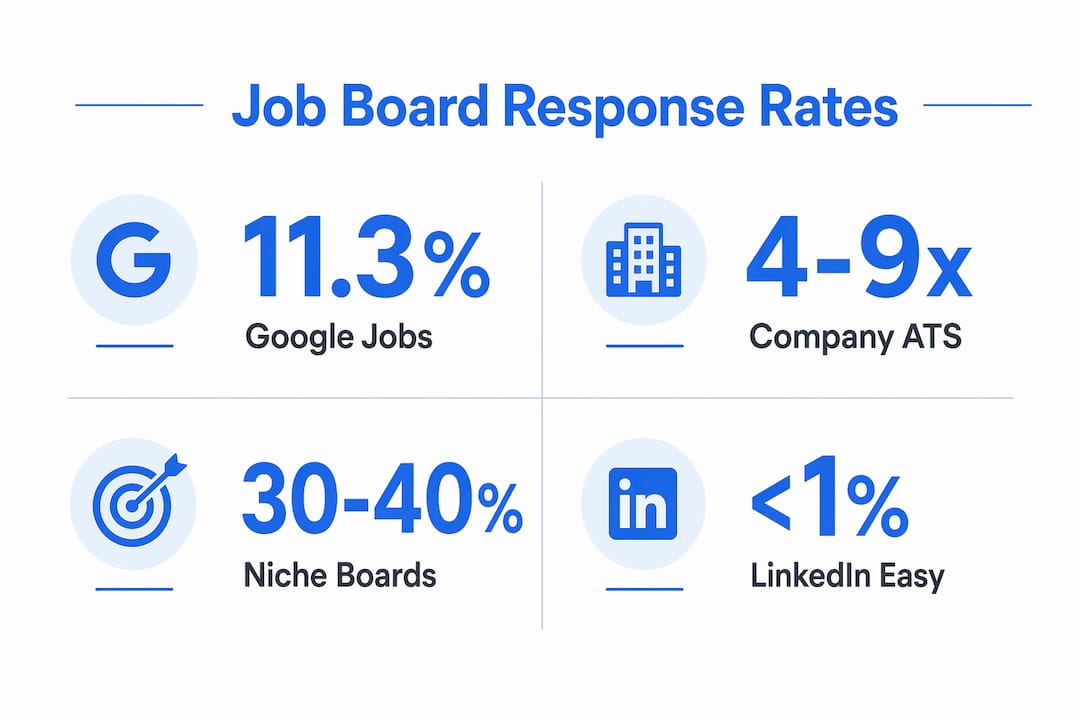
Here's a comparison of the top platforms for board-related leadership roles:
| Platform | Response rate | Best use case |
|---|---|---|
| Google Jobs | ~11.3% | Aggregated fresh postings; apply via company ATS |
| Niche boards (BoardProspects, Idealist) | 30–40% | Board-specific and nonprofit leadership roles |
| Company career pages | 8–15% | Direct applications with no middleman filter |
| LinkedIn (standard apply) | ~3.1% | Research and networking; use sparingly for direct apply |
| LinkedIn Easy Apply | Under 1% | Avoid for senior roles entirely |
The pattern is clear: applying through company ATS portals yields 4 to 9 times better callback rates than mass-apply features. LinkedIn Easy Apply produces zero interviews for 72.5% of users who rely on it heavily. That's not a minor inefficiency. That's a broken strategy.
Pro Tip: Use LinkedIn as a research and discovery tool, not your primary application channel for board-level roles. Find the posting on LinkedIn, then go directly to the company's career page and apply there. You'll land in a smaller, more visible applicant pool.
How to combine job boards with direct outreach to maximize interviews
The most effective job search strategy treats job boards as discovery tools, not application destinations. An effective search blends early application, tailored resumes, and direct hiring manager outreach for maximum impact. The sequence matters: find the role on a board, apply directly through the company's ATS, then reach out to the hiring manager or a mutual connection on LinkedIn within 24 hours.
Why does direct outreach matter so much? 94% of candidates are more likely to accept offers when the hiring manager reaches out first. That statistic signals something important: hiring managers who already know your name before the formal process begins are far more likely to champion your candidacy internally. Your outreach creates that familiarity before the interview even happens.
The "Value Note" is the most effective outreach format I've seen work consistently. It's a three-sentence message that does three things: names a specific challenge the organization faces, connects it to a result you delivered in a board or leadership role, and asks for a brief conversation. No resume attached. No "I'd love to be considered." Just a clear, confident signal of relevance.
Here's a daily search routine that balances applications with networking:
- Morning (30 minutes): Search Google Jobs and your two niche boards for new postings. Flag any roles posted within the last 24 hours as priority.
- Mid-morning (20 minutes): Apply directly through the company's career page for each flagged role. Tailor your resume title and summary to match the job description before submitting.
- Afternoon (20 minutes): Identify the hiring manager or board chair for each role you applied to. Send a Value Note via LinkedIn.
- End of day (10 minutes): Log every application, outreach message, and response in a tracker. Tools like Huntr or a simple Google Sheet work well here.
- Weekly (30 minutes): Review your response rate by channel. If one platform is producing zero responses after two weeks, replace it with a niche board or increase your direct company applications.
This routine keeps your search focused on quality signals rather than volume. Referral conversions run 12 to 25%, while generic board applications convert at 1 to 3%. Shifting even 20% of your effort from mass applying to direct outreach can meaningfully change your results.
Common mistakes that kill your chances when using job boards
The most damaging mistake is treating high application volume as a success metric. Confusing volume with effectiveness is the single biggest time waster in a job search. Sending 50 generic applications through LinkedIn Easy Apply produces worse results than sending 5 tailored applications through company career pages. The math is not close.
Here are the mistakes that consistently reduce interview rates for professionals with board experience:
- Generic resume titles. If your resume says "Experienced Executive" and the job description says "Chief Governance Officer," you've already lost the ATS match before a human sees your file.
- Relying on LinkedIn Easy Apply. As noted above, this channel produces under 1% conversion for senior roles. It signals low effort to recruiters who can see how you applied.
- Applying late. Applying within 24 hours of a posting significantly improves your visibility. Job boards often bury older applications algorithmically, and hiring managers frequently review the first wave of applicants before the posting even closes.
- Not tailoring cover letters. A cover letter that names the organization's specific strategic challenge and connects it to your board experience converts far better than a template. Recruiters can tell the difference in under 30 seconds.
- Hiding board experience in a separate section. Many professionals list board roles under "Volunteer Experience" or "Additional Experience." For senior roles, board positions belong in your main experience section with full outcome descriptions.
The three-tier funnel approach puts this in perspective. Referrals produce 12 to 34% hire rates, company career pages produce 15 to 30%, and job boards produce 1 to 5%. Allocating your time to match those conversion rates is the most rational thing you can do with a finite job search budget.
Key takeaways
Positioning board experience with outcome-focused language, applying directly through company ATS portals, and combining job board discovery with direct hiring manager outreach produces the highest interview conversion rates for leadership candidates.
| Point | Details |
|---|---|
| Mirror job description language | Use exact governance keywords from postings to pass ATS filters and reach recruiters. |
| Apply via company career pages | Direct ATS applications convert 4 to 9 times better than LinkedIn Easy Apply for senior roles. |
| Use 3+ platforms strategically | Diversifying across Google Jobs, niche boards, and company pages doubles interview likelihood. |
| Outreach within 24 hours | Sending a Value Note to the hiring manager after applying increases your visibility before review. |
| Quantify board outcomes | Replace titles with results: committee led, budget overseen, risk reduced, or revenue influenced. |
What I've learned about board experience and job search strategy
I've watched professionals with genuinely impressive board credentials get passed over repeatedly, not because their experience was weak, but because they buried it. They listed "Board Member" with no context, no outcomes, and no connection to the role they were applying for. Then they wondered why the callbacks weren't coming.
The shift that actually works is treating your board experience as leadership proof, not a side credential. If you chaired an audit committee at a $30M organization, that's CFO-adjacent experience. If you led a governance restructuring, that's change management at the executive level. The work is real. The problem is that most people don't translate it into language that hiring managers recognize as relevant to the role they're filling.
I also think most professionals dramatically underestimate how much the application channel matters. You can have a perfect resume and still get zero responses if you're submitting through the wrong channel. The job board as discovery tool mindset is the single biggest tactical shift I'd recommend. Find the role on the board, then go around it. Apply directly. Reach out directly. The board is a map, not the destination.
Quality over quantity is not just good advice. It's the only approach that actually scales when you're targeting board-level and executive roles where the applicant pool is smaller and every touchpoint matters more.
How Earnhire helps you turn board experience into interviews
Earnhire is built for exactly this kind of search. If you're trying to position your board experience and cut through the noise on job boards, Earnhire's AI resume tailoring tools align your experience with the specific language of each job description, so you clear ATS filters and land in front of recruiters. The job analysis feature breaks down what a posting is actually looking for, so you know exactly which board outcomes to highlight before you apply. And unlike traditional boards, Earnhire's guided job search keeps your search organized and strategic, not scattered. Every action you take on Earnhire builds your professional data worth, so your effort signals value to employers even between applications. Start your search at Earnhire and make every application count.
FAQ
How do I list board experience on a resume for a job search?
List board positions in your main experience section, not under volunteer or additional experience. Include the organization's size, your committee role, and at least one quantified outcome to signal leadership impact.
What job boards work best for board-level and executive roles?
Google Jobs, niche boards like BoardProspects, and direct company career pages produce the highest response rates for senior roles. Google Jobs achieves an 11.3% response rate, far above LinkedIn's 3.1%.
Why is LinkedIn Easy Apply ineffective for board-related positions?
LinkedIn Easy Apply produces under 1% conversion for senior roles and results in zero interviews for 72.5% of heavy users. Applying directly through a company's ATS portal is consistently more effective.
How soon should I apply after a job is posted?
Apply within 24 hours. Early applications receive significantly better visibility because hiring managers often review the first wave before the posting closes and algorithmic filters deprioritize older submissions.
How do I reach out to a hiring manager after applying?
Send a three-sentence Value Note on LinkedIn: name a specific challenge the organization faces, connect it to a result from your board experience, and request a brief conversation. Keep it direct and skip the resume attachment.
— Eric